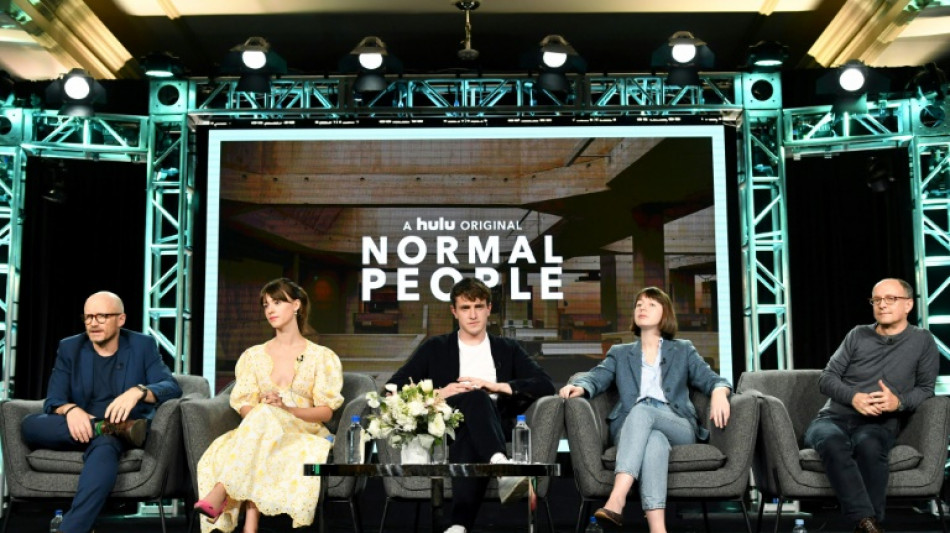
Sally Rooney returns with 30-something questions / Photo: Amy Sussman - GETTY IMAGES NORTH AMERICA/AFP

 Kenya's economy faces climate change risks: World Bank

 Far right and far left battle for power in polarised Berlin

 The last trio: S.Africa's zoo elephants await their fate

 Oil industry sees war windfall but girds for political blowback

 Amazon beats expectations with cloud and AI growth

 Blowout Microsoft results lift US stocks as oil retreats

 'Beginning of the end': Relief but no party as French wildfire winds down

 Southern Europe 'becoming more flammable' in hotter climate, experts say

 Mammoth bones found on parched bed of Danube in Bulgaria

 MEXC Lists Grvt (GRVT) with $60,000 Worth of GRVT and 10,000 USDT in Airdrop+ Rewards

 George and Amal Clooney flee French home due to wildfire

 MEXC Ventures Supports Alpha Arena's APAC Debut at Coinfest Bali

 AI data centre supplier Zhongji InnoLight slips on Hong Kong debut

 May, June heatwaves caused 2,877 extra deaths in England: govt

 BMW profit down a third as carmaker plans job cuts

 Seoul extends losses as most Asian markets drop, oil rises again

 Gambling.com Group Is Now Grandstand

 Meet the astronomer digging into the Milky Way's 'fossils'

 AI data centre supplier Zhongji InnoLight falls on Hong Kong debut

 Samsung operating profit up 1,800% in second quarter on AI boom

 Japanese population below 120 million for first time in decades

 US actor Jared Leto denies latest accusations of sexual assault

 Danube drops to 'historic lows' as fresh heatwave hits

 BTS pulls out of Grammys after Asian pop category introduction

 OpenAI says rogue AI agent attack hit other companies

Irish author Sally Rooney, hailed as the "voice of a generation" after the runaway success of "Normal People", examines modern love in all its glory and friction in her fourth novel "Intermezzo" released next week.
The book, out on Tuesday, includes all the elements of Rooney's hugely popular oeuvre: keen observations on relationships, spiky, realistic dialogues played out in Dublin houses, erotic scenes and existential conversations on the patriarchy and capitalism.
Having already created a number of striking female characters, the story focuses on two estranged brothers, Peter and Ivan, who come together in the weeks after their father's death, and the romantic relationships they forge in a delicate period of mourning.
Six years after her debut novel "Conversations with Friends" (2017), the characters are now thirty-somethings like the author, and agonise over questions of motherhood and the climate crisis.
Rooney's pared-back and realistic style has also evolved, with precise dialogues dipping into vivid, internal monologues.
"I feel like the older I get the more freedom I have to write about a greater range of life experiences," the 33-year-old author told The Guardian in an interview.
- 'Private person' -
The publicity-shy Irish author, who grew up in the small town of Castlebar in County Mayo, was not prepared for the success of her second novel "Normal People" (2018), with its 2020 BBC television adaptation exploding in popularity during the lockdown.
Rooney has enjoyed a rare literary breakthrough into the mainstream, speaking to the angst of the times and capturing the ways in which "millennials" and internet-generations navigate friendships, romantic connections and family relations.
Her books have been cast by social media spaces like "BookTok" into a genre termed "sad girl lit" -- a term Rooney says she is unfamiliar with -- centring young women with few material problems but who are fraught with internal turmoil.
She has won praise from the likes of Barack Obama and Taylor Swift.
In 2022, Rooney was included in Time magazine's 100 most influential people list, described as a "voice of a generation" and the "Snapchat Salinger" -- a tag that she is eager to distance herself from.
The success of "Normal People" felt "too much", she told the Guardian. "I don't want to be the centre of attention like that ever again," she added.
Rooney still struggles with her notoriety, watched closely by millions of fans but also detractors, who deem her writing "simple" and "overrated".
With her unostentatious style and brunette bangs, she gives few interviews, has stopped doing book tours, and says she is awkward when asked to pose for photos.
"I feel a lot of anxiety about my privacy and the privacy of my family and loved ones... I'm a very private person and I like to go unnoticed," Rooney told the Irish Times, adding that she sometimes regretted not writing under a pseudonym like Italian writer Elena Ferrante.
- Marxist -
With five literary prizes and millions of copies sold, Rooney hopes to break free of the label of the "young novelist".
After 10 years in Dublin and a stint in New York, she now lives with her husband -- a maths professor whom she met during university at Trinity College, Dublin -- in the peaceful Irish countryside, near where she grew up.
Rooney is open about being a Marxist, her politics seeping into the wry commentary by her fictional characters on topics ranging from global wars to Dublin's housing crisis.
In 2021, she refused to allow her third book, "Beautiful World, Where Are You?" to be translated into Hebrew by an Israeli publishing house due to her stance on the Israeli-Palestinian conflict and in support of the BDS (Boycott, Divestment, Sanctions) movement.
Three years on, she says she will not "stay silent in the face of genocide".
"The horrors unfolding in Gaza feel to me like a turning point in history. How are we allowing this to happen?", Rooney told the Irish Times.
Rooney has always denied writing autobiographical works but many have seen her alter ego in the character of Alice, the young novelist in her third book who struggles to come to terms with her fame and takes refuge in a small coastal town in Ireland.
"There is a sense of having lived a lot of life very quickly, in quite a compressed sort of time frame", Rooney told Vogue when "Beautiful World" was published. "I think the book dramatises some of those challenges."
Ch.Lefebvre--CPN