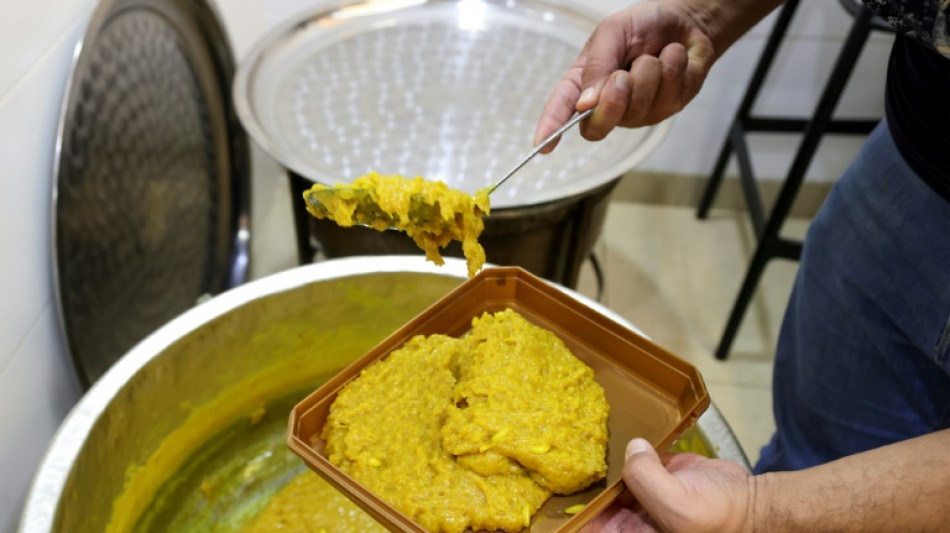
Family keeps up Beirut dessert tradition / Photo: ANWAR AMRO - AFP

 Kenya's economy faces climate change risks: World Bank

 Far right and far left battle for power in polarised Berlin

 The last trio: S.Africa's zoo elephants await their fate

 Oil industry sees war windfall but girds for political blowback

 Amazon beats expectations with cloud and AI growth

 Blowout Microsoft results lift US stocks as oil retreats

 'Beginning of the end': Relief but no party as French wildfire winds down

 Southern Europe 'becoming more flammable' in hotter climate, experts say

 Mammoth bones found on parched bed of Danube in Bulgaria

 MEXC Lists Grvt (GRVT) with $60,000 Worth of GRVT and 10,000 USDT in Airdrop+ Rewards

 George and Amal Clooney flee French home due to wildfire

 MEXC Ventures Supports Alpha Arena's APAC Debut at Coinfest Bali

 AI data centre supplier Zhongji InnoLight slips on Hong Kong debut

 May, June heatwaves caused 2,877 extra deaths in England: govt

 BMW profit down a third as carmaker plans job cuts

 Seoul extends losses as most Asian markets drop, oil rises again

 Gambling.com Group Is Now Grandstand

 Meet the astronomer digging into the Milky Way's 'fossils'

 AI data centre supplier Zhongji InnoLight falls on Hong Kong debut

 Samsung operating profit up 1,800% in second quarter on AI boom

 Japanese population below 120 million for first time in decades

 US actor Jared Leto denies latest accusations of sexual assault

 Danube drops to 'historic lows' as fresh heatwave hits

 BTS pulls out of Grammys after Asian pop category introduction

 OpenAI says rogue AI agent attack hit other companies

At a shop nestled in a busy, crowded Beirut district, Hasan El-Makary is weighing out containers of warm, fragrant mufataka, a traditional sweet in the Lebanese capital that is rarely found in stores.
"I've been in this shop for 50 years, but we started specialising in mufataka 30 years ago," Makary said from the humble shop with its ageing decor and low ceiling.
A kind of rice pudding made with turmeric, tahini sesame paste, sugar and pine nuts, mufataka is traditional in Beirut but less known even outside the city.
Makary, 73, said he used to sell other sweets but as demand grew for mufataka, he abandoned the rest and now just makes the yellow pudding, together with his cousin, who is also his business partner.
"At the beginning you add turmeric, that's the main thing, then tahini, sugar and rice... we cook it slowly on fire," he said.
The rice must be soaked overnight, and Makary said he comes to the shop at 5:00 am to make the dish, which takes around four hours and requires regular stirring.
He said his father started making mufataka despite initially believing people would not pay money for a dish that is normally prepared at home.
Plastic containers of the pudding, which is eaten with a spoon, dotted trays and tables across the shop, waiting for customers who peered through a window to place their order from the busy street outside.
Customer Iman Chehab, 55, was picking up mufataka for her mother, who used to make it herself.
"She is elderly now and she can't stir... it takes a lot of work," said Chehab, who works in human resources management.
The dish is "something traditional for us who are from Beirut", she told AFP.
Places like Makary's shop "are the old face of Beirut that we love and always want to remember", she added.
- 'Heritage' -
A few bustling neighbourhoods away, Samir Makari, 35, is carrying on the family tradition.
At a gleaming shop also selling Arabic sweets like baklava, Makari attends to a huge copper pot of mufataka behind the counter, stirring it with a long, wooden-handled implement.
He weighs out and mixes the sugar, tahini paste and pine nuts in a second pot, later combining it all.
Mufataka used to be made just once a year on the last Wednesday in April, with families gathering by the sea at Beirut's public beach, father and son said.
The occasion was "Job's Wednesday", a reference to the biblical figure also mentioned in the Koran and who is renowned for his patience, the younger Makari said, noting the virtue is also required for making mufataka.
On the wall of his shop, which he runs with his brother, were photos of his father and his grandfather at work.
He said he sometimes makes mufataka twice a day depending on demand, with some customers taking it outside Beirut to introduce it to those who do not know the dish.
At the original store, the elder Makary said he was happy his children had kept up the tradition.
Mufataka is part of "my heritage", he said, and the family has "taken it from generation to generation".
Y.Ponomarenko--CPN