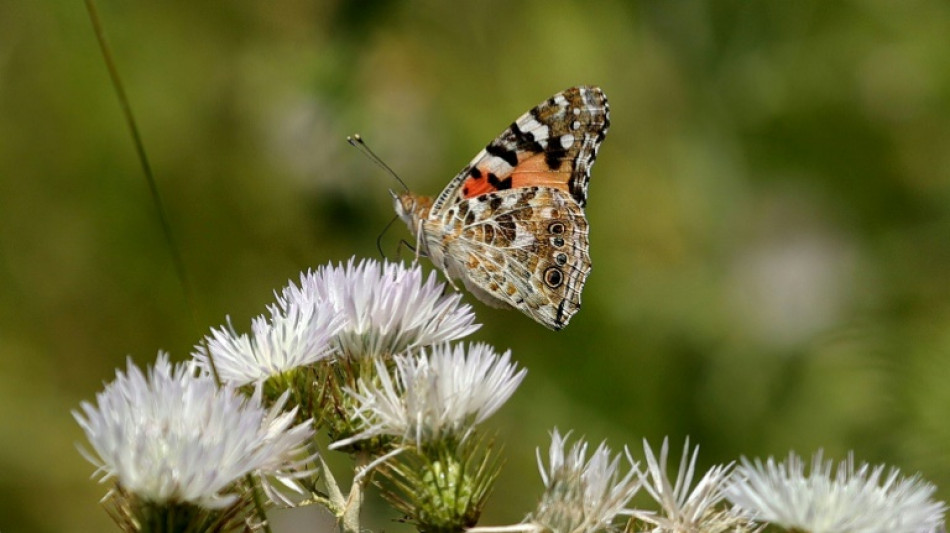
'Nature's mirror': Climate change batters Albania's butterflies
/ Photo: Adnan Beci - AFP

 Kenya's economy faces climate change risks: World Bank

 Far right and far left battle for power in polarised Berlin

 The last trio: S.Africa's zoo elephants await their fate

 Oil industry sees war windfall but girds for political blowback

 Amazon beats expectations with cloud and AI growth

 Blowout Microsoft results lift US stocks as oil retreats

 'Beginning of the end': Relief but no party as French wildfire winds down

 Southern Europe 'becoming more flammable' in hotter climate, experts say

 Mammoth bones found on parched bed of Danube in Bulgaria

 MEXC Lists Grvt (GRVT) with $60,000 Worth of GRVT and 10,000 USDT in Airdrop+ Rewards

 George and Amal Clooney flee French home due to wildfire

 MEXC Ventures Supports Alpha Arena's APAC Debut at Coinfest Bali

 AI data centre supplier Zhongji InnoLight slips on Hong Kong debut

 May, June heatwaves caused 2,877 extra deaths in England: govt

 BMW profit down a third as carmaker plans job cuts

 Seoul extends losses as most Asian markets drop, oil rises again

 Gambling.com Group Is Now Grandstand

 Meet the astronomer digging into the Milky Way's 'fossils'

 AI data centre supplier Zhongji InnoLight falls on Hong Kong debut

 Samsung operating profit up 1,800% in second quarter on AI boom

 Japanese population below 120 million for first time in decades

 US actor Jared Leto denies latest accusations of sexual assault

 Danube drops to 'historic lows' as fresh heatwave hits

 BTS pulls out of Grammys after Asian pop category introduction

 OpenAI says rogue AI agent attack hit other companies

Bright yellow, black, red and blue, Alexanor butterflies once fluttered abundantly on southwestern Albania's flowery slopes. Now, like many related species, scientists say they are disappearing due to human impacts, including climate change.
Increasingly absent from the picturesque district of Zvernec, the Alexanor is one of 58 of the Balkan country's 207 butterfly species that researchers say are at risk.
"Sensitive to changes, they are a true mirror of the conditions of the ecosystem in which they live," said Anila Paparisto, an entomologist at Tirana University.
In Zvernec, Paparisto leads a team of researchers and students working to identify the country's remaining butterfly species along with those that are now extinct.
Numerous scientific studies have measured the impact of climate change on butterfly populations, though researchers also cite other environmental factors.
They blame a combination of rapid urbanisation, pesticides and warming temperatures for the decrease.
"Human activity and climate change have had major impacts on nature," said biology student Fjona Skenderi, who was helping conduct research in Zvernec.
In the nearby Divjaka Natural Park, Albanian agronomist Altin Hila points to the disappearance of the Giant Peacock Moth and the Plain Tiger as another worrying sign.
"It's a disaster marked by climatic disruptions, an early spring and excessively high temperatures in January and February," explained Hila, who is also a passionate collector and oversees a butterfly museum in Divjaka.
"It encouraged the eggs to hatch and the butterfly larvae to grow, but in April the temperatures were too low" for them to survive, he added.
- 'Butterfly effect' -
The butterflies' decline also affects other species.
"It will impact the entire food chain and biodiversity, which is also essential for humans," Paparisto said.
"When there are fewer butterflies, you expect... the butterfly effect."
Like large swaths of Albania, coastal areas near Zvernec have become increasingly overrun with resorts and apartment blocks, built with little oversight.
Scientists say the rapid urbanisation in the area, along with overfishing and climate change, has also played a part in the dramatic drop in migratory bird populations.
And while some butterfly populations are in decline, other similar species are prospering -- to the detriment of the environment.
The arrival of a non-native moth through imports of ornamental plants from China has ravaged more than 80 percent of Albania's boxwood forests since 2019, according to experts.
"It is very aggressive, it can reproduce three to four times a year, and it is a real misfortune which reduces entire areas to nothing," said forest engineer Avdulla Diku.
With their distinct neon green and black bodies, the larvae are easily spotted when clinging to the boxwoods' leaves and stems.
On the road along Lake Ohrid to Pogradec in northwestern Albania, the once vibrant green rows of boxwoods are reduced to husks after being devoured by the moths' larvae.
"It is a firm reminder of the fragility and subtle balance of the environment in which we live," said Sylvain Cuvelier, an entomological researcher who co-authored the first Albanian butterfly atlas.
"It is obviously urgent to unite our efforts to find solutions, to rethink in depth our use of natural resources and the way forward for the protection and restoration of our environment."
C.Peyronnet--CPN