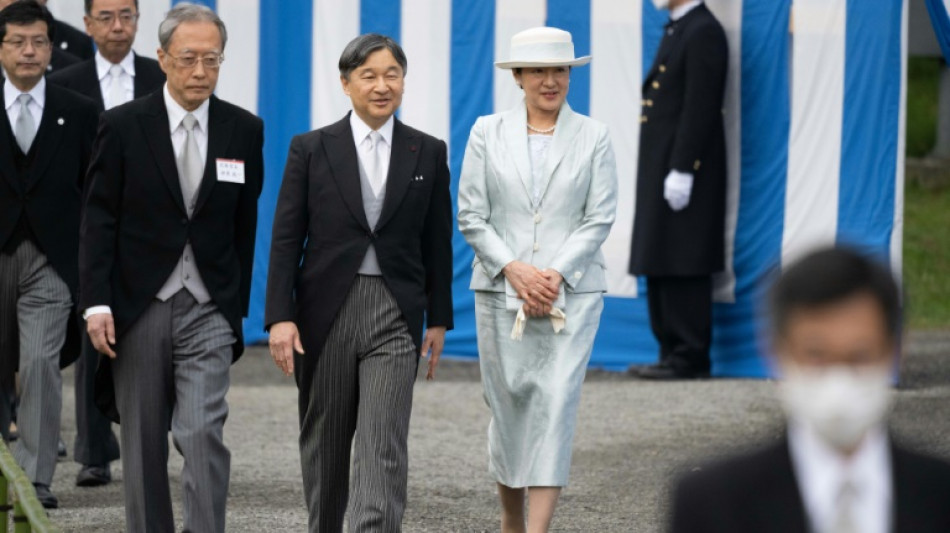
Japan's royals: tradition, myths and Instagram / Photo: Yuichi YAMAZAKI - POOL/AFP

 Kenya's economy faces climate change risks: World Bank

 Far right and far left battle for power in polarised Berlin

 The last trio: S.Africa's zoo elephants await their fate

 Oil industry sees war windfall but girds for political blowback

 Amazon beats expectations with cloud and AI growth

 Blowout Microsoft results lift US stocks as oil retreats

 'Beginning of the end': Relief but no party as French wildfire winds down

 Southern Europe 'becoming more flammable' in hotter climate, experts say

 Mammoth bones found on parched bed of Danube in Bulgaria

 MEXC Lists Grvt (GRVT) with $60,000 Worth of GRVT and 10,000 USDT in Airdrop+ Rewards

 George and Amal Clooney flee French home due to wildfire

 MEXC Ventures Supports Alpha Arena's APAC Debut at Coinfest Bali

 AI data centre supplier Zhongji InnoLight slips on Hong Kong debut

 May, June heatwaves caused 2,877 extra deaths in England: govt

 BMW profit down a third as carmaker plans job cuts

 Seoul extends losses as most Asian markets drop, oil rises again

 Gambling.com Group Is Now Grandstand

 Meet the astronomer digging into the Milky Way's 'fossils'

 AI data centre supplier Zhongji InnoLight falls on Hong Kong debut

 Samsung operating profit up 1,800% in second quarter on AI boom

 Japanese population below 120 million for first time in decades

 US actor Jared Leto denies latest accusations of sexual assault

 Danube drops to 'historic lows' as fresh heatwave hits

 BTS pulls out of Grammys after Asian pop category introduction

 OpenAI says rogue AI agent attack hit other companies

As Emperor Naruhito and Empress Masako make the first Japanese state visit to Britain since 1998, here are some key things to know about the imperial family:
- Sun goddess -
Legend has it that Japan's royals, whose myth-filled history spans 2,600 years, are descended from the Shinto sun goddess Amaterasu.
Their divine status was renounced after World War II following Japan's militaristic sweep across Asia in the name of Emperor Hirohito.
The family holds no political power under the post-war constitution, but the institution remains hugely symbolic.
After Hirohito died in 1989, his son Akihito dramatically modernised the monarchy by marrying a commoner and expressing regret over Japan's brutal wartime past.
In 2019, Akihito became the first emperor in two centuries to abdicate, and his son Naruhito, now 64, ascended the Chrysanthemum Throne in a ritual-bound ceremony.
- Male bloodline -
Male-only succession rules mean the imperial family is facing extinction, with only one current heir: Naruhito's 17-year-old nephew Prince Hisahito.
His daughter Princess Aiko, 22, is barred from the throne under the Imperial Household Law, in place since 1947.
Royal women must leave the family when they wed a commoner -- as in 2021 when former princess Mako Komuro, Naruhito's niece, married her university sweetheart.
Lawmakers in May began discussing possible relaxations to the strict succession rules, and a recent Kyodo News poll found 90 percent public support for female succession.
But resistance among conservative MPs, who revere the royals as the perfect example of a patriarchal Japanese family, makes that change unlikely any time soon.
- Instagram debut -
The royals face huge pressure to conform to tradition and meet exacting standards of behaviour, with each move intensely scrutinised.
They rarely share their personal lives -- even on an official Instagram account which went live in April, in an attempt to spark interest among younger generations.
Criticism of the emperor is virtually non-existent in Japan, a phenomenon known as the Chrysanthemum taboo.
On some occasions in the past, right-wingers physically attacked people they saw as imperial opponents.
But more recently, tabloids and some entertainment shows have dug deeper into the lives of the wider family.
- Pressure on women -
As in Britain, women who marry into the royal family do not have an easy ride.
Empress Masako, a former high-flying diplomat, has suffered from a stress-related illness for years, with some observers blaming the pressure of producing a male heir.
Akihito's wife Michiko, the first commoner to join the family, faced tabloid gossip and criticism from hardliners, especially in the early years of the marriage.
She once lost her voice for months, and has also suffered stomach problems linked to stress.
And when Mako married out of the family, she developed complex post-traumatic stress disorder after she and her husband Kei Komuro were plagued by gossip over allegations that his family had run into financial difficulties.
- Soft power -
Like his father, Naruhito has tried to bring the royal household closer to the people, travelling with Masako to meet the survivors of natural disasters.
Their official UK engagements from June 25 to 27 follow the couple's first state visit last year to Indonesia. They also attended Queen Elizabeth II's funeral in 2022.
Other royals have also gone abroad: in November, Mako's sister Princess Kako visited Peru, marking the 150th anniversary of diplomatic ties between the countries.
The family is known for its research endeavours, especially in the sciences, and the emperor spent two years at Oxford University in the 1980s.
A 2015 book by Naruhito's second cousin Princess Akiko, describing her studies at Oxford and her diplomatic passport causing suspicion at an airport, was a recent hit.
Y.Uduike--CPN