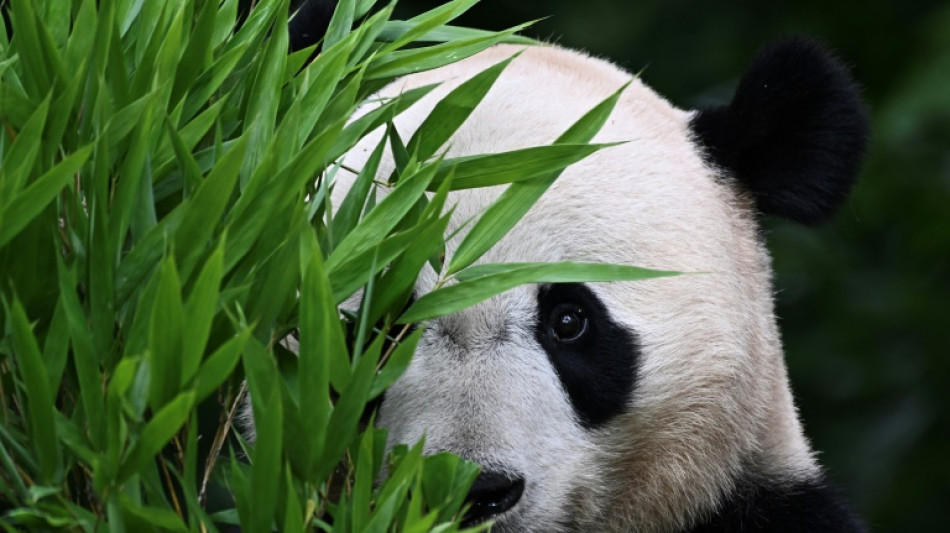
Foreign-born pandas join China's efforts to boost wild population / Photo: Pedro PARDO - AFP

 Kenya's economy faces climate change risks: World Bank

 Far right and far left battle for power in polarised Berlin

 The last trio: S.Africa's zoo elephants await their fate

 Oil industry sees war windfall but girds for political blowback

 Amazon beats expectations with cloud and AI growth

 Blowout Microsoft results lift US stocks as oil retreats

 'Beginning of the end': Relief but no party as French wildfire winds down

 Southern Europe 'becoming more flammable' in hotter climate, experts say

 Mammoth bones found on parched bed of Danube in Bulgaria

 MEXC Lists Grvt (GRVT) with $60,000 Worth of GRVT and 10,000 USDT in Airdrop+ Rewards

 George and Amal Clooney flee French home due to wildfire

 MEXC Ventures Supports Alpha Arena's APAC Debut at Coinfest Bali

 AI data centre supplier Zhongji InnoLight slips on Hong Kong debut

 May, June heatwaves caused 2,877 extra deaths in England: govt

 BMW profit down a third as carmaker plans job cuts

 Seoul extends losses as most Asian markets drop, oil rises again

 Gambling.com Group Is Now Grandstand

 Meet the astronomer digging into the Milky Way's 'fossils'

 AI data centre supplier Zhongji InnoLight falls on Hong Kong debut

 Samsung operating profit up 1,800% in second quarter on AI boom

 Japanese population below 120 million for first time in decades

 US actor Jared Leto denies latest accusations of sexual assault

 Danube drops to 'historic lows' as fresh heatwave hits

 BTS pulls out of Grammys after Asian pop category introduction

 OpenAI says rogue AI agent attack hit other companies

After years of charming millions of people around the world with their furry bodies and clumsy antics, foreign-born giant pandas are adapting to new lives in China.
The fluffy envoys are loaned to overseas zoos as part of Beijing's "panda diplomacy", with the offspring returned to China within a few years of their birth to join breeding programmes.
And as they sit among leafy surrounds in conservation centres in southwest China chomping on bamboo, they are oblivious to their diplomatic roles -- or the crucial part they could play in saving their species from extinction.
"Our work is very intense and very urgent and we need to replenish the wild panda populations (with those) in captivity," Zhang Hemin, chief expert at the China Conservation and Research Center for the Giant Panda (CCRCGP), told reporters during a recent press tour.
Behind him, US-born panda Bei Bei sorted through shoots of bamboo with his paws as he sat inside his exhibit at the Ya'an base in Sichuan province.
"After the fourth national giant panda census, we found that our wild population has formed 33 giant populations, but 22 of these populations are relatively small in number," he explained.
"If we don't help them, they may be at risk of extinction in the next 30 to 50 years."
- Habitat loss -
Pandas, native to mountain ranges in Sichuan, Shaanxi and Gansu provinces, were first placed in capacity in the 1980s to save them from starvation, Dujiangyan Reintroduction and Breeding Research Center's Qi Dunwu said.
Most were later released, but a breeding programme has since seen the captive population swell to more than 700, according to Zhang.
Since 2003, Qi said 12 captive pandas -- 11 from CCRCGP and one from a separate agency -- have been released into the wild, with 10 surviving.
But the Covid pandemic saw the rewilding efforts put on hold for five years.
And apart from preparing the mammals for the dangers of living in the wild, authorities need to ensure they are sent to habitats with sufficient bamboo and space, Qi added.
There are an estimated 1,860 giant pandas left in the wild, according to environmental group WWF.
But the animals, which were removed from the International Union for Conservation of Nature's endangered species list in 2016, still face serious threats from loss of habitat and fragmentation.
Officials are working on linking habitats to allow for pandas to mingle and breed, with more than 40 nature reserves now grouped together to form the Giant Panda National Park covering nearly 22,000 square kilometres (8,500 square miles).
- Star attractions -
The conservation efforts are partly funded by foreign zoos, which pay China millions of dollars under multi-year agreements to loan pandas.
The zoos hope the bears become star attractions that draw in more visitors, while China benefits from projecting a softer image.
But at the same time, the ebb and flow of diplomatic relations has seen Beijing recently recall several pandas after their loans expired.
Britain's only pandas, Tian Tian and Yang Guang, left Scotland in December after 12 years without cubs.
And three pandas at Washington's National Zoo took a one-way trip back to China in November.
Some are leaving China: Beijing said in February it had signed agreements to send pandas to San Diego, and two will return to Washington before the end of 2024.
In Ya'an, Netherlands-born panda Fan Xing, who flew to China in September, napped in her exhibit as keeper Li Xiaoyan looked on.
Fan Xing, born in May 2022, has slowly adjusted to her new diet and surroundings -- including learning how to understand Chinese.
"When they first come back, we'll speak a little bit of English to the English-speaking ones, and then we'll slowly change into speaking Chinese," she told AFP.
"In this process, we need to raise it with love and care, and build up a good relationship with the keepers."
D.Philippon--CPN