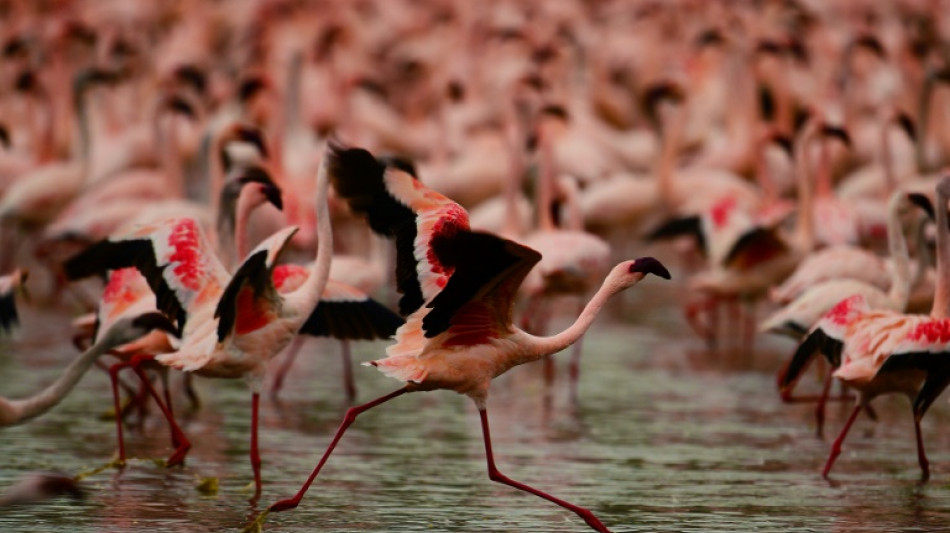
Future of Africa's flamingos threatened by rising lakes: study / Photo: CARL DE SOUZA - AFP

 Kenya's economy faces climate change risks: World Bank
 British oil giant BP aims to sell North Sea business

 China factory activity slides as leaders seek spending boost

 Tech rebound fuels record-breaking rally in South Korean stocks
 Cables and cooling bring AI windfall to Indian suppliers

 Anthropic's models gained unauthorized 'real-world' access during testing

 Apple tops estimates in CEO Cook's final quarter, but shares fall

 Milei demands expulsion of foreigners expressing 'hate' against Argentina

 Italy's Po River valley on drought alert

 Prada profits pinched as growth hard to chase

 Stocks climb on earnings and rates, oil retreats

 US economic growth slows in second quarter, missing expectations

 Russia adds Telegram founder Durov to 'terrorist' blacklist

 Stocks diverge on earnings, as oil steadies

 Eurozone economy grows despite Middle East war

 Singapore group will develop 'most promising' Ebola vaccine

 Shell profit surges as Mideast war fuels oil prices

 Car maker Stellantis says back in profit in second quarter

 Samsung quarterly operating profit up 1,800% on AI boom

 South Korean stocks bounce after rout, oil holds gains on Mideast woes

 South Korea's women web sleuths fight AI deepfake porn

 Anything but programmable: New cost-efficient EC-power-supply-series for the DIN rail by CAMTEC PS

 Meta misses profit expectations, sticks to massive AI spending

 Campari - king of the spritz - hopes to conquer American heartland
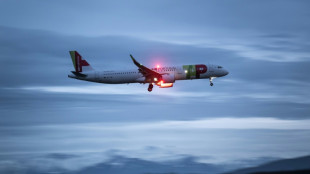 Air France-KLM and Lufthansa bid for Portugal's TAP airline

The lakes where Africa's flamingos congregate in spectacular numbers are producing less food for the iconic birds as their water levels rise, researchers said Friday, threatening the survival of a much-loved species.
Three-quarters of the world's lesser flamingos live in East Africa and more than a million birds at a time can gather at lakes in huge "flamboyances" for feeding and courtship.
But as these lakes expand to record highs, scientists have discovered they produce less of the unique algae upon which flamingos rely, putting at risk a species already in decline.
This is driving the distinctive, pink-plumed birds away from their usual habitats into unprotected areas in search of food, said Aidan Byrne, lead author of the research.
"They might be able to move elsewhere, but they could be lost from the region that they're currently in at these key feeding lakes," said Byrne, a PhD student jointly supervised by King's College London and the Natural History Museum.
Flamingos use their specialised beaks to feed on a particular type of algae that exists in salty, alkaline waters known as soda lakes.
These lakes are concentrated in Kenya, Tanzania and Ethiopia and despite being harsh landscapes, certain species -- including the flamingo and the algae they feast on -- have adapted to thrive there.
- 'Iconic species' -
But the lakes have risen to levels not seen in decades, driven in part by increased rainfall linked to climate change over the catchment areas.
This has greatly diluted the alkalinity and salinity of the water at these soda lakes.
Byrne and other researchers wanted to study the impact that had on biodiversity and found a "massive decline" in concentrations of the very algal blooms upon which flamingos survive.
Earlier studies had looked at the problem but its extent was not known until now, he said.
"We were surprised at the scale of the changes, and how much the flamingo habitats are threatened," he told AFP.
Erratic and extreme rainfall predicted for East Africa in future would only make the problem worse and "increase the threat to the species within the region", he added.
The study, published in the journal Current Biology, is the first to use satellite imagery to observe all 22 of the soda lakes that host flamingos across the East African region.
This was combined with climate records and bird observation data over more than 20 years.
The sharpest drops in algae concentrations were observed in Kenya, including at Nakuru, one of the most important flamingo feeding lakes in Africa known for hosting million-strong "flamboyances".
It expanded by roughly 90 percent between 2009 and 2022 while algal concentration halved.
Lake Bogoria and Lake Elmenteita, also tourist magnets for their brilliant flamingo displays, experienced steep declines as well.
And where algal blooms declined, so too did flamingo numbers, Byrne said, putting in doubt revenue from tourism as well.
Flamingo habitats in East Africa are protected whereas outside these ranges monitoring would be difficult and other threats -- including from humans -- could emerge, he said.
"They're just such an iconic species that are unique to these environments. If they're lost, it would be devastating," Byrne said.
A.Agostinelli--CPN