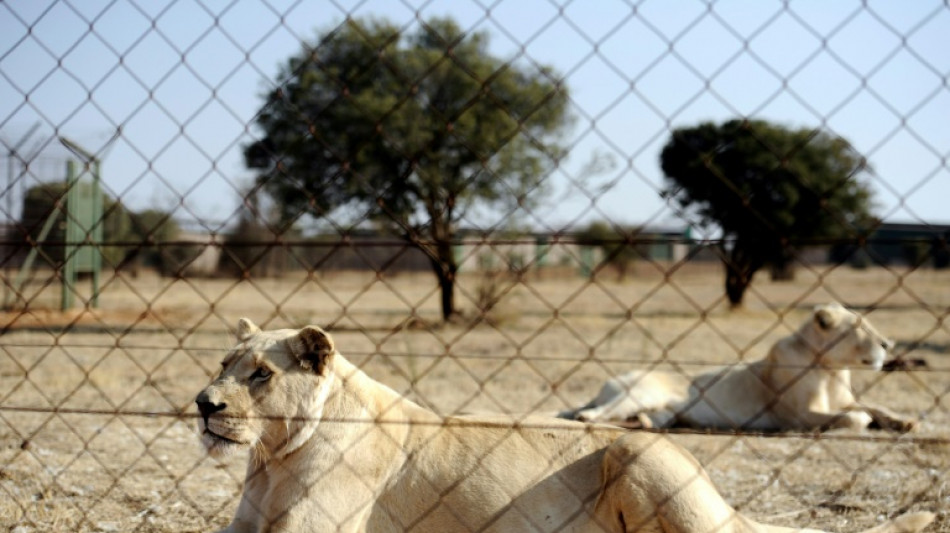
South Africa to end captive lion breeding for hunting / Photo: STEPHANE DE SAKUTIN - AFP/File

 Kenya's economy faces climate change risks: World Bank

 British oil giant BP aims to sell North Sea business

 China factory activity slides as leaders seek spending boost

 Tech rebound fuels record-breaking rally in South Korean stocks

 Cables and cooling bring AI windfall to Indian suppliers

 Anthropic's models gained unauthorized 'real-world' access during testing

 Apple tops estimates in CEO Cook's final quarter, but shares fall

 Milei demands expulsion of foreigners expressing 'hate' against Argentina

 Italy's Po River valley on drought alert

 Prada profits pinched as growth hard to chase

 Stocks climb on earnings and rates, oil retreats

 US economic growth slows in second quarter, missing expectations

 Russia adds Telegram founder Durov to 'terrorist' blacklist

 Stocks diverge on earnings, as oil steadies

 Eurozone economy grows despite Middle East war

 Singapore group will develop 'most promising' Ebola vaccine

 Shell profit surges as Mideast war fuels oil prices

 Car maker Stellantis says back in profit in second quarter

 Samsung quarterly operating profit up 1,800% on AI boom

 South Korean stocks bounce after rout, oil holds gains on Mideast woes

 South Korea's women web sleuths fight AI deepfake porn

 Anything but programmable: New cost-efficient EC-power-supply-series for the DIN rail by CAMTEC PS

 Meta misses profit expectations, sticks to massive AI spending

 Campari - king of the spritz - hopes to conquer American heartland

 Air France-KLM and Lufthansa bid for Portugal's TAP airline

South Africa on Wednesday laid out plans to phase out the captive breeding of lions for hunting purposes as the country moves to ban the controversial business.
The practice of breeding big cats to later have them shot by wealthy hunters typically paying thousands of US dollars has long been loathed by conservation and animal rights groups.
Hunters, usually foreigners, sometimes take home the head or skin of the killed animal as a trophy.
The South African government had already announced its intention to ban the breeding of lions for hunting in 2021 and an ad hoc panel has been working on the issue for the past two years.
"The panel recommended the closure of the captive breeding sector, including the keeping of lions in captivity, or the use of captive lions or their derivatives commercially," Environment Minister Barabara Creecy told a press conference in Cape Town.
Breeders will have two years to voluntarily withdraw from the sector and change their business model before the ban kicks in.
The idea, which has faced strong opposition from representatives of the highly lucrative industry, was approved by the government last week but is yet to be translated into law.
The move comes with trophy hunting facing a growing backlash in the West.
Campaigns to ban the import of trophies have drawn support in the United States, Australia and several European countries in recent years.
"The industry is large and complex with a long history that is not aligned with both current international trends and domestic policy changes on conservation," said Kamalasen Chetty, head of the ad hoc panel.
Between 8,000 and 12,000 lions are kept on about 350 farms across South Africa, according to estimates by animal rights groups that regularly denounce the conditions in which the animals are held.
The number of wild lions in comparison totals only around 3,500, according to the Endangered Wildlife Trust, a South Africa-based NGO.
P.Gonzales--CPN