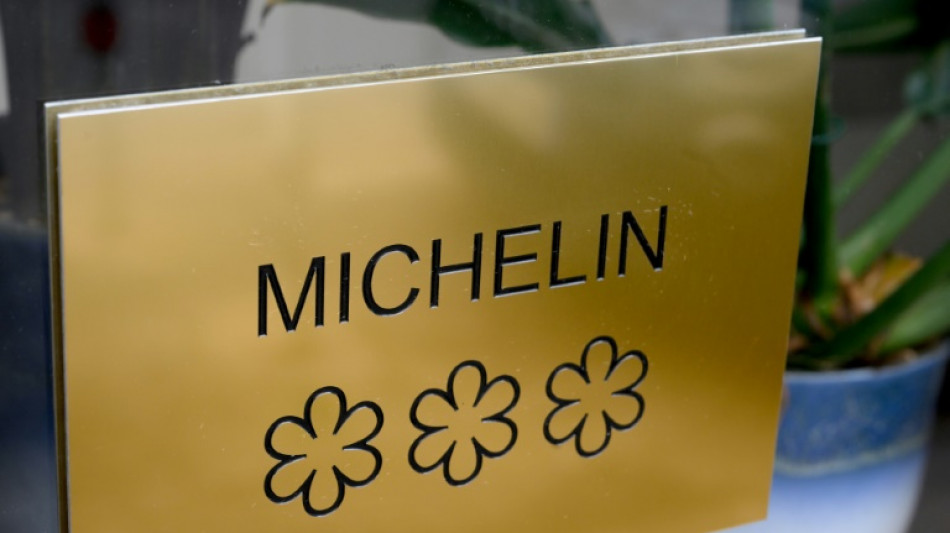
The secret agents of the Michelin Guide / Photo: Nicolas TUCAT - AFP

 Kenya's economy faces climate change risks: World Bank
 Japan probe made closest-ever asteroid flyby: space agency
 British oil giant BP aims to sell North Sea business

 China factory activity slides as leaders seek spending boost

 Tech rebound fuels record-breaking rally in South Korean stocks

 Cables and cooling bring AI windfall to Indian suppliers
 Anthropic's models gained unauthorized 'real-world' access during testing

 Apple tops estimates in CEO Cook's final quarter, but shares fall

 Milei demands expulsion of foreigners expressing 'hate' against Argentina

 Italy's Po River valley on drought alert

 Prada profits pinched as growth hard to chase

 Stocks climb on earnings and rates, oil retreats

 US economic growth slows in second quarter, missing expectations

 Russia adds Telegram founder Durov to 'terrorist' blacklist

 Stocks diverge on earnings, as oil steadies

 Eurozone economy grows despite Middle East war
 Singapore group will develop 'most promising' Ebola vaccine

 Shell profit surges as Mideast war fuels oil prices

 Car maker Stellantis says back in profit in second quarter

 Samsung quarterly operating profit up 1,800% on AI boom

 South Korean stocks bounce after rout, oil holds gains on Mideast woes

 South Korea's women web sleuths fight AI deepfake porn

 Anything but programmable: New cost-efficient EC-power-supply-series for the DIN rail by CAMTEC PS
 Meta misses profit expectations, sticks to massive AI spending

 Campari - king of the spritz - hopes to conquer American heartland

They are paid to eat in the best restaurants in the world -- but the price is having to lie even to their friends about the job.
Hidden amongst hundreds of guests descending on the 16th century Chateau de Chambord in the Loire Valley for a luxurious dinner ahead of the Michelin Guide's annual ceremony on Monday was the group's covert inspectors.
One guest at the weekend event told AFP he worked in the automobile industry -- plausible given Michelin's main business of selling tyres.
But his knowledge of France's best restaurants was suspiciously encyclopedic.
Whether or not he was a Michelin inspector would remain a mystery, since they are sworn to secrecy.
Each year, the guide receives 8,000 spontaneous applications to become an inspector, its boss Gwendal Poullennec told AFP.
The key criteria are "professionalism" and "openness" -- to travel, different cultures and new experiences, he added.
Michelin does not say how many it employs -- part of the strict secrecy it maintains to ensure they are never recognised by a restaurant and given preferential treatment.
The guide does reveal that its inspectors currently include 25 different nationalities, and men and women of all ages, operating across the 45 destinations covered by Michelin.
- Undercover -
It is a full-time job, and all are drawn from the world of fine dining and hospitality: applicants must have at least 10 years of experience as chefs, sommeliers or hoteliers, according to the guide's website.
A new inspector is paired with a more experienced colleague for a training period of up to two years -- or around 800 meals -- to learn the Michelin method, the organisation told AFP.
The inspector then lives undercover. Only their inner circle of family are allowed to know -- and they have an interest in keeping quiet since they often tag along to meals to avert suspicion.
The most common cover story that inspectors give their friends and wider family is that they are "consulting" with restaurants on their business strategies -- a good excuse to travel and indulge.
They give false names and even change their phone numbers when making reservations -- vital since many restaurants now have applications to scan their bookings for journalists and potential inspectors.
The reviews require an excellent memory. The inspector must recall the tiniest details of the food, service and ambiance -- right down to the appearance of the toilets -- without taking notes, though phone pictures are now common.
They must also research the wider context -- the restaurant's suppliers, how it fits into the local community and its finances.
The final report sticks to five criteria: the quality of the ingredients, the culinary technique, the harmony of the flavours, the emotion which the chef is seeking to convey through their menu, and the restaurant's consistency over time. The latter requires multiple visits.
The awarding of a star -- with three stars as the absolute pinnacle -- must be a unanimous choice when inspectors meet to discuss their reviews.
If there is disagreement, further visits are organised until a consensus is reached.
Ch.Lefebvre--CPN