Zimbabwean schoolkids cycle past elephant danger
/ Photo: Zinyange Auntony - AFP

 Kenya's economy faces climate change risks: World Bank

 Japan probe made closest-ever asteroid flyby: space agency
 British oil giant BP aims to sell North Sea business

 China factory activity slides as leaders seek spending boost

 Tech rebound fuels record-breaking rally in South Korean stocks
 Cables and cooling bring AI windfall to Indian suppliers
 Anthropic's models gained unauthorized 'real-world' access during testing

 Apple tops estimates in CEO Cook's final quarter, but shares fall

 Milei demands expulsion of foreigners expressing 'hate' against Argentina

 Italy's Po River valley on drought alert

 Prada profits pinched as growth hard to chase

 Stocks climb on earnings and rates, oil retreats

 US economic growth slows in second quarter, missing expectations

 Russia adds Telegram founder Durov to 'terrorist' blacklist

 Stocks diverge on earnings, as oil steadies

 Eurozone economy grows despite Middle East war

 Singapore group will develop 'most promising' Ebola vaccine

 Shell profit surges as Mideast war fuels oil prices

 Car maker Stellantis says back in profit in second quarter

 Samsung quarterly operating profit up 1,800% on AI boom

 South Korean stocks bounce after rout, oil holds gains on Mideast woes

 South Korea's women web sleuths fight AI deepfake porn

 Anything but programmable: New cost-efficient EC-power-supply-series for the DIN rail by CAMTEC PS

 Meta misses profit expectations, sticks to massive AI spending

 Campari - king of the spritz - hopes to conquer American heartland
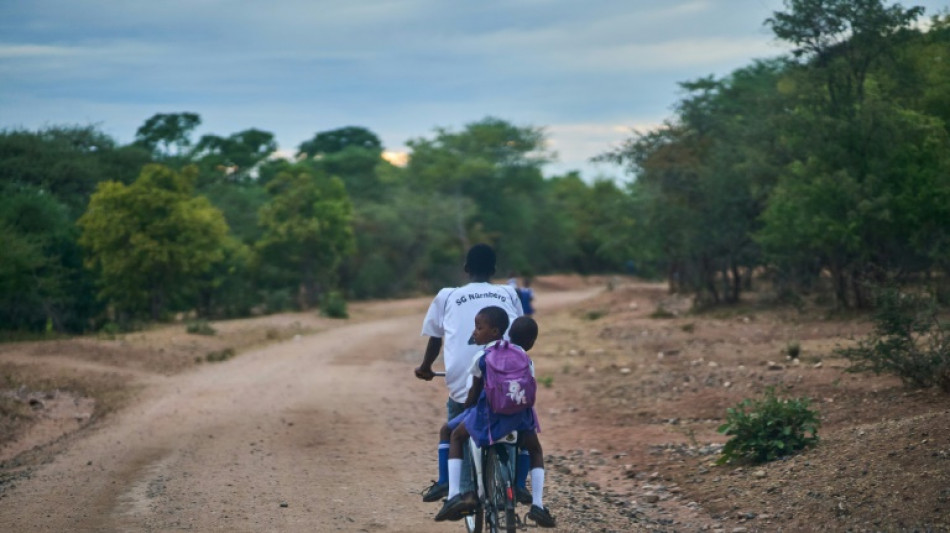
Running into elephants or a pack of hyenas on the way to school is not an unusual experience for children living near a nature reserve in northwest Zimbabwe.
Still, it can be dangerous.
Wild animals killed 50 people and injured 85 more in the southern African country last year, and elephants are among the most dangerous.
In order to shorten the amount of time kids are exposed on the route to school, park authorities have come up with an unconventional solution: bicycles.
Joaquim Homela, 12, is one of about 100 children who received a brand new two-wheeler that allows him to set off later, and avoid the pre-dawn hours when animals are most active.
Until recently, he used to hurry on foot, accompanied by his grandmother.
"Wild animals, particularly elephants as well as lions often roam around our villages," said the woman, Siphiwe Moyo. "So we worry for our young ones."
- 'Predator-proof' -
The bicycle project was concocted by the national parks authority, Zimparks, and the International Fund for Animal Welfare, a charity.
They hope it will tame tensions between the park and nearby farming communities.
Deaths caused by wild animals in 2023 were down 26 percent on the previous year, but there are concerns the number might pick up again in 2024 as the tusked giants move further afield in search of water because of a drought exacerbated by the El Nino weather phenomenon.
"If left unattended, human-wildlife conflict poses a serious threat to the well-being of the communities and biodiversity integrity of the greater Hwange ecosystem," said Phillip Kuvawoga, IFAW landscape conservation director.
The group is also setting up "predator-proof" livestock enclosures in villages where farmers complain donkeys and cattle are regularly mauled by big cats.
Such initiatives help locals "appreciate the benefits of their wildlife heritage," said ZimParks director, Fulton Mangwanya.
"Because the moment they don't see value in wildlife, you can be certain that it will be decimated through poaching and the like," he said.
With an estimated 100,000 animals, Zimbabwe has the second biggest elephant population in the world after Botswana -- and it is growing.
Thanks to conservation efforts, Hwange is home to 65,000 of them, more than four times capacity, according to ZimParks.
Some can become aggressive, especially after interactions with farmers.
Following the example of Botswana, Zimbabwe has approved the creation of a fund to compensate victims of wildlife, but it is yet to become operational.
Meanwhile, hoping to see wild animals only from a safe distance, 12-year-old Homela now hops on his black and white bicycle shortly after dawn.
He cannot really sit on the saddle as the bike is still too big for him. But his determined pedalling on the uneven, winding gravel road that leads to the school betrays his excitement.
Along the way he passes some of his schoolmates walking. A few trot behind him.
S.F.Lacroix--CPN