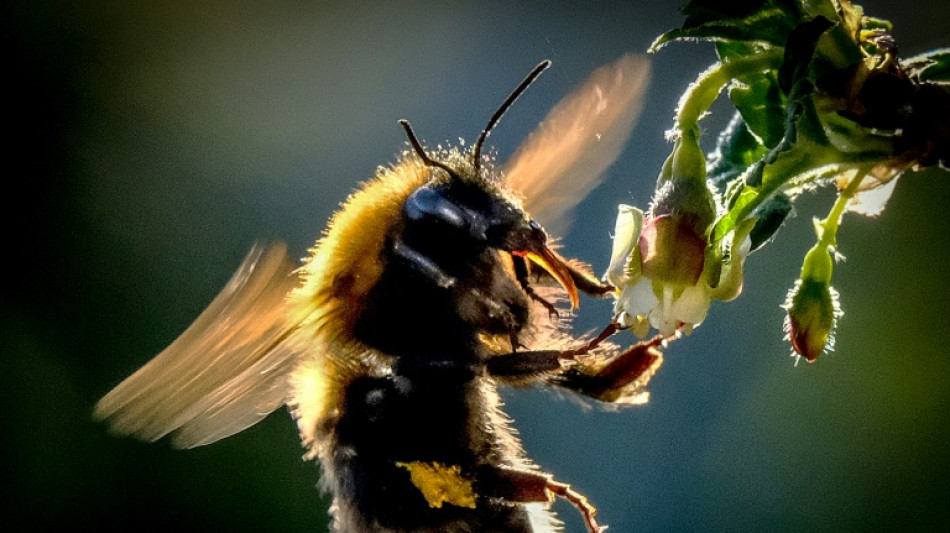
Not just humans: Bees and chimps can also pass on their skills / Photo: Yuri KADOBNOV - AFP/File

 Kenya's economy faces climate change risks: World Bank

 Profits surge at US oil giant amid Iran war supply shock

 Stock markets rally on tech rebound
 France, Spain assess scorched terrain as new wildfires threaten other regions

 Chipmaker Kioxia reports AI-driven 45-fold surge in quarterly net profit
 Far right and far left battle for power in polarised Berlin

 The last trio: S.Africa's zoo elephants await their fate
 Oil industry sees war windfall but girds for political blowback
 Amazon beats expectations with cloud and AI growth

 Blowout Microsoft results lift US stocks as oil retreats

 'Beginning of the end': Relief but no party as French wildfire winds down

 Southern Europe 'becoming more flammable' in hotter climate, experts say

 Mammoth bones found on parched bed of Danube in Bulgaria

 MEXC Lists Grvt (GRVT) with $60,000 Worth of GRVT and 10,000 USDT in Airdrop+ Rewards

 George and Amal Clooney flee French home due to wildfire

 MEXC Ventures Supports Alpha Arena's APAC Debut at Coinfest Bali

 AI data centre supplier Zhongji InnoLight slips on Hong Kong debut

 May, June heatwaves caused 2,877 extra deaths in England: govt
 BMW profit down a third as carmaker plans job cuts

 Seoul extends losses as most Asian markets drop, oil rises again

 Gambling.com Group Is Now Grandstand

 Meet the astronomer digging into the Milky Way's 'fossils'

 AI data centre supplier Zhongji InnoLight falls on Hong Kong debut

 Samsung operating profit up 1,800% in second quarter on AI boom

 Japanese population below 120 million for first time in decades

Bumblebees and chimpanzees can learn skills from their peers so complicated that they could never have mastered them on their own, an ability previously thought to be unique to humans, two studies said on Wednesday.
One of humanity's crowning talents is called "cumulative culture" -- our ability to build up skills, knowledge and technology over time, improving them as they pass down through the generations.
This ability to transfer abilities no individual could learn by themselves is credited with helping driving humanity's rise and domination of the world.
"Imagine that you dropped some children on a deserted island," said Lars Chittka, a behavioural ecologist at the Queen Mary University of London and co-author of the bee study.
"They might -- with a bit of luck -- survive, but they would never know how to read or to write because this requires learning from previous generations," he said in a video published with the study in the journal Nature.
Previous experiments have demonstrated that some animals are capable of what is known as social learning -- working out how to do something by observing others of their kind.
Some of these behaviours seem to have been perfected over time, such as the incredible navigational talent of homing pigeons or chimpanzees' ability to crack nuts, suggesting they could be examples of cumulative culture.
But it is difficult for scientists to rule out that an individual pigeon or chimp could not have worked out how to do achieve these feats by themselves.
So a UK-led team of researchers turned to the humble bumblebee.
- 'So surprised' -
The first step was training a crack squad of "demonstrators" to do a complex skill that they could later teach to others.
In the lab, some bees were given a two-step puzzle box. They were tasked with first pushing a blue tab, then a red tab to release the sugary prize at the end.
Alice Bridges, a study co-author also from Queen Mary University, told AFP: "This task is really difficult for bees because we are essentially asking them to learn to do something in exchange for nothing" during the first step.
Initially, the baffled bees just tried to push the red tab -- without first moving the blue one -- and simply gave up.
To motivate the bees, the researchers put a sugary treat at the end of this first step which was gradually withdrawn as they mastered the process.
The demonstrators were then paired up with some new "naive" bees, which watched the demonstrators solve the puzzle before having a go themselves.
Five of the 15 naive bees swiftly completed the puzzle -- without needing a reward after the first stage.
"We were so surprised," Bridges said. "We were all just going crazy" when it first happened, she said.
Alex Thornton, a professor of cognitive evolution at the UK's University of Exeter not involved in the research, acknowledged that it was a small sample size.
"But the point is clear -- the task was exceptionally hard to learn alone, yet some bees could solve it through social learning," he wrote in a comment piece in Nature.
The authors of the research said it was the first demonstration of cumulative culture in an invertebrate.
- Chimp off the old block -
Chimpanzees -- our closest living relatives -- also seem to possess this talent, according to a separate study in Nature Human Behaviour.
The puzzle box for a troupe of semi-wild chimpanzees at the Chimfunshi Wildlife Orphanage in Zambia was a little more difficult.
It involved retrieving a wooden ball, holding open a drawer, slotting in the ball then closing it to release the peanut prize.
Over three months, 66 chimps tried and failed to solve the puzzle.
Then the Dutch-led team of researchers trained two demonstrator chimpanzees to show the others how it was done.
After two months, 14 "naive" chimps had mastered it.
And the more the chimps watched the demonstrators, the quicker they learned to solve the problem.
Bridges said the studies "can't help but fundamentally challenge the idea that cumulative culture is this extremely complex, rare ability that only the very 'smartest' species -- e.g. humans -- are capable of".
Thornton said the research again showed how "people habitually overestimate their abilities relative to those of other animals".
D.Avraham--CPN
