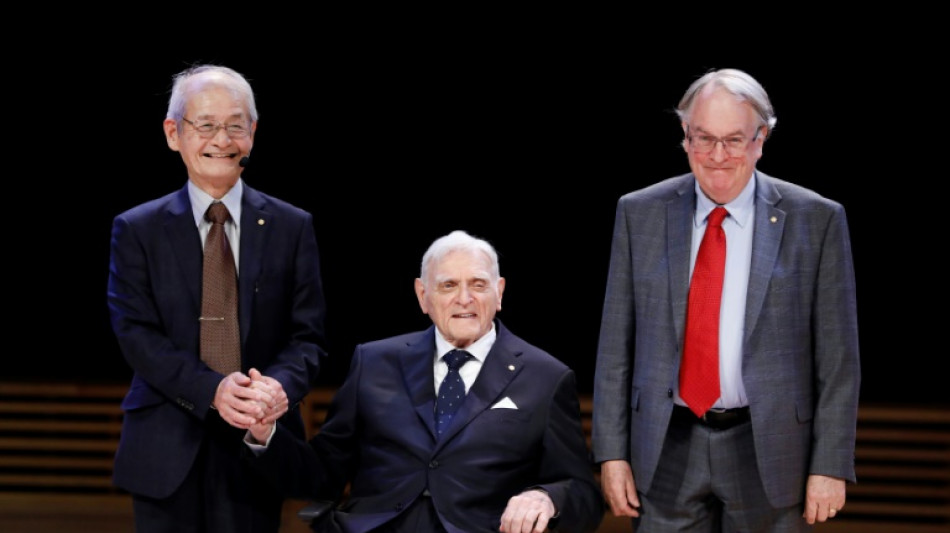
Nobel-winning lithium battery inventor John Goodenough dies at 100 / Photo: Jonas EKSTROMER - TT News Agency/AFP/File

 Kenya's economy faces climate change risks: World Bank

 British oil giant BP aims to sell North Sea business

 China factory activity slides as leaders seek spending boost

 Tech rebound fuels record-breaking rally in South Korean stocks
 Cables and cooling bring AI windfall to Indian suppliers

 Anthropic's models gained unauthorized 'real-world' access during testing

 Apple tops estimates in CEO Cook's final quarter, but shares fall

 Milei demands expulsion of foreigners expressing 'hate' against Argentina

 Italy's Po River valley on drought alert

 Prada profits pinched as growth hard to chase

 Stocks climb on earnings and rates, oil retreats

 US economic growth slows in second quarter, missing expectations

 Russia adds Telegram founder Durov to 'terrorist' blacklist

 Stocks diverge on earnings, as oil steadies

 Eurozone economy grows despite Middle East war

 Singapore group will develop 'most promising' Ebola vaccine

 Shell profit surges as Mideast war fuels oil prices

 Car maker Stellantis says back in profit in second quarter

 Samsung quarterly operating profit up 1,800% on AI boom

 South Korean stocks bounce after rout, oil holds gains on Mideast woes

 South Korea's women web sleuths fight AI deepfake porn

 Anything but programmable: New cost-efficient EC-power-supply-series for the DIN rail by CAMTEC PS

 Meta misses profit expectations, sticks to massive AI spending

 Campari - king of the spritz - hopes to conquer American heartland

 Air France-KLM and Lufthansa bid for Portugal's TAP airline

John Goodenough, who shared the 2019 Nobel Prize in Chemistry for developing the lithium-ion battery that revolutionized modern life, has died at the age of 100, the University of Texas announced.
Goodenough died on Sunday, said the university, where he worked as an engineering professor.
The US scientist's contributions to the development of lithium-ion batteries paved the way for smartphones and a fossil fuel-free society.
"John's legacy as a brilliant scientist is immeasurable -- his discoveries improved the lives of billions of people around the world," Jay Hartzell, president of the University of Texas at Austin, said in the statement.
"He was a leader at the cutting edge of scientific research throughout the many decades of his career."
In 1986, at the age of 64, Goodenough joined the University of Texas where he served as a faculty member in the Cockrell School of Engineering for 37 years.
"The world has lost an incredible mind and generous spirit. He will be truly missed among the scientific and engineering community, but he leaves a lasting legacy that will inspire generations of future innovators and researchers," said Sharon Wood, provost of the University of Texas.
Goodenough became the oldest person to win a Nobel Prize when at the age of 97 he shared the 2019 chemistry award with Britain's Stanley Whittingham and Akira Yoshino of Japan for the invention of the lithium-ion battery.
Seeking an alternative source of power during the oil crisis of the 1970s, Whittingham discovered a way to harness the potential energy in lithium, a metal so light it floats on water.
However, the battery he constructed was too unstable to be used.
Goodenough built on Whittingham's prototype, substituting a different metal compound and doubling the potential energy of the battery to four volts.
This paved the way for far more powerful and durable batteries in the future.
In 1985, Yoshino instead used a carbon-based material that stores lithium ions, finally rendering the battery commercially viable.
The culmination of the trio's research resulted in the most powerful, lightweight and rechargeable battery ever seen.
- 'A rechargeable world' -
"They created a rechargeable world," the Royal Swedish Academy of Sciences, which awarded the accolade, said at the time.
"Lithium batteries have revolutionized our lives since they first entered the market in 1991," and were "of the greatest benefit to humankind".
Their work considerably boosted human mobility, and allowed millions in developing countries to access information and services online with just a mobile phone.
Lithium-ion batteries have also reduced the reliance on planet-warming fossil fuels, especially in electric cars.
On receiving news of his Nobel, Goodenough expressed pride in the worldwide impact of his work.
"I'm extremely happy that my discovery has been able to help communication through the world," he said.
"We need to build relationships, not wars. I am happy if people use this for good, not evil."
Born in 1922 in Germany, Goodenough grew up in the United States and earned a bachelor's degree in mathematics from Yale University.
After serving as a meteorologist in the US Army during World War II, Goodenough earned a master's degree and a PhD in physics at the University of Chicago in 1952, according to the University of Texas statement.
From 1952, he worked at the Massachusetts Institute of Technology's Lincoln Laboratory for 24 years and laid the groundwork for the development of computer random-access memory (RAM).
Goodenough was head of the inorganic chemistry laboratory at Oxford University when he made his lithium-ion battery discovery.
In 1986, he joined the University of Texas where he was known for his "quick wit and infectious laugh."
He was still coming into work well into his 90s, the university said.
Goodenough and his wife Irene were married for 70 years, until her death in 2016.
O.Ignatyev--CPN