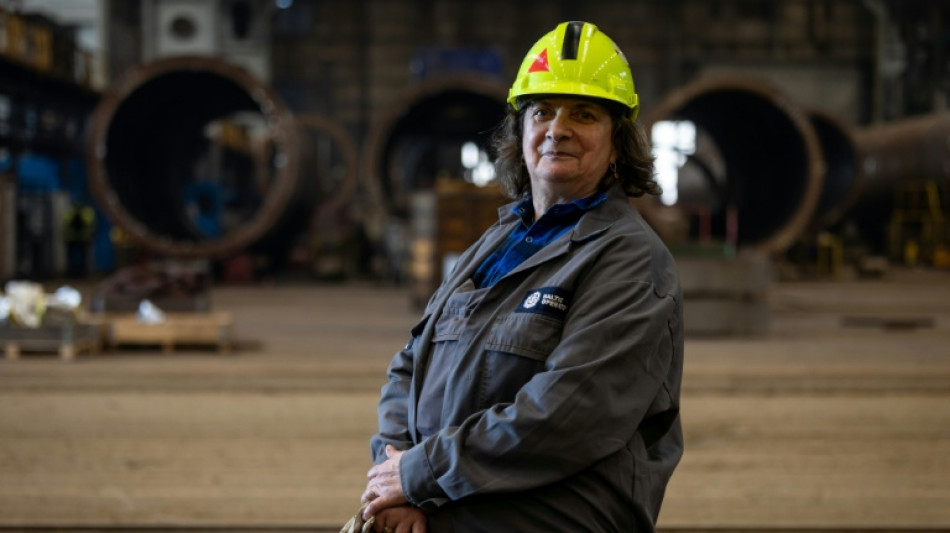
Women rule the roost atop the Gdansk shipyard cranes / Photo: Wojtek RADWANSKI - AFP

 US House faces test on sweeping Russia sanctions bill

 British PM says to make 'difficult decisions' as inflation rises

 Global fuel price demos: a round-up

 Leverate Launches MCP for Traders to Connect AI Assistants With Trading Platforms

 MEXC Launches $1M "Discover Your Wall Street DNA" Campaign to Help Traders Find Their Market Fit

 Stocks edge higher ahead of US Fed rate call

 BASIS.pro Expands On-Chain Infrastructure with XDC Network Partnership and Zypher DAO as Auto Earn Goes Live

 Pickle-flavoured tart? AI inspires Japan's convenience stores

 EU chief hosts Canada's Carney in push to 'deepen' alliance

 Meta chief pushes back on AI slowdown calls

 US Fed to deliver rate decision with markets betting on hike

 Sanders, Bannon warn of AI dangers in rare US left-right alignment

 Empty benches as schools reopen in Venezuela's quake-hit Guaira

 Tiny English village holds 'independence' vote over asylum seeker housing

 US Treasury chief says to meet Chinese counterpart at weekend

 BingX Evolves into a Multi-Asset Trading Platform, Connecting Users to Global Opportunities

 International Trading Institute Expands Professional Trader Development Beyond the Master’s in Trading

 Lake Energy Secures $80 Million for U.S. Renewable Energy Expansion

 Stocks drop, oil climbs and Treasury yields hit 19-year high

 SkySail Strategies Outperforms Wall Street's 30-Year Risk Standard With Proprietary AI Inference Model

 Just add fish: Scientists pursue more rice, less disease in Senegal paddies

 Belgium completes outer structure of offshore energy island

 China retail sales growth weakens further in August
 In Kashmir, lake weeds mix with traditional art

 'Widow's Bay' and 'The Pitt' take key Emmy awards

For the past 30 years, Halina Krauze has sat atop a 15-metre (49-foot) crane surveying the Gdansk shipyard, the birthplace of the Solidarnosc trade union.
For eight hours, the 65-year-old displaces tonnes of steel that will become ship hulls and wind turbine components.
She is one of dozens of crane operators at the huge yard, the largest in Central Europe.
Far below the cabin, hundreds of workers in overalls, helmets and protective goggles are busy at work.
The noise is constant, sparks fly and the air is full of welding fumes.
Around 70 percent of Poland's construction site crane operators are women, a tradition inherited from the Communist era.
In the Soviet period, "women had to be employed somewhere and since they couldn't do hard labour, they were integrated into other professions", explained Agnieszka Pyrzanowska, spokeswoman for the state-owned Baltic Industrial Group, which now operates part of the shipyard.
"Entire families worked for the same company."
Indeed, Krauze met her husband Stanislaw at the yard and today they work in the same unit.
"He's up there!" she exclaimed, waving energetically at another crane cabin in the sky.
- Remembering a legend -
Krauze joined what was then called the Vladimir Lenin shipyard in 1983, first in a coal-fired boiler room and later operating a crane.
"In the beginning, it was a shipyard. We built a good dozen ships a year. Now we build dozens of wind turbine towers. It's quite different," she said.
She is proud to have worked on the same crane as Anna Walentynowicz, one of the founders of Solidarnosc.
It was Walentynowicz's dismissal in 1980 that triggered the huge shipyard strike and the creation of the first free trade union in the Communist bloc.
Walentynowicz was "a kind of legend, especially among the older generation", Krauze remembered.
With a steady hand, she manoeuvred a huge wind turbine section, five metres in diameter, across the yard.
"There are people below you so you have to be careful nothing happens to them," said Lesia Kovalchuk, a 48-year-old Ukrainian colleague.
Kovalchuk was a crane operator in Ukraine for 15 years before moving to Poland as a refugee when Russia invaded her country in 2022.
Now she teaches young apprentices on Gdansk construction sites.
"In Ukraine, it's completely normal for women to operate cranes. No-one is surprised," she shrugged.
Both women agreed their male colleagues preferred to work with them than with other men.
"Women are calmer and more precise," Hrauze opined.
"Blokes try to get things done as fast as they can. Girls are all about finesse," Kovalchuk grinned.
One thing has changed though, since the Communist era.
At those days, women workers used to receive small gifts on International Women's Day -- "those famous tights, chocolates, carnations...", Krauze recalled.
"There's nothing any more," she said ruefully. "The unions have all forgotten about women."
O.Hansen--CPN