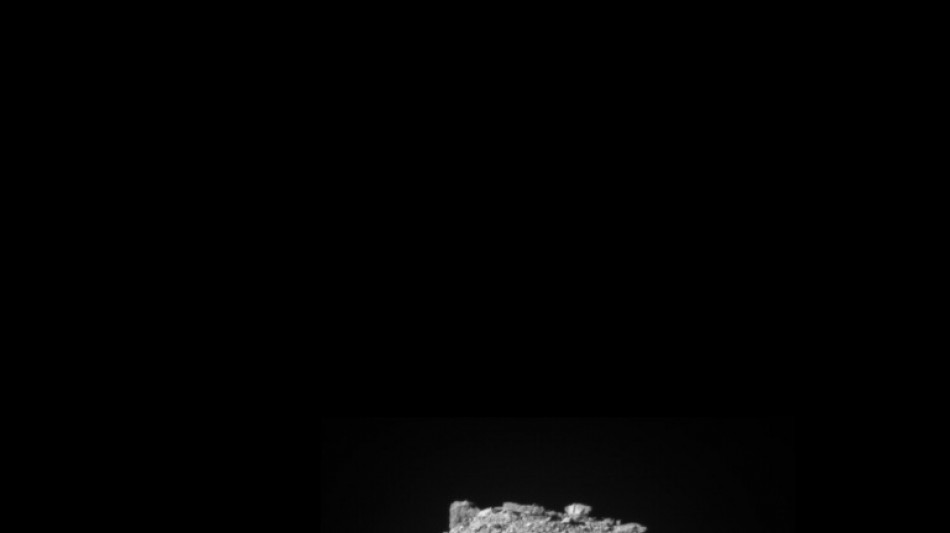
NASA defense test kicked asteroid off course -- and changed its orbit around the sun / Photo: Handout - NASA/Jons Hopkins APL/AFP

 US House faces test on sweeping Russia sanctions bill

 British PM says to make 'difficult decisions' as inflation rises

 Global fuel price demos: a round-up

 Leverate Launches MCP for Traders to Connect AI Assistants With Trading Platforms

 MEXC Launches $1M "Discover Your Wall Street DNA" Campaign to Help Traders Find Their Market Fit

 Stocks edge higher ahead of US Fed rate call

 BASIS.pro Expands On-Chain Infrastructure with XDC Network Partnership and Zypher DAO as Auto Earn Goes Live

 Pickle-flavoured tart? AI inspires Japan's convenience stores

 EU chief hosts Canada's Carney in push to 'deepen' alliance

 Meta chief pushes back on AI slowdown calls

 US Fed to deliver rate decision with markets betting on hike

 Sanders, Bannon warn of AI dangers in rare US left-right alignment

 Empty benches as schools reopen in Venezuela's quake-hit Guaira

 Tiny English village holds 'independence' vote over asylum seeker housing

 US Treasury chief says to meet Chinese counterpart at weekend

 BingX Evolves into a Multi-Asset Trading Platform, Connecting Users to Global Opportunities

 International Trading Institute Expands Professional Trader Development Beyond the Master’s in Trading

 Lake Energy Secures $80 Million for U.S. Renewable Energy Expansion

 Stocks drop, oil climbs and Treasury yields hit 19-year high

 SkySail Strategies Outperforms Wall Street's 30-Year Risk Standard With Proprietary AI Inference Model

 Just add fish: Scientists pursue more rice, less disease in Senegal paddies

 Belgium completes outer structure of offshore energy island

 China retail sales growth weakens further in August

 In Kashmir, lake weeds mix with traditional art

 'Widow's Bay' and 'The Pitt' take key Emmy awards

Four years ago, NASA purposely smashed a spacecraft into a small asteroid to see if they could deflect it -- a test to prove humanity could protect Earth from threatening space rocks.
The experiment pushed the moonlet asteroid Dimorphos into a smaller, faster route around its sibling Didymos -- and according to new research out Friday, it also pushed the pair into a slightly different orbit around the Sun.
The test on Dimorphos was never based on any actual threat to our planet.
But the successful experiment and additional analysis offers a solid data point to mount a defense if any such eventual threat is detected, researchers said.
"This study marks a notable step forward in our ability to prevent future asteroid impacts on Earth," the team of international researchers wrote in their new paper published in the journal Science Advances.
Their observations detailed in the paper showed that the Double Asteroid Redirection Test (DART) in 2022 marked "the first time a human-made object has measurably altered the path of a celestial body around the Sun," NASA said in a statement.
Rahil Makadia, the study's lead author, told AFP his team tracked stellar occultations -- the moment when an asteroid passes in front of a star, causing a brief dimming for less than a second -- to obtain hyper-precise measurements of the asteroid's position, speed and shape.
- Tiny change, significant deflection -
Obtaining this data is no small feat. The team relied on volunteer astronomers from around the globe, who recorded 22 of these stellar occultations.
Using that data along with years of additional observations, Makadia said the team was able to measure Didymos's orbit around the sun with precision.
"We were able to measure what this change was exactly," he said, and make computations that could assist with future "planetary defense efforts."
The orbital change was miniscule -- just 0.15 seconds.
But it's enough to make a difference, scientists say.
"This is a tiny change to the orbit, but given enough time, even a tiny change can grow to a significant deflection," said Thomas Statler, lead scientist for solar system small bodies at NASA Headquarters in Washington, in a statement.
"The team's amazingly precise measurement again validates kinetic impact as a technique for defending Earth against asteroid hazards and shows how a binary asteroid might be deflected by impacting just one member of the pair."
Y.Uduike--CPN