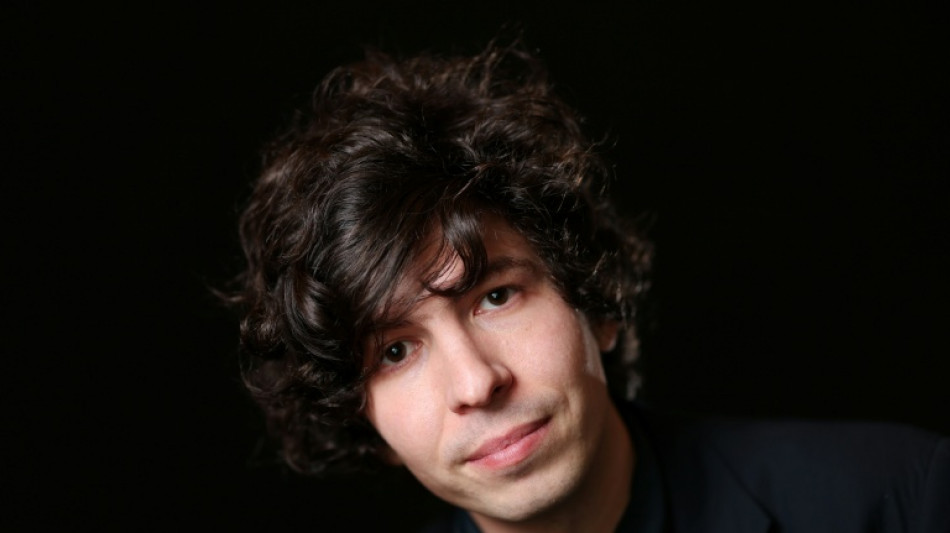
Sci-fi without AI: Oscar nominated 'Arco' director prefers human touch / Photo: Valerie MACON - AFP/File

 US House faces test on sweeping Russia sanctions bill

 British PM says to make 'difficult decisions' as inflation rises

 Global fuel price demos: a round-up

 Leverate Launches MCP for Traders to Connect AI Assistants With Trading Platforms

 MEXC Launches $1M "Discover Your Wall Street DNA" Campaign to Help Traders Find Their Market Fit

 Stocks edge higher ahead of US Fed rate call

 BASIS.pro Expands On-Chain Infrastructure with XDC Network Partnership and Zypher DAO as Auto Earn Goes Live

 Pickle-flavoured tart? AI inspires Japan's convenience stores

 EU chief hosts Canada's Carney in push to 'deepen' alliance

 Meta chief pushes back on AI slowdown calls

 US Fed to deliver rate decision with markets betting on hike

 Sanders, Bannon warn of AI dangers in rare US left-right alignment

 Empty benches as schools reopen in Venezuela's quake-hit Guaira

 Tiny English village holds 'independence' vote over asylum seeker housing

 US Treasury chief says to meet Chinese counterpart at weekend

 BingX Evolves into a Multi-Asset Trading Platform, Connecting Users to Global Opportunities

 International Trading Institute Expands Professional Trader Development Beyond the Master’s in Trading

 Lake Energy Secures $80 Million for U.S. Renewable Energy Expansion

 Stocks drop, oil climbs and Treasury yields hit 19-year high

 SkySail Strategies Outperforms Wall Street's 30-Year Risk Standard With Proprietary AI Inference Model

 Just add fish: Scientists pursue more rice, less disease in Senegal paddies

 Belgium completes outer structure of offshore energy island
 China retail sales growth weakens further in August

 In Kashmir, lake weeds mix with traditional art

 'Widow's Bay' and 'The Pitt' take key Emmy awards

Oscar-nominated animated film "Arco" tells the story of a young boy in a future where humanity lives in harmony with nature, far from the robots and artificial intelligence shaping our present.
For first-time director Ugo Bienvenu, who drew the whole film by hand, there was never any chance he would resort to using AI.
"That's why I make science fiction," the French director told AFP. "It was to say to this generation: 'Maybe there are other paths, maybe there are other things to imagine.'"
The graphic novel illustrator, 38, says he is alarmed by society's increasing dependence on artificial intelligence, which he insists is inferior to the things it is being used to replace.
"It's like wanting to saw off your own leg just because you have a great crutch," he said.
The Academy of Motion Picture Arts and Sciences, the body that will hand out the Oscars in Hollywood on March 15, last year updated its rules to say it was neutral on the technology.
"Generative Artificial Intelligence and other digital tools... neither help nor harm the chances of achieving a nomination," it said in April.
"The Academy and each branch will judge the achievement, taking into account the degree to which a human was at the heart of the creative authorship."
- 'Nobody really wants to use it' -
The move came after a furor over the use of AI in best picture contenders "The Brutalist" -- where Adrien Brody's Hungarian accent was artificially smoothed out -- and "Dune: Part Two," in which certain characters had their eye color changed.
This season, two Oscar-eligible animated shorts openly acknowledged their use of AI, but did not get a nomination.
For Bienvenu, the reliance on AI in the creative process is dangerous because it risks allowing the imagination to wither.
"If we tell ourselves that the machine will do it for us, we never make the mistakes that allow us to access our subconscious" where true creativity lies, he said.
Bienvenu, who spoke to AFP on the sidelines of the Oscars nominees luncheon in Beverly Hills last month, said many conversations at the gathering had touched on the use of AI in filmmaking -- a key sticking point in the writers' and actors' strikes that crippled Hollywood in 2023.
"Everyone is more or less on the same page," he said. "Nobody really wants to use it."
- 'Human' -
In January, more than 800 creatives, including actresses Scarlett Johansson and Cate Blanchett, as well as director Guillermo Del Toro, published an open letter accusing AI giants of "theft."
The Mexican filmmaker, whose "Frankenstein" is competing this year for the best picture Oscar, in 2022 said animation created by AI is an "insult to life itself."
Bienvenu shares that alarm.
"The real danger is that we... become weaker intellectually," he says.
"It's not about protecting our jobs, it's about what makes us human."
"Fiction is about sharing experiences," he says -- a process that helps us to be "emotionally prepared when something serious happens to us in life, so we don't fall apart."
Too much of modern life is dominated by machines that can only regurgitate what has come before, says Bienvenu.
"Today, there are people who wear clothes made by robots, and eat food made by robots — basically, they're the poor," he said.
"And now, this same group will be consuming fiction made by robots."
The massive companies that make AI do not pay the true cost of their product, Bienvenu says, and something must be done to level the playing field.
He suggests levying a tax on the huge volumes of water used by companies to cool their server farms, an amount one study published in December found exceeded the volume of bottled water consumed around the planet every year.
"AI isn't free," says Bienvenu.
"It has physical repercussions and impacts on our subconscious."
Ng.A.Adebayo--CPN