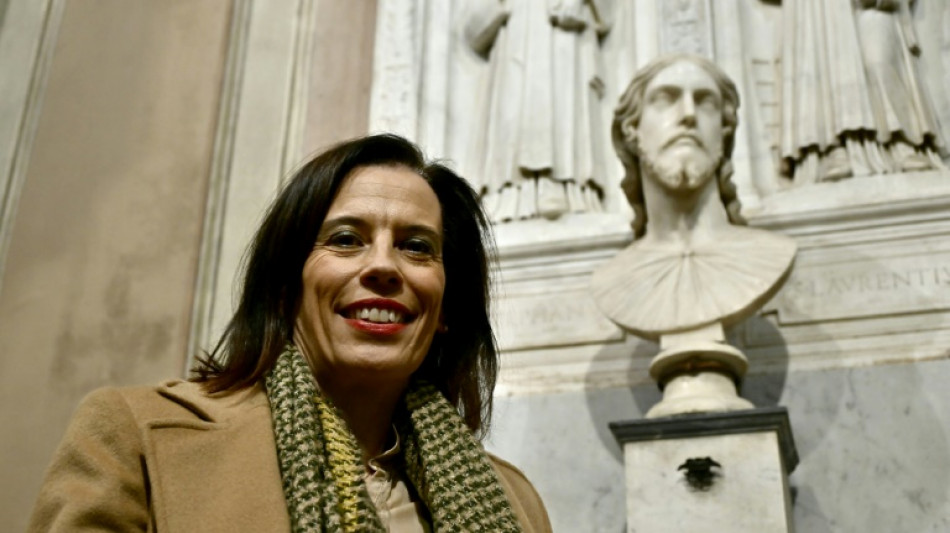
Michelangelo's works hidden in 'secret room', researcher says / Photo: Filippo MONTEFORTE - AFP

 US House faces test on sweeping Russia sanctions bill

 British PM says to make 'difficult decisions' as inflation rises

 Global fuel price demos: a round-up

 Leverate Launches MCP for Traders to Connect AI Assistants With Trading Platforms

 MEXC Launches $1M "Discover Your Wall Street DNA" Campaign to Help Traders Find Their Market Fit

 Stocks edge higher ahead of US Fed rate call

 BASIS.pro Expands On-Chain Infrastructure with XDC Network Partnership and Zypher DAO as Auto Earn Goes Live

 Pickle-flavoured tart? AI inspires Japan's convenience stores

 EU chief hosts Canada's Carney in push to 'deepen' alliance

 Meta chief pushes back on AI slowdown calls

 US Fed to deliver rate decision with markets betting on hike

 Sanders, Bannon warn of AI dangers in rare US left-right alignment

 Empty benches as schools reopen in Venezuela's quake-hit Guaira

 Tiny English village holds 'independence' vote over asylum seeker housing

 US Treasury chief says to meet Chinese counterpart at weekend

 BingX Evolves into a Multi-Asset Trading Platform, Connecting Users to Global Opportunities

 International Trading Institute Expands Professional Trader Development Beyond the Master’s in Trading

 Lake Energy Secures $80 Million for U.S. Renewable Energy Expansion

 Stocks drop, oil climbs and Treasury yields hit 19-year high

 SkySail Strategies Outperforms Wall Street's 30-Year Risk Standard With Proprietary AI Inference Model

 Just add fish: Scientists pursue more rice, less disease in Senegal paddies

 Belgium completes outer structure of offshore energy island

 China retail sales growth weakens further in August

 In Kashmir, lake weeds mix with traditional art

 'Widow's Bay' and 'The Pitt' take key Emmy awards

Renaissance artist Michelangelo ordered many of his artworks to be hidden by his pupils in a secret room to protect them for posterity, an Italian researcher claimed Wednesday.
According to renowned art historian Giorgio Vasari, the Italian genius burned a large number of his own drawings and sketches before his death in Rome in 1564.
But researcher Valentina Salerno says she has unearthed unpublished archival documents that reveal a plot to squirrel away his works.
"One of these three unpublished documents I found in the archives speaks of a room" kept by students of the Michelangelo school, the origins of which "can be traced back" to the artist, Salerno told AFP on the sidelines of a press conference in Rome.
"Assets are hidden inside this room. These assets are locked away so tightly that they require a system of multiple keys, so that no one can access them without the permission of others," she said.
Salerno was researching a book on Michelangelo when she came across a document that showed the artist had in 1550 joined the Brotherhood of the Most Holy Crucifix. Those close to him in his final years were members too.
Over a decade of research, she followed the document trail between a series of archives in the Vatican, Italy and European cities including Paris.
As part of what she called a "maniacal plan" cooked up by Michelangelo, his works were to be hidden "because otherwise it would all end up with a nephew he detested".
"The goal was to pass on to his poor, vulnerable, non-noble descendants the material to be able to continue studying, to transmit his art to future generations," she said.
Those involved in the plan went on to form the famous art Academy of San Luca in the 16th century, she added. It still exists today.
Salerno believes the secret room designed to safeguard the artist's creations was likely somewhere inside the Saint Peter in Chains church in central Rome.
- Michelangelo bust -
During her research, she also stumbled across a reference to a bust at the Basilica of Sant'Agnese, also in Rome, currently attributed to an anonymous artist.
She found documents attributing the white bust of Christ the Saviour to Michelangelo down the centuries.
In the 1930s it appears to disappear from documentation, only to reappear in the 1980s, attributed to a minor artist.
Italy's cultural authorities later declared it to be a work by an unknown sculptor instead.
But Salerno insists the bust is a genuine Michelangelo, not just due to the paper trail, but also because it shares a striking resemblance to Tommaso dei Cavalieri.
Cavalieri was a young nobleman with whom Michelangelo became infatuated in his 50s.
Salerno's work has not yet been peer reviewed, but she is a member of the Vatican committee for the celebrations marking the 500th anniversary of Michelangelo's birth.
Y.Jeong--CPN