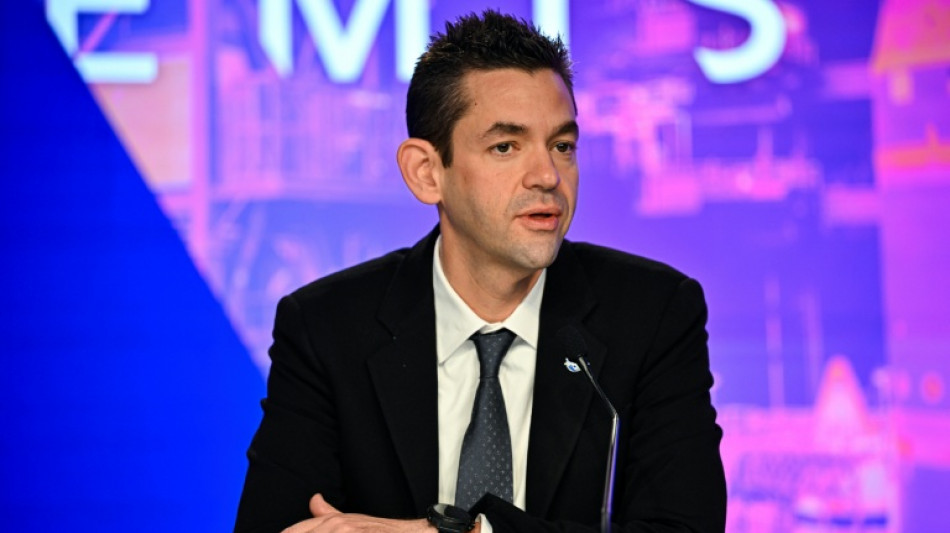
NASA announces overhaul of Artemis lunar program amid technical delays / Photo: Miguel J Rodriguez Carrillo - AFP

 US House faces test on sweeping Russia sanctions bill

 British PM says to make 'difficult decisions' as inflation rises

 Global fuel price demos: a round-up

 Leverate Launches MCP for Traders to Connect AI Assistants With Trading Platforms

 MEXC Launches $1M "Discover Your Wall Street DNA" Campaign to Help Traders Find Their Market Fit

 Stocks edge higher ahead of US Fed rate call

 BASIS.pro Expands On-Chain Infrastructure with XDC Network Partnership and Zypher DAO as Auto Earn Goes Live

 Pickle-flavoured tart? AI inspires Japan's convenience stores

 EU chief hosts Canada's Carney in push to 'deepen' alliance

 Meta chief pushes back on AI slowdown calls

 US Fed to deliver rate decision with markets betting on hike

 Sanders, Bannon warn of AI dangers in rare US left-right alignment

 Empty benches as schools reopen in Venezuela's quake-hit Guaira

 Tiny English village holds 'independence' vote over asylum seeker housing

 US Treasury chief says to meet Chinese counterpart at weekend

 BingX Evolves into a Multi-Asset Trading Platform, Connecting Users to Global Opportunities

 International Trading Institute Expands Professional Trader Development Beyond the Master’s in Trading

 Lake Energy Secures $80 Million for U.S. Renewable Energy Expansion

 Stocks drop, oil climbs and Treasury yields hit 19-year high

 SkySail Strategies Outperforms Wall Street's 30-Year Risk Standard With Proprietary AI Inference Model

 Just add fish: Scientists pursue more rice, less disease in Senegal paddies

 Belgium completes outer structure of offshore energy island

 China retail sales growth weakens further in August
 In Kashmir, lake weeds mix with traditional art

 'Widow's Bay' and 'The Pitt' take key Emmy awards

NASA on Friday said it would revise its Artemis lunar program that has suffered multiple delays in recent years, in a bid to ensure Americans can return to the Moon's surface by 2028.
The US space agency will add missions between this spring's Artemis 2 and the ultimate lunar landing, a strategic revision that NASA administrator Jared Isaacman told a briefing would allow for improved launch "muscle memory."
That means Artemis 3, which was meant to send astronauts to the Moon's surface, will now have the alternate goal of "rendezvous in low-Earth orbit" of at least one lunar lander.
The next phase, Artemis 4, will aim for a lunar landing in early 2028. Isaacman said he hoped that mission could be followed relatively quickly by a second Moon landing within the year.
"We're not necessarily committing to launching two missions in 2028," he said, "but we want to have the opportunity to be able to do that."
The NASA chief said speeding up the cadence of Artemis launches would allow for building more institutional knowledge in the model of the Apollo program, which originally put Americans on the Moon.
"Mercury, Gemini, Apollo, through the shuttle program -- I don't think it would surprise many of the folks in the room that our average launch cadence was closer to three months throughout all those programs, not three years," he said. "We need to start getting back to basics and moving in this direction."
"Launching every three years, your skills atrophy, you lose muscle memory."
- 'Space race'? -
The revised architecture announcement comes in the wake of repeated delays to the Artemis 2 mission, which now will not launch before April.
It is meant to see the first flyby of the Moon in more than half a century.
Earlier this week, the US space agency rolled back its towering SLS rocket and Orion spacecraft off the launchpad to investigate its problems and make necessary repairs.
President Donald Trump announced he wanted Americans to once again set foot on the lunar surface in his first term.
The US space agency now hopes to put humans back on the Moon as China forges ahead with its own effort, which is targeting 2030 at the latest for a first crewed mission.
China's uncrewed Chang'e 7 mission is expected to be launched in 2026 for an exploration of the Moon's south pole, and testing of its crewed spacecraft Mengzhou is also set to go ahead this year.
Queried on the so-called "space race," Isaacman said Friday that "I think competition is good."
"We're here talking to you about what is a common-sense approach to achieve the objective, whether we had a great rival in the running or not."
A.Mykhailo--CPN