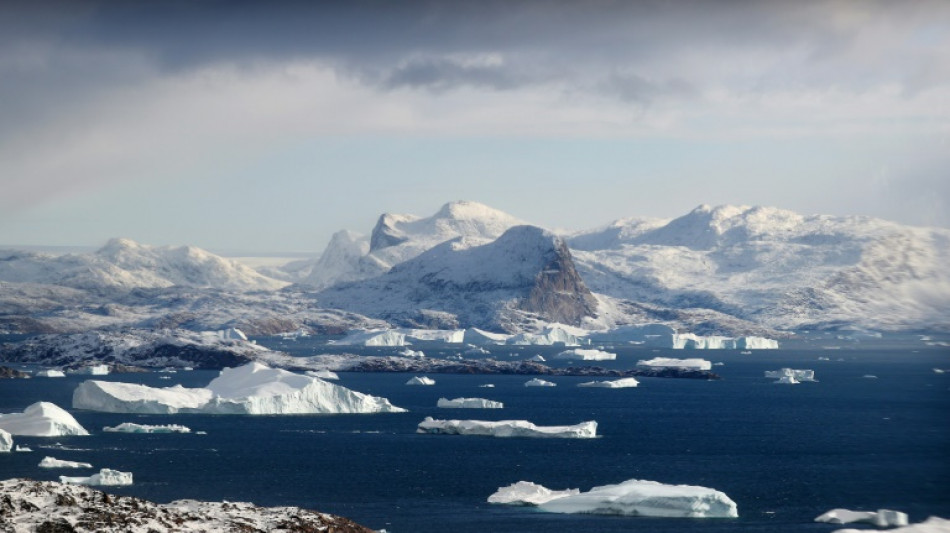
Greenland ice cap loses enough water in 20 years to cover US: study

 Wildfires push endangered Sumatran elephants to brink: Indonesian NGO

 Bank of Japan set to raise rates under pressure from inflation, US

 EU chief to unveil social media, gaming curbs for under-15s

 'Resident Evil' film brings video game's ethos to the big screen

 i-payout Expands U.S. Money Transmitter Licensing Footprint and Advances European EMI Strategy

 US Senate crypto bill collapses amid partisan deadlock

 OpenAI, Anthropic and Google are working to create an AI standards body

 Protesting shepherds, farmers clash with Romanian police

 Foundation Lets Ledger Users Switch to Open Source Without Starting Over

 EU to propose curbing social media, online games for under 15s

 FX Junction Reaches 40,600 Members and 26 Million Trades

 'We unleashed the beast': the world's fears and hopes about AI

 Hospitality leaders ask Burnham to halve VAT amid rising costs

 Worcestershire invited to nominate groups for 2027 King’s volunteer award

 Berlin's run-down public spaces at heart of election campaign

 'Widow's Bay' and 'The Pitt' win big at Emmy Awards

 Most markets drop as oil extends gains ahead of expected US rate hike

 Sri Lanka's famed beach shack battles demolition

 Vserv targets ₹1,000 crore revenue by 2030 through AI expansion

 India prohibits bank fees on UPI payments up to ₹2,000

 Brazil's Amazon defender Raoni has cancer

 Trump rejects AI slowdown concerns as UN urges coordinated controls

 Higher wages draw migrant workers to Kashmir despite attacks

 Oil supply concerns and AI warnings weigh on global markets

 'I am the hoax buster': Trump rejects AI danger warnings

Greenland's immense ice sheet has lost enough ice in the past 20 years to submerge the entire United States in half a metre of water, according to data released this week by Danish researchers.
The climate is warming faster in the Arctic than anywhere else on the planet and melting ice from Greenland is now the main factor in the rise in the Earth's oceans, according to NASA.
Since measurements began in 2002, the Greenland ice sheet has lost about 4,700 billion tonnes of ice, said Polar Portal, a joint project involving several Danish Arctic research institutes.
This represents 4,700 cubic kilometres of melted water -- "enough to cover the entire US by half a meter" -- and has contributed 1.2 centimetres to sea level rise, the Arctic monitoring website added.
Polar Portal's findings are based on satellite imagery from the US-German GRACE programme (Gravity Recovery and Climate Experiment), which showed the ice melt to be most severe near the coasts of the Arctic territory, at the edge of the ice sheet.
In these peripheral zones, "independent observations also indicate that the ice is thinning, that the glacier fronts are retreating in fjords and on land, and that there is a greater degree of melting from the surface of the ice", the website said.
The west coast of Greenland is particularly affected, according to the data.
Climate change is particularly alarming in the Arctic, which scientists say is warming at a rate three to four times the global average.
According to a study published by NASA in late January, the accelerated melting near Greenland's coasts can be explained by the warming of the Arctic Ocean.
The phenomenon "is melting Greenland's glaciers at least as much as warm air is melting them from above".
Melting ice from Greenland is currently the main factor in the rise in the Earth's oceans and the territory's glaciers are now retreating six to seven times faster than they were 25 years ago, the US agency added.
According to climate scientists, the Greenland ice sheet contains enough water to raise the oceans by more than seven metres, and the ice sheet in Antarctica contains enough for a rise of almost 50 metres.
Arctic sea ice cover, although its melting has no effect on sea levels, has also shrunk considerably, losing almost 13 percent of its average surface area every 10 years.
P.Gonzales--CPN