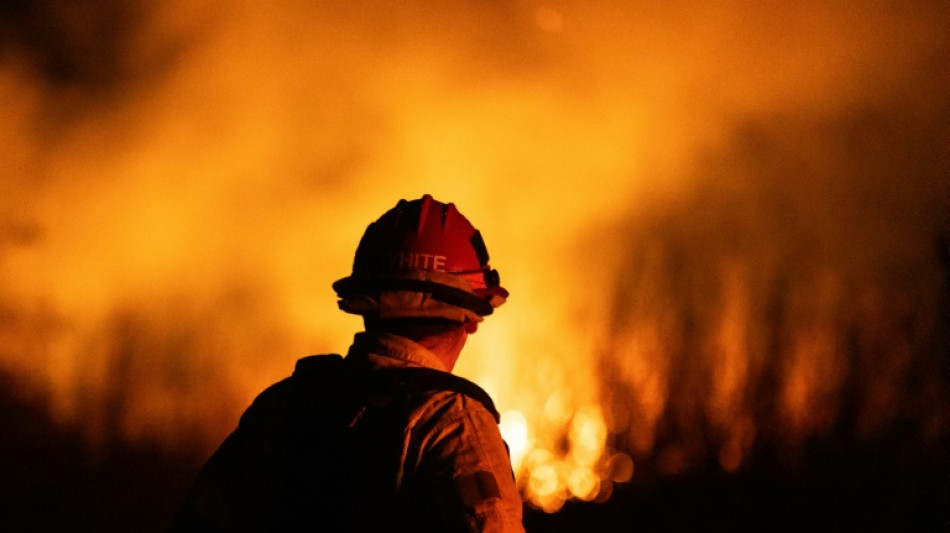
Survivors count the mental cost of Los Angeles fires / Photo: ETIENNE LAURENT - AFP

 Modi pitches India as global chipmaking hub

 Ukraine plans record defence spending in 2027

 NASA scan discovers new, 'once in a century' Moon crater

 Most stocks rise as Fed hikes and indicates drive to curb inflation

 UK-Sudanese author pens book to give children 'African history of Africa'

 US Congress passes sweeping Russia sanctions bill

 US stocks fall, dollar gains after Fed lifts interest rates

 US Fed raises rates to tackle 'too high' inflation in move sure to rile Trump

 US Fed raises rates to battle inflation in move likely to rile Trump

 US House faces test on sweeping Russia sanctions bill

 British PM says to make 'difficult decisions' as inflation rises

 Global fuel price demos: a round-up

 Leverate Launches MCP for Traders to Connect AI Assistants With Trading Platforms

 MEXC Launches $1M "Discover Your Wall Street DNA" Campaign to Help Traders Find Their Market Fit

 Stocks edge higher ahead of US Fed rate call

 BASIS.pro Expands On-Chain Infrastructure with XDC Network Partnership and Zypher DAO as Auto Earn Goes Live

 Pickle-flavoured tart? AI inspires Japan's convenience stores

 EU chief hosts Canada's Carney in push to 'deepen' alliance

 Meta chief pushes back on AI slowdown calls

 US Fed to deliver rate decision with markets betting on hike

 i-payout Expands U.S. Money Transmitter Licensing Footprint and Advances European EMI Strategy

 US Senate crypto bill collapses amid partisan deadlock

 OpenAI, Anthropic and Google are working to create an AI standards body

 Protesting shepherds, farmers clash with Romanian police

 Foundation Lets Ledger Users Switch to Open Source Without Starting Over

When the Pacific Palisades neighborhood of Los Angeles went up in smoke, Alexander Swedelson lost his apartment, but also a bit of his identity: the flames ravaged the businesses he loved, the trails he ran, and even the place he fished.
"It's just been the most heartbreaking thing I've ever seen in my life. Man, it's just like a war zone," the 39-year-old photographer told AFP, standing in the ruins of what was once one of the most desirable bits of real estate in the country.
The awful sight of a place where familiar landmarks have been erased has re-opened old wounds for Swedelson.
"I'm probably gonna restart therapy," sighed the recovering alcoholic, who has been sober for six years.
For the past week, the former volunteer firefighter has been doing his part to help his community.
Armed with a water pump and a chainsaw, he first tried -- in vain -- to save his parents' house, before fighting the spread of embers in the neighborhood.
Then, he delivered food and air filters to the elderly who had not evacuated.
Sleep has been a rarity.
"I think I hit my limit," he said, his eyes misty, sitting in a pickup truck covered in pink retardant dropped by the firefighting planes.
As a one-time drug rehab counselor who has seen first responders grapple with trauma in the aftermath of a tragedy, he knows enough to see that he is at risk now.
"I just kind of stirred up a dormant beast in me, and I'm just gonna have to be really careful."
- Get treatment early -
With at least 24 people dead and tens of thousands displaced by fires that continue to smoulder, the last eight days will leave a lasting mark on America's second biggest city.
From the initial panicked evacuation to the terrible firefight that saw hydrants run dry, the opening day of the disaster was just the beginning.
Thousands of people have seen their homes reduced to ashes. And even those whose homes were spared have been heartbroken by the ruin of their neighborhoods.
Psychotherapist Sonnet Daymont said the mental health impacts will also extend to teenagers in the city who have been glued to rolling imagery of the unfolding carnage, or to people who live outside the diaster zone but who have watched their city burn.
"There is such a thing as survivor's guilt and vicarious trauma," she told AFP in her Pasadena office, where she offers free sessions to those affected.
"The sooner you get treatment, the better, so that you can learn the skills you need to bring your body down, cope and calm, and get strategic about your next steps as you rebuild," she said.
A study by Canada's Laval University followed survivors of a fire that afflicted Alberta in 2016.
A year after the disaster, a third of them suffered from depression, anxiety, drug addiction or post-traumatic stress.
- Eco-anxiety -
"The impact of wildfire unfolds over time," said Kathryn Andrews, a 51-year-old artist who lost her mobile home in the flames that wrecked Pacific Palisades.
Tragically, this is not the first time she has been through the devastation.
In 2020, her house was razed by a fire in Juniper Hills, an hour and a half drive northeast of Los Angeles.
"I developed a creative block for about a year and a half," she said.
"When I make art, I feel very vulnerable, and I couldn't take on feeling any more vulnerable. It was just an overwhelming experience, and I sort of shut down."
Andrews said she also experienced a kind of eco-anxiety, the effect of living in a part of the world that has been raked by increasingly destructive wildfires over the last 15 years.
"I began to think of, really, the entire American West as a potential fire zone," she said.
"It made me just have a better understanding of global warming."
Wildfire survivors "bring up climate change all of the time," said Daymont.
In her practice, she encourages them to think of themselves as "survivors," rather than "victims," and she works with them to develop strategies to soothe the body and mind.
"It is an opportunity to work towards post traumatic growth," she said.
"If we have something hard happen and we deal with it well, we can take those lessons and that strategy and use it for other things."
Y.Jeong--CPN