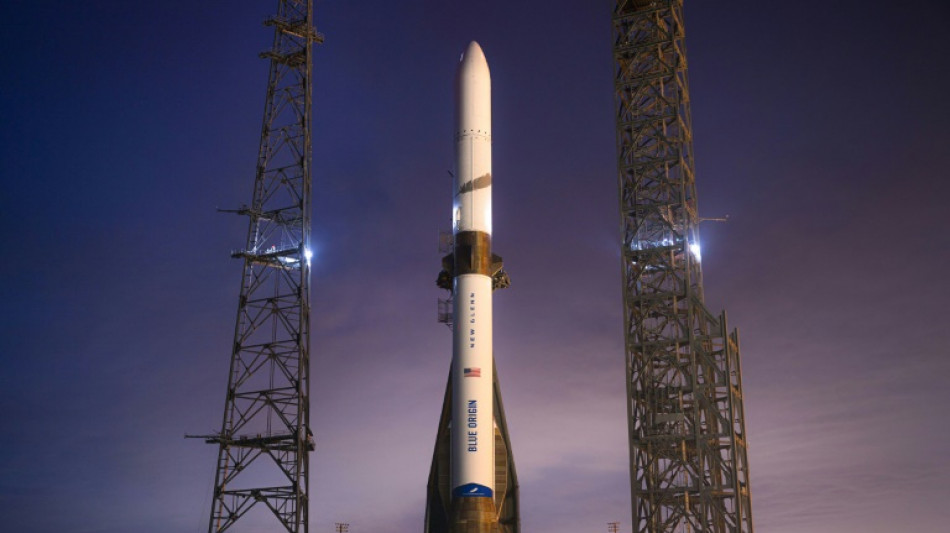
Five things to know about New Glenn, Blue Origin's new rocket / Photo: HANDOUT - BLUE ORIGIN/AFP/File

 Modi pitches India as global chipmaking hub

 Ukraine plans record defence spending in 2027

 NASA scan discovers new, 'once in a century' Moon crater

 Most stocks rise as Fed hikes and indicates drive to curb inflation

 UK-Sudanese author pens book to give children 'African history of Africa'

 US Congress passes sweeping Russia sanctions bill

 US stocks fall, dollar gains after Fed lifts interest rates

 US Fed raises rates to tackle 'too high' inflation in move sure to rile Trump

 US Fed raises rates to battle inflation in move likely to rile Trump

 US House faces test on sweeping Russia sanctions bill

 British PM says to make 'difficult decisions' as inflation rises

 Global fuel price demos: a round-up

 Leverate Launches MCP for Traders to Connect AI Assistants With Trading Platforms

 MEXC Launches $1M "Discover Your Wall Street DNA" Campaign to Help Traders Find Their Market Fit

 Stocks edge higher ahead of US Fed rate call

 BASIS.pro Expands On-Chain Infrastructure with XDC Network Partnership and Zypher DAO as Auto Earn Goes Live

 Pickle-flavoured tart? AI inspires Japan's convenience stores

 EU chief hosts Canada's Carney in push to 'deepen' alliance

 Meta chief pushes back on AI slowdown calls

 US Fed to deliver rate decision with markets betting on hike

 i-payout Expands U.S. Money Transmitter Licensing Footprint and Advances European EMI Strategy

 US Senate crypto bill collapses amid partisan deadlock

 OpenAI, Anthropic and Google are working to create an AI standards body

 Protesting shepherds, farmers clash with Romanian police

 Foundation Lets Ledger Users Switch to Open Source Without Starting Over

Blue Origin, the US space company founded by billionaire Jeff Bezos in 2000, is poised for a historic first: its maiden voyage into orbital space with a brand new rocket, New Glenn.
Here are five key things to know about the heavy-lift vehicle aiming to challenge SpaceX's dominance in the commercial space market.
- Homage -
New Glenn honors a legendary astronaut: John Glenn, the first American to orbit Earth in 1962.
It follows in the steps of New Shepard, Blue Origin's first rocket which was named for Alan Shepard, the first American in space.
Standing 320 feet (98 meters) tall -- roughly equivalent to a 32-story building -- New Glenn is both larger and more powerful than its smaller sibling, which is used for suborbital space tourism.
- Heavy-lift -
New Glenn is classified as a "heavy-lift launcher," capable of placing substantial payloads into low-Earth orbit. It is expected to carry up to 45 tons into orbit.
That is more than double that of SpaceX's Falcon 9, which can lift around 22 tons, though it falls short of the Falcon Heavy's 63.8-ton capacity.
However, New Glenn has a unique edge: its wider payload fairing, which can accommodate larger objects.
It "has the largest capacity to put objects in space, large objects" as a result of its wider payload fairing, Elliott Bryner, a professor at Embry-Riddle Aeronautical University, told AFP.
- Swiss knife -
Its versatility means New Glenn could become a "Swiss Army knife" of rockets, capable of deploying a diverse array of payloads to both low and higher orbits.
These are set to include commercial and military satellites -- as well as Project Kuiper, Bezos's planned space internet constellation, to compete with SpaceX's Starlink.
New Glenn also has the potential to carry crewed spacecraft, notes George Nield, president of Commercial Space Technologies. "One other potential use is for commercial space stations," he adds.
With the International Space Station slated for decommissioning in 2030, the race is on to develop replacements. Blue Origin is among the contenders vying to build the first privately run platform.
- Partially reusable -
Like SpaceX's Falcon 9, New Glenn features a reusable first-stage booster -- designed for up to 25 flights -- and an expendable second stage.
But to reuse the rocket, Blue Origin first has to land it. The company has mastered the technique with its much smaller New Shepard rocket, which touches down on solid ground. However, reusing New Glenn will require a successful landing on a drone ship stationed in the Atlantic Ocean.
This is no small feat: It took SpaceX six years to perfect the maneuver with Falcon 9 after its debut launch in 2010.
"Landing a rocket like this, the way they're doing it, is definitely not simple," said Bryner. "The level of technology required to do this is unbelievable."
Yet achieving reusability is crucial to reducing costs and broadening access to space, added Nield.
- Higher tech -
Under the hood, New Glenn's propulsion system represents a step up.
The first stage is powered by liquid methane, a cleaner and more efficient fuel than the kerosene used in both stages of Falcon 9.
Its second stage uses liquid hydrogen, an even cleaner and more powerful fuel, though more challenging to handle due to its cryogenic properties.
"It's the difference between driving a, you know, a Ferrari or a Volkswagen," William Anderson, a professor of aeronautics and astronautics at Purdue University told AFP, comparing the technology behind New Glenn and Falcon 9.
L.Peeters--CPN