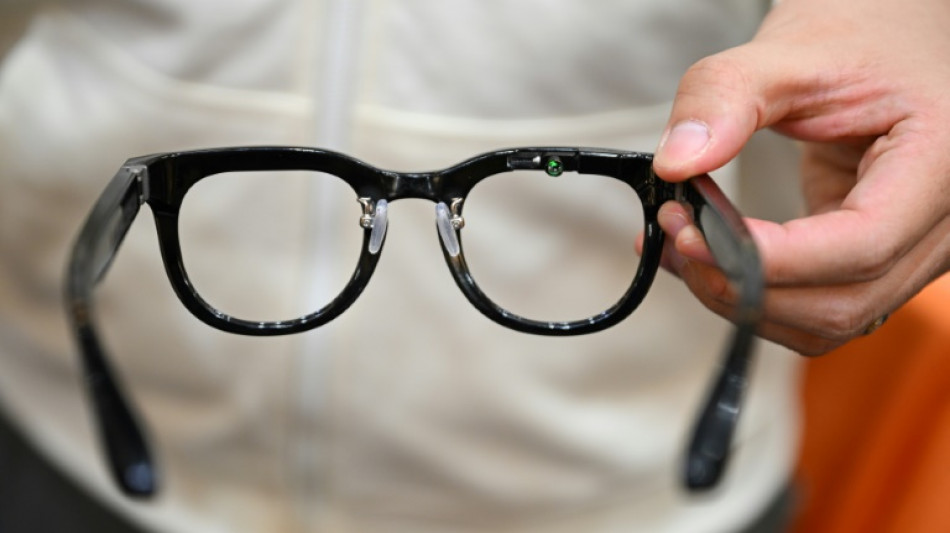
Smart glasses enter new era with sleeker designs, lower prices / Photo: Patrick T. Fallon - AFP

 Modi pitches India as global chipmaking hub

 Ukraine plans record defence spending in 2027

 NASA scan discovers new, 'once in a century' Moon crater

 Most stocks rise as Fed hikes and indicates drive to curb inflation

 UK-Sudanese author pens book to give children 'African history of Africa'

 US Congress passes sweeping Russia sanctions bill

 US stocks fall, dollar gains after Fed lifts interest rates

 US Fed raises rates to tackle 'too high' inflation in move sure to rile Trump

 US Fed raises rates to battle inflation in move likely to rile Trump

 US House faces test on sweeping Russia sanctions bill

 British PM says to make 'difficult decisions' as inflation rises

 Global fuel price demos: a round-up

 Leverate Launches MCP for Traders to Connect AI Assistants With Trading Platforms

 MEXC Launches $1M "Discover Your Wall Street DNA" Campaign to Help Traders Find Their Market Fit

 Stocks edge higher ahead of US Fed rate call

 BASIS.pro Expands On-Chain Infrastructure with XDC Network Partnership and Zypher DAO as Auto Earn Goes Live

 Pickle-flavoured tart? AI inspires Japan's convenience stores

 EU chief hosts Canada's Carney in push to 'deepen' alliance

 Meta chief pushes back on AI slowdown calls

 US Fed to deliver rate decision with markets betting on hike

 i-payout Expands U.S. Money Transmitter Licensing Footprint and Advances European EMI Strategy

 US Senate crypto bill collapses amid partisan deadlock

 OpenAI, Anthropic and Google are working to create an AI standards body

 Protesting shepherds, farmers clash with Romanian police

 Foundation Lets Ledger Users Switch to Open Source Without Starting Over

Producers of hi-tech connected eyewear are multiplying their innovations with increasingly discreet models in an attempt to make a difference in a highly competitive -- and fast-emerging -- market.
Live translation, GPS, cameras: glasses are quickly adopting new functionalities.
"There are so many of these smart wearables, and more of them are going on your face," said Techsponential analyst Avi Greengart at the Consumer Electronics Show (CES) in Las Vegas, where numerous smart glasses manufacturers showcased their latest innovations.
The industry has come a long way from its early days. Gone are the conspicuous protrusions of Google Glass and the bulky frames and cables of Epson's Moverio from the early 2010s.
Today's smart glasses, all paired with smartphone apps, increasingly resemble traditional eyewear. The Ray-Ban Meta, developed by Mark Zuckerberg's social media giant, currently leads the market with this new approach.
According to a recent MarketsandMarkets study, the sector's growth is "driven by advancements in augmented reality, artificial intelligence, and miniaturization technologies, which are pushing the boundaries of what these wearable devices can achieve."
However, integrating technology into fashionable frames requires careful compromise.
The Ray-Ban Meta, for instance, can capture photos and videos, play music, and provide information about objects in view, but doesn't offer augmented reality with superimposed images.
Meta representative Robin Dyer explained that while AR capabilities may come later, they would likely double the current price.
- 200 dollars -
Price is a major battleground in this market, particularly with the entry of Chinese manufacturers.
While Google Glass initially retailed for around $1,500 in 2013, today's smart glasses are approaching the price of premium conventional frames.
Meta's James Nickerson noted that their Ray-Ban collaboration starts at $300, just $50 more than standard Ray-Bans, offering "a cool camera" as a bonus.
Chinese startup Vue has pushed prices even lower, offering basic models with voice assistant and music capabilities for $200.
Some manufacturers, like XReal, focus on augmented reality, projecting smartphone, computer, or gaming console displays -- though this is a market for which Apple's VisonPro failed to create excitement last year.
For AR, recent advances help move away from the bulk of a virtual reality headset towards that of classic sunglasses, even if they require a cable to be connected to the device.
Meta's ambition is to launch its own pared down version, the Orion, currently in the test phase but not expected to be marketed until 2027 at the earliest.
- Chasing cool -
Companies like Even Realities and Halliday are pioneering ultra-thin frames that look identical to standard glasses while offering basic AR capabilities.
"If we want to make a good pair of smart glasses, we must first make a pair of cool glasses," emphasized Carter Hou, Halliday's second-in-command.
Halliday's $489 model, launching in March, displays text in the upper corner of the wearer's vision. Using AI, it can suggest responses during conversations, provide real-time translation, and function as a discrete teleprompter.
Even Realities has also taken a minimalist approach.
"We got rid of the speaker, we got rid of the camera," explained the company's Tom Ouyang. "Glasses are for the eyes, not the ears."
P.Gonzales--CPN