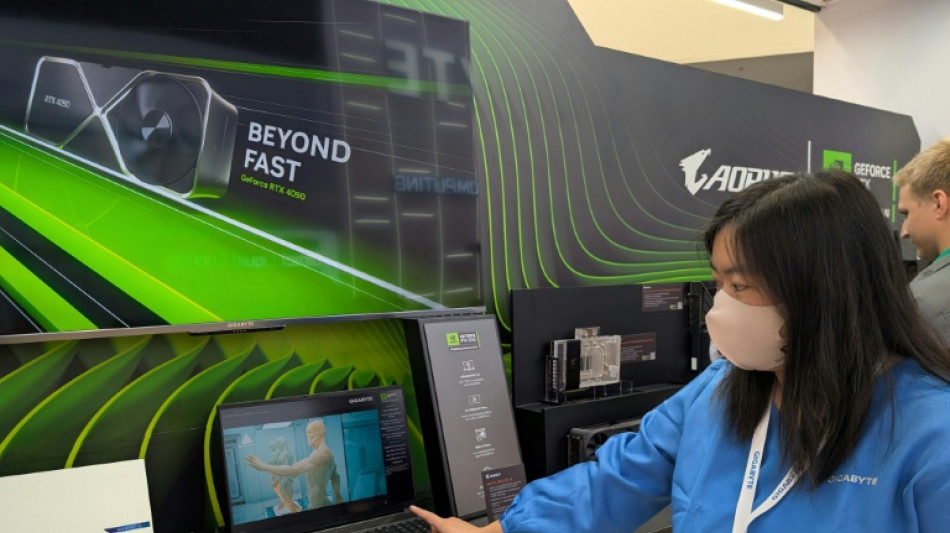
AI comes down from the cloud as chips get smarter / Photo: Glenn CHAPMAN - AFP

 Modi pitches India as global chipmaking hub

 Ukraine plans record defence spending in 2027

 NASA scan discovers new, 'once in a century' Moon crater

 Most stocks rise as Fed hikes and indicates drive to curb inflation

 UK-Sudanese author pens book to give children 'African history of Africa'

 US Congress passes sweeping Russia sanctions bill

 US stocks fall, dollar gains after Fed lifts interest rates

 US Fed raises rates to tackle 'too high' inflation in move sure to rile Trump

 US Fed raises rates to battle inflation in move likely to rile Trump

 US House faces test on sweeping Russia sanctions bill

 British PM says to make 'difficult decisions' as inflation rises

 Global fuel price demos: a round-up

 Leverate Launches MCP for Traders to Connect AI Assistants With Trading Platforms

 MEXC Launches $1M "Discover Your Wall Street DNA" Campaign to Help Traders Find Their Market Fit

 Stocks edge higher ahead of US Fed rate call

 BASIS.pro Expands On-Chain Infrastructure with XDC Network Partnership and Zypher DAO as Auto Earn Goes Live

 Pickle-flavoured tart? AI inspires Japan's convenience stores

 EU chief hosts Canada's Carney in push to 'deepen' alliance

 Meta chief pushes back on AI slowdown calls

 US Fed to deliver rate decision with markets betting on hike

 i-payout Expands U.S. Money Transmitter Licensing Footprint and Advances European EMI Strategy

 US Senate crypto bill collapses amid partisan deadlock

 OpenAI, Anthropic and Google are working to create an AI standards body

 Protesting shepherds, farmers clash with Romanian police

 Foundation Lets Ledger Users Switch to Open Source Without Starting Over

Artificial intelligence is moving from data centers to "the edge" as computer makers build the technology into laptops, robots, cars and more devices closer to home.
The Consumer Electronics Show (CES) gadget extravaganza closing Friday was rife with PCs and other devices touting AI chips, making them more capable than ever and untethering them from the cloud.
Attention-grabbing stars included "AI PCs," personal computers boasting chips that promised a level of performance once limited to muscular data centers.
"Whatever was running in the cloud last year is running on the edge this year," Kamesh Medapalli, senior vice president of innovation and technology at Infineon Technologies, told AFP.
"The pattern is already there and will only accelerate; the opportunity is huge on the edge."
Nvidia chief executive Jensen Huang got a celebrity reception at CES, where he announced a ramped-up line of graphics processing units (GPUs) that imbue PCs with AI capabilities.
Huang told a packed arena that nearly all computer makers are working with Nvidia to get ready "so AI PCs are coming to a home near you."
- Home supercomputer -
Huang unveiled "Project DIGITS," described as a personal AI supercomputer.
It features a new Nvidia "superchip" for prototyping, fine-tuning and running large AI models on desktop computing systems, according to the chip maker.
"AI will be mainstream in every application for every industry," Huang said.
"Placing an AI supercomputer on the desks of every data scientist, AI researcher and student empowers them to engage and shape the age of AI."
Project DIGITS signals that Nvidia's strategy for AI data centers is extending to consumers who want the technology on their own machines, according to University of Pennsylvania computer science professor Benjamin Lee.
- Offline smarts -
Infineon's Medapalli said a shift to the edge means that functions like engaging with generative AI chatbots that once involved sending requests to be processed in data centers could be handled on a PC or smartphone.
"You don't have to have any internet connection; you don't have to talk to anybody in the cloud," Medapalli said.
"All your data is private and local -- that is what I mean by edge AI, and that is rapidly coming."
The AI edge could be anywhere processors can be embedded, including robots, cameras and cars.
"That's why the opportunity is huge in edge AI," Medapalli said.
Market tracker Canalys has projected that AI-capable PCs will account for some 40 percent of overall PC shipments this year, with that number more than doubling by 2028.
"The wider availability of AI-accelerating silicon in personal computing will be transformative," Canalys principal analyst Ishan Dutt said in a post.
"PCs with dedicated on-device AI capabilities will enable new and improved user experiences, driving productivity gains and personalizing devices at scale while offering better power efficiency, stronger security and reduced costs associated with running AI workloads."
CES goers flocked to a Gigabyte Technology booth at CES to check out PCs enhanced with Nvidia high-performance processors.
"We've had a lot of interest in the graphics card as well as the gaming laptop, because they are the top from Nvidia right now," Mia Qu of Gigabyte told AFP.
"Especially for gamers or people who plan to us it for large storage or high performance on a daily basis, they’re eyeing these specific products.”
Techsponential analyst Avi Greengart said chip and laptop vendors at CES are seeing AI capabilities resonate with people who want to speed up workflow, extend battery life and enhance video calls.
"We are actually seeing AI making a difference in real things people actually do," Greengart said.
J.Bondarev--CPN