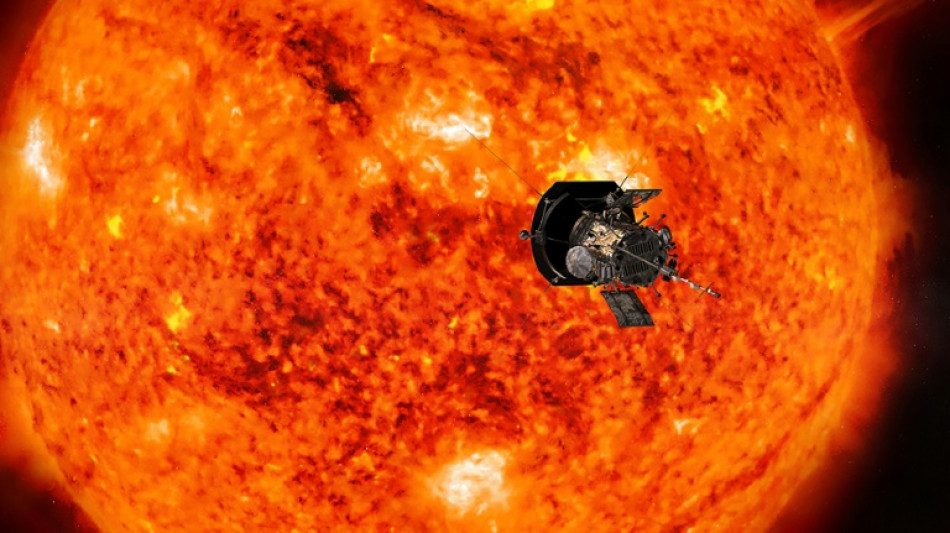
NASA solar probe to make its closest ever pass of Sun / Photo: HO - NASA/Johns Hopkins APL/AFP/File

 Germany urges EU action against China to defend carmakers

 Japan eyes changing prostitution law to punish sex buyers

 Modi pitches India as global chipmaking hub

 Ukraine plans record defence spending in 2027

 NASA scan discovers new, 'once in a century' Moon crater

 Most stocks rise as Fed hikes and indicates drive to curb inflation

 UK-Sudanese author pens book to give children 'African history of Africa'

 US Congress passes sweeping Russia sanctions bill

 US stocks fall, dollar gains after Fed lifts interest rates

 US Fed raises rates to tackle 'too high' inflation in move sure to rile Trump

 US Fed raises rates to battle inflation in move likely to rile Trump

 US House faces test on sweeping Russia sanctions bill

 British PM says to make 'difficult decisions' as inflation rises

 Global fuel price demos: a round-up

 Leverate Launches MCP for Traders to Connect AI Assistants With Trading Platforms

 MEXC Launches $1M "Discover Your Wall Street DNA" Campaign to Help Traders Find Their Market Fit

 Stocks edge higher ahead of US Fed rate call

 BASIS.pro Expands On-Chain Infrastructure with XDC Network Partnership and Zypher DAO as Auto Earn Goes Live

 Pickle-flavoured tart? AI inspires Japan's convenience stores

 EU chief hosts Canada's Carney in push to 'deepen' alliance

 Meta chief pushes back on AI slowdown calls

 US Fed to deliver rate decision with markets betting on hike

 i-payout Expands U.S. Money Transmitter Licensing Footprint and Advances European EMI Strategy

 US Senate crypto bill collapses amid partisan deadlock

 OpenAI, Anthropic and Google are working to create an AI standards body

NASA's pioneering Parker Solar Probe is poised to make its closest-ever approach of the Sun on Christmas Eve, a record-setting 3.8 million miles (6.2 million kilometers) from the surface.
Launched in August 2018, the spaceship is on a seven-year mission to deepen scientific understanding of our star and help forecast space-weather events that can affect life on Earth.
Its closest approach to date will happen on Tuesday, December 24, at 6:53 am (11:53 GMT).
If the distance between Earth and the Sun is the equivalent to the length of an American football field, the spacecraft would be about four yards (meters) from the end zone at that point.
"This is one example of NASA's bold missions, doing something that no one else has ever done before to answer longstanding questions about our universe," said Arik Posner, Parker Solar Probe program scientist, in a statement.
"We can't wait to receive that first status update from the spacecraft and start receiving the science data in the coming weeks."
During this closest approach -- known as perihelion -- mission teams will lose direct contact with Parker, relying on a "beacon tone" this Friday to confirm the spacecraft's status.
Although the heat shield will endure scorching temperatures of about 1,600 to 1,700 degrees Fahrenheit (870 to 930 degrees Celsius), the probe's internal instruments will remain near room temperature -- around 85F (29C) -- as it explores the Sun's outer atmosphere, called the corona.
Not only will the temperatures be extreme, but Parker will also be moving at a blistering pace of around 430,000 mph (690,000 kph), fast enough to fly from the US capital Washington to Tokyo in under a minute.
"No human-made object has ever passed this close to a star, so Parker will truly be returning data from uncharted territory," said Nick Pinkine, Parker Solar Probe mission operations manager at the Johns Hopkins Applied Physics Laboratory (APL) in Laurel, Maryland.
"We're excited to hear back from the spacecraft when it swings back around the Sun."
By venturing into these extreme conditions, Parker has been helping scientists tackle some of the Sun's biggest mysteries: how the solar wind originates, why the corona is hotter than the surface below, and how coronal mass ejections -- massive clouds of plasma that hurl through space -- are formed.
This Christmas Eve flyby is the first of three record-setting close passes, with the next two -- on March 22, 2025, and June 19, 2025 -- both expected to bring Parker Solar Probe back to a similarly close distance from the Sun.
M.Mendoza--CPN