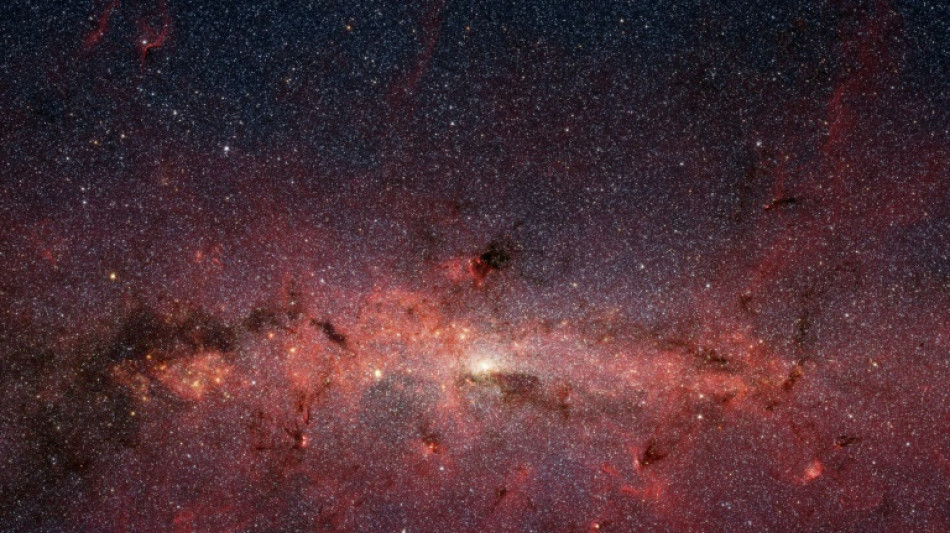
Object found in the Milky Way 'unlike anything astronomers have seen'

 Wildfires push endangered Sumatran elephants to brink: Indonesian NGO

 Bank of Japan set to raise rates under pressure from inflation, US

 EU chief to unveil social media, gaming curbs for under-15s

 'Resident Evil' film brings video game's ethos to the big screen

 i-payout Expands U.S. Money Transmitter Licensing Footprint and Advances European EMI Strategy

 US Senate crypto bill collapses amid partisan deadlock

 OpenAI, Anthropic and Google are working to create an AI standards body

 Protesting shepherds, farmers clash with Romanian police

 Foundation Lets Ledger Users Switch to Open Source Without Starting Over

 EU to propose curbing social media, online games for under 15s

 FX Junction Reaches 40,600 Members and 26 Million Trades

 'We unleashed the beast': the world's fears and hopes about AI

 Hospitality leaders ask Burnham to halve VAT amid rising costs

 Worcestershire invited to nominate groups for 2027 King’s volunteer award

 Berlin's run-down public spaces at heart of election campaign

 'Widow's Bay' and 'The Pitt' win big at Emmy Awards

 Most markets drop as oil extends gains ahead of expected US rate hike

 Sri Lanka's famed beach shack battles demolition

 Vserv targets ₹1,000 crore revenue by 2030 through AI expansion

 India prohibits bank fees on UPI payments up to ₹2,000

 Brazil's Amazon defender Raoni has cancer

 Trump rejects AI slowdown concerns as UN urges coordinated controls

 Higher wages draw migrant workers to Kashmir despite attacks

 Oil supply concerns and AI warnings weigh on global markets

 'I am the hoax buster': Trump rejects AI danger warnings

Australian researchers have discovered a strange spinning object in the Milky Way they say is unlike anything astronomers have ever seen.
The object, first spotted by a university student working on his undergraduate thesis, releases a huge burst of radio energy three times every hour.
The pulse comes "every 18.18 minutes, like clockwork," said astrophysicist Natasha Hurley-Walker, who led the investigation after the student's discovery, using a telescope in the Western Australian outback known as the Murchison Widefield Array.
While there are other objects in the universe that switch on and off -- such as pulsars -- Hurley-Walker said 18.18 minutes is a frequency that has never been observed before.
Finding this object was "kind of spooky for an astronomer," she said, "because there's nothing known in the sky that does that."
The research team is now working to understand what they have found.
Trawling back through years of data, they have been able to establish a few facts: the object is about 4,000 light-years from Earth, is incredibly bright and has an extremely strong magnetic field.
But there are still many mysteries to untangle.
"If you do all of the mathematics, you find that they shouldn't have enough power to produce these kind of radio waves every 20 minutes," Hurley-Walker said.
"It just shouldn't be possible."
The object may be something researchers have theorised could exist but have never seen called an "ultra-long period magnetar".
It could also be a white dwarf, a remnant of a collapsed star.
"But that's quite unusual as well. We only know of one white dwarf pulsar, and nothing as great as this," Hurley-Walker said.
"Of course, it could be something that we've never even thought of -- it could be some entirely new type of object."
On the question of whether the powerful, consistent radio signal from space could have been sent by some other life form, Hurley-Walker conceded: "I was concerned that it was aliens."
But the research team was able to observe the signal across a wide range of frequencies.
"That means it must be a natural process, this is not an artificial signal," Hurley-Walker said.
The next step for the researchers is to look for more of these strange objects across the universe.
"More detections will tell astronomers whether this was a rare one-off event or a vast new population we'd never noticed before," Hurley-Walker said.
The team's paper on the object has been published in the latest edition of the journal Nature.
P.Petrenko--CPN