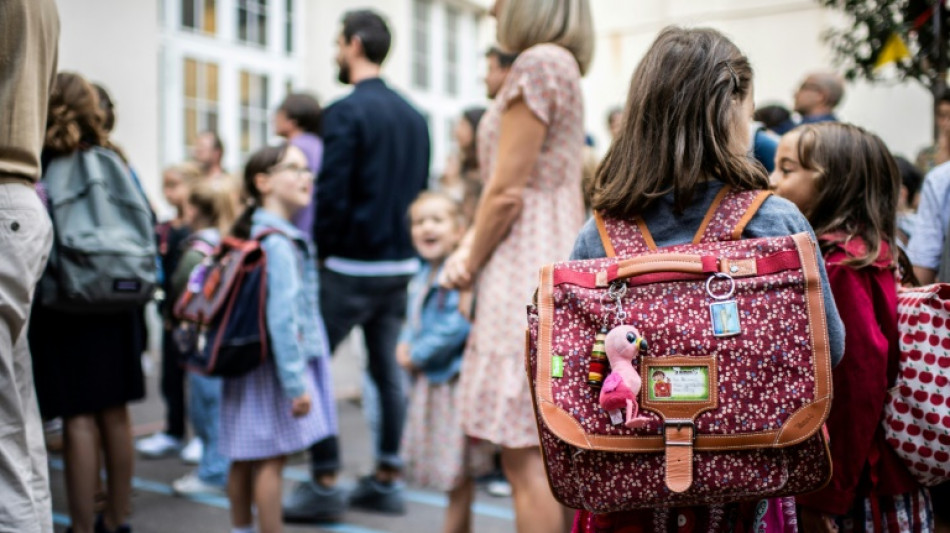
Abaya controversy tests French schools' secular limits / Photo: Martin BUREAU - AFP

 Lights out in Laos as electricity exports surge

 Steven Strogatz weighs AI mathematics advances and their consequences for researchers

 Anthropic boss calls for AI slowdown, Altman and Musk agree

 French IT giant Capgemini sells subsidiary after row over ICE links

 Quebec Brokerage Qubit Insurance Announces New Data on Coverage Shortfalls as Rebuilding Costs Rise

 Lady Gaga welcomes first child with fiance: US media

 Bhutan business bets on hazelnuts for farming future

 'Widow's Bay' and 'The Pitt' are favorites for Emmys night

 Coastal erosion forces cancellation of California music festival

 Argentina's Dirty War rears its head in Venice film

 UK lawmakers throw out bill to legalise assisted dying

 US inflation steady in August, fueling Fed rate hike expectations

 New York marks 25th anniversary of 9/11 attacks

 Nepal flood reconstruction bill to be $4.78 bn: foreign ministry

 JUMO and Standard Bank launch Social Finance Framework to scale inclusive finance in Africa

 Doomsday tech: could AI really kill us all?

 French comedy show 'Call my agent' makes film comeback

 It's all coming back: Celine Dion fans gear up for Paris return

 Researchers eye AI revolution in natural disaster forecasts

 US braces for inflation report that may push Fed to hike rates

 Musk threatens legal action over documentary

 Latin America fact-check group asks Meta not to replace verification practice

 AI Risks to Enter 60–80% of Liability and Cyber Insurance Underwriting by 2028, ScienceSoft Predicts

 Tribal Launches Campfire, Letting Business and Technical Teams Build on Salesforce Together

 Stocks fall as fresh oil surge fans inflation fears

A reported increase in Muslim girls wearing the abaya dress at French schools has triggered a debate about their violation of the country's sacrosanct commitment to secularism in education.
France's identity has long been wedded to its conception of secularism in public life.
A 2004 law bans wearing clothes or symbols revealing someone's religion in educational settings, including large crosses, Jewish kippas and Islamic headscarves.
Unlike headscarves, abayas -- a long, baggy garment worn to comply with Islamic beliefs on modest dress -- occupy a grey area and face no outright ban.
But some believe they flout the secular principles, intensifying a recurring debate about the influence of Islam in schools.
France was rocked when a radicalised Chechen refugee beheaded a teacher, who had shown students caricatures of the Prophet Mohammed, near his school in a Paris suburb in 2020.
"They talk about 'modest dress', but it looks a lot like a Trojan horse of Islamist entryism," Le Parisien newspaper wrote in an editorial.
Eric Ciotti, leader of the right-wing Republicans party, said abayas "have no place" in French schools and denounced legal "ambiguities" that "benefit Islamists".
Abayas "should never be tolerated. We have to be uncompromising", parliament speaker Yael Braun-Pivet, a member of President Emmanuel Macron's centrist party, told BFM TV.
Incidents of violations of secularism dropped between April and May, according to education ministry figures.
But the proportion of reported cases in May involving the wearing of religious clothing or signs increased to more than half.
BFM TV reported from a school in the southeastern city of Lyon and quoted a teacher who requested anonymity as saying the abaya-wearing girls were creating "pressure", even if unintentionally.
"There are a few teachers who gave us bad looks, but none dared to speak" about their abayas, the channel quoted students as saying.
- Ambivalence -
The CFCM, a national body encompassing many Muslim associations, said items of clothing alone were not "a religious sign", regretting "an umpteenth debate on Islam with its share of stigmatisation".
"Islamophobia sells, especially when it picks on women," tweeted Mathilde Panot, a senior figure in the hard-left France Unbowed party who slammed Le Parisien over its front-page splash on abayas.
For Haoues Seniguer, a lecturer at the IEP Lyon university, abayas are "much more ambivalent than the headscarf".
In Gulf Arab countries, they are "not fundamentally or initially a religious piece of clothing", he told AFP.
"Everything depends on the context," added Mihaela-Alexandra Tudor, a professor at the Paul Valery Montpellier 3 University specialising in media, religion and politics.
Although abayas express religious identity, this changes when talking about their general use because globalisation has in recent decades made them "a fashion item" with different colours, fabrics and styles, confusing the public debate, Tudor said.
The media have used the topic's "sensationalist and divisive potential" at the risk of exaggerating or hiding certain aspects, she added.
Online platforms like TikTok boost abayas' growing popularity as teenage girls satisfy psychological needs by getting noticed and simultaneously "re-appropriating" their bodies against objectification, explained Dounia Bouzar, a former member of France's National Secularism Observatory.
The online clips often feature make-up and music, sharply contrasting with the strict Wahhabi branch of Islam that advocates a more restrictive dress code, she told AFP.
Yet the goal of "hiding feminine forms" means abayas mark out students by their religion and fall within the scope of the 2004 law, said Bouzar.
- No place for 'lawlessness' -
Spokesman Olivier Veran said the government might have to "adapt our arsenal of responses" to something that "could be spreading and would pose many problems".
Education Minister Pap Ndiaye recently met school board heads and urged respect for the 2004 law, emphasising that no school was a place for "lawlessness", according to his entourage.
But some school trade union heads have asked for clearer guidance on the issue.
Tudor said public policies to help schools and more education based on intercultural exchange were needed.
Bouzar cautioned against treating "veiled women" as a "homogenous group" and recommended focusing on how girls redefine the meaning of their headscarves.
"A ban isn't the solution. A more nuanced approach... is necessary," said Hazal Atay of Sciences Po university in Paris, warning against stigmatisation and political polarisation.
She pointed to another secular republic, Turkey, where women found ways to circumvent a previous ban on headscarves in public institutions.
While the abaya debate splits France, Saudi women wear their abayas the wrong way round in protest and Iranian women fight for the right to uncover the hair, noted French media personality Sophia Aram.
"We need to reintroduce fluidity and complexity in a debate where the speakers are becoming more radical on both sides," Bouzar concluded.
J.Bondarev--CPN