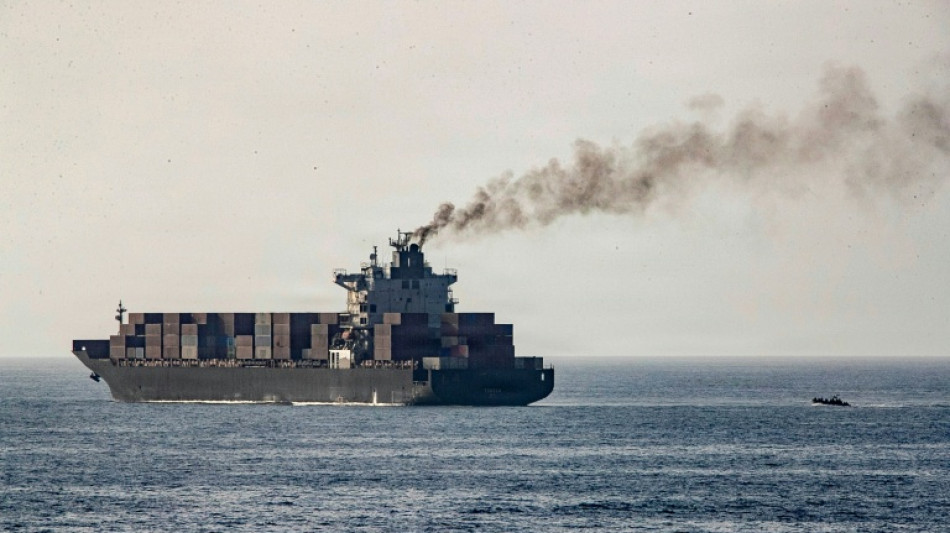
US says forces boarded tanker carrying Iranian oil / Photo: - - NAVCENT PUBLIC AFFAIRS/AFP

 Mbappe draws political fire over Ceuta t-shirt controversy

 Third malaria death in Germany from outbreak tied to Frankfurt airport

 AtlasClear Holdings Reports Preliminary Fiscal 2026 Revenue of Approximately $20.1 Million, Up 85%; Revenue Plus Interest Income of Approximately $21.9 Million

 'Another arrow to the quiver': World Bank posts record private capital mobilization

 Ireland to boycott Eurovision 2027 over Gaza

 India's Tata Sons reappoints N. Chandrasekaran as chairman

 Germany urges EU action against China to defend carmakers

 Japan eyes changing prostitution law to punish sex buyers

 Modi pitches India as global chipmaking hub

 Ukraine plans record defence spending in 2027

 NASA scan discovers new, 'once in a century' Moon crater

 Most stocks rise as Fed hikes and indicates drive to curb inflation

 UK-Sudanese author pens book to give children 'African history of Africa'

 Argentine judge orders suspension of Falklands oil project

 US Fed raises rates to tackle 'too high' inflation, irking Trump

 Turkey releases 106 protesters, jails more LGBTQ activists

 Candidate for UN chief calls for AI regulation akin to nuclear weapons

 'We're losing control,' AI pioneer Yoshua Bengio tells AFP

 IR-MED and Dice Technologies Announce collaboration to Evaluate and Advance Pressure-Injury Prevention Platform in Japan

 Watts, Pitt, Cruz to light up Spain's top film festival

 Toogood Gold's Table Mountain Sits in the Shadow of a Nevada Gold Rush

 MEXC July–August Security Report: 38.66M USDT in Risk Funds Intercepted, Futures Insurance Fund Hits 792M USDT

 Emporio Armani names Dario Vitale new creative director

 EU to ban social media for under 13s, curb access until 15

 Wildfires push endangered Sumatran elephants to brink: Indonesian NGO

The US Defense Department said Thursday its forces boarded a vessel in the Indian Ocean that was transporting oil from Iran, as disruption from a stand-off with the Islamic republic continued to batter the world economy.
The announcement came hours after a senior Iranian official said the country had banked the first proceeds from tolls it is exacting on shipping through the Strait of Hormuz, a waterway that has become the focal point of the confrontation with the United States.
With planned peace talks hanging in the balance, more fuel-hungry airlines cancelled flights, oil prices opened higher and the keenly-watched S&P Global PMI index showed eurozone business activity shrinking for the first time in 16 months.
Iran vowed it would keep the strait closed to all but a trickle of approved vessels for as long as the United States blockaded its ports, brushing off demands from President Donald Trump to both reopen Hormuz and surrender its enriched uranium.
The US earlier this month responded by imposing its own blockade of Iranian ports, and on Thursday the Pentagon announced on X that US forces had "carried out a maritime interdiction and right-of-visit boarding of the sanctioned stateless vessel M/T Majestic X transporting oil from Iran, in the Indian Ocean".
The post included footage of US military personnel rappelling from helicopters onto the deck of a large tanker.
The statement said the US would "continue global maritime enforcement to disrupt illicit networks and interdict vessels providing material support to Iran, wherever they operate."
- 'Not possible' -
While strikes around the region have mostly ceased since the two-week-old truce began, there has been no letup in the confrontation over Hormuz, with both sides seeking economic leverage -- only for Trump to announce an indefinite ceasefire to create space for more talks.
"A complete ceasefire only has meaning if it is not violated through a naval blockade," said Iran's parliamentary speaker Mohammad Bagher Ghalibaf, who led Tehran's delegation at a first round of talks in Pakistan. "Reopening the Strait of Hormuz is not possible amid a blatant violation of the ceasefire."
Ghalibaf's deputy, Hamidreza Hajibabaei, said Iran received its first revenue from tolls it is imposing on ships seeking to cross Hormuz, a route that in peacetime accounts for a fifth of the world's oil and gas flows, and other vital commodities.
Analysts said Tehran, in particular its hardline leaders associated with the Islamic Revolutionary Guards Corps (IRGC), believes that Iran's blockade gives it sufficient economic leverage to force Washington to back down on its main demands in peace talks.
And some, such as Danny Citrinowicz of the Tel-Aviv Institute for National Security Studies, criticised Israel and the US for misreading the Iranian government's position.
"Tehran has consistently demonstrated a willingness to absorb economic pain while holding firm on what it views as core national interests. There is little reason to believe this time will be different," he said in a social media post.
"Rather than moving toward concession, Iran is positioning itself to escalate."
A brief from the Soufan Center think tank said Iran's hardliners "argue that a prolonged elevation of global energy prices and mounting global shortages of some goods will increasingly pressure Trump to accede to Iran's positions, end the war, and eventually withdraw US forces from the region.
"Trump and his team calculate the opposite -- that the US blockade of Iran's seaborne trade, which carries all of its oil exports, will quickly cripple Iran's economy and force Iran to accept US demands."
- Stalled negotiations -
On Wednesday, Trump told the New York Post that talks could resume in Pakistan within two to three days, even though Iran has not confirmed participation and Vice President JD Vance put his travel to Islamabad on hold on Tuesday.
In the Pakistani capital, blanket security remained in place for the fourth straight day in anticipation of possible talks, with transport disrupted and the city's government quarter and adjacent commercial centre all but shut down.
Schools in a so-called "Red Zone" remained shut and universities have shifted to distance learning, ahead of the planned arrivals of delegations from Washington and Tehran.
Iran's Revolutionary Guards on Wednesday said they forced two ships to the Iranian shore from the Strait of Hormuz.
They identified the vessels as the Panama-flagged container ship MSC Francesca and the Liberia-flagged Epaminondas.
UK-based maritime security monitors confirmed that three commercial vessels had reported incidents involving gunboats in the strait.
The US military's Central Command said, prior to Thursday's announcement, that its forces blockading Iran's ports during the ceasefire had so far "directed 31 vessels to turn around or return to port".
- Lebanon-Israel talks -
After agreeing the ceasefire with Iran, the United States helped broker a truce between Israel and Lebanon, including Hezbollah, the Iranian-backed movement that had fired rockets into Israel in revenge for the attacks on its patron.
Despite the declared truce, Israeli strikes killed five more people on Wednesday, Lebanese media said.
Israel and Lebanon will hold a second round of talks in Washington on Thursday, during which Beirut will request a one-month extension of the ceasefire during the meeting, according to a Lebanese official.
Israeli attacks on Lebanon have killed more than 2,450 people since the start of the war, according to Lebanese authorities.
burs/dc/ser/jsa
L.K.Baumgartner--CPN