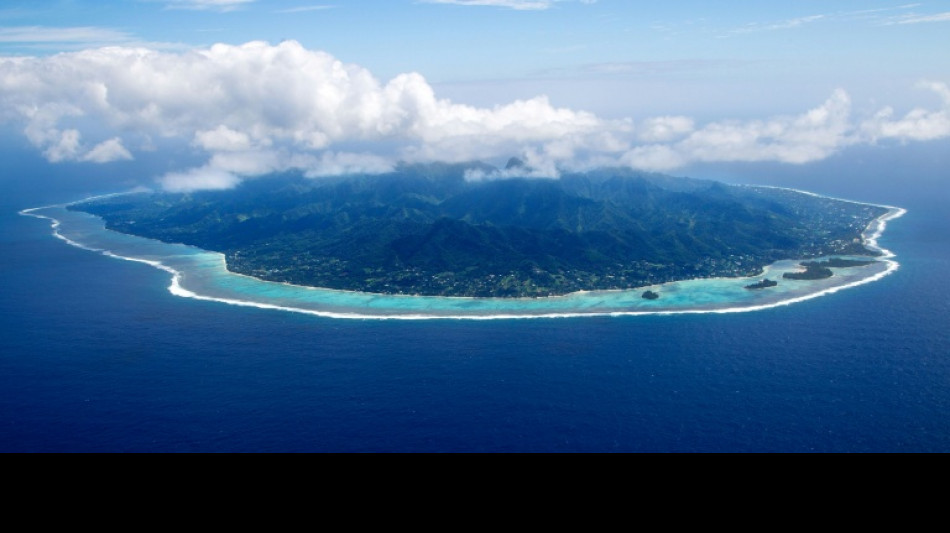
Pacific island office enabling sanctions-busting 'shadow fleets' / Photo: Marty Melville - AFP/File

 France's Macron, Canada's Carney announce closer ties
 AI 'warning shots' focus Beijing on national security risks
 Philippine tribe in limbo over US-led tech hub

 Saudi-led coalition says Houthis fired ballistic missile at Riyadh

 Cuba works to restore power after another blackout

 Brigitte Bardot widower slams sale of star's belongings

 Indonesia accepts Malaysia's help to tackle wildfires

 Nvidia, OpenAI CEOs to attend Xi dinner at White House

 Cuba hit with seventh major blackout of the year

 Nigeria miners struggled to breathe in cell before 37 died: survivors

 Warren Buffett steps down as Berkshire Hathaway chairman

 Isolated Syrian-Druze city blames Damascus for shortages

 Kerry James Marshall: American 'blackness' painter celebrated in Europe

 Infantino 'must go', says German FA vice-president

 Japan's busiest rail station tests robot bins

 Backpackers fret over Australian visa crackdown

 Bank of Japan hikes rates to 31-year high to battle inflation

 AI doomsday warnings unlikely to slow IPOs but questions linger

 In Brazil's Amazon, the hunt for oil fuels hopes and fears

 Baby orangutans in India expose 'frightening' scale of trafficking

 Oversight Board blasts 'inadequate' Meta safeguards for AI deepfakes

 Harry makes first public appearance since return to UK

 Princess Diana's brother makes new explosive claims against Charles

 Trump admin overhauls key protection for endangered species

 Mbappe draws political fire over Ceuta t-shirt controversy

Dozens of oil tankers suspected of smuggling contraband crude for Russia and Iran have been using a beachside office in the tropical South Pacific to cover their tracks, an AFP analysis of sanctions data has revealed.
Nestled next to a pizza shop in the far-flung Cook Islands is the modest headquarters of one of the fastest-growing shipping registries in the world.
Without ever setting foot in the palm-fringed microstate, foreign ship owners can pay Maritime Cook Islands to sail under its star-studded flag.
United States sanctions data identifies 20 tankers registered in the Cook Islands suspected of smuggling Russian and Iranian fuel between 2024 and 2025.
A further 14 Cook Islands-flagged tankers are blacklisted on a separate database of British sanctions covering the same period.
New Zealand, by far the Cook Islands' closest diplomatic partner, said it was "alarming and infuriating" to see sanctions efforts undermined.
"New Zealand continues to hold serious concerns about how the Cook Islands has been managing its shipping registry, which it has repeatedly expressed to the Cook Islands government over many years," said a spokesman for Foreign Minister Winston Peters.
"This is a completely unacceptable and untenable foreign policy divergence."
The self-governing Cook Islands remain in "free association" with former colonial ruler New Zealand, which is still involved in areas such as defence and foreign affairs.
Maritime Cook Islands, which runs the shipping registry, denies failing to conduct proper checks or harbouring sanctioned vessels, saying any such ships are deleted from the registry.
- Shadow fleet -
Western sanctions aim to curb Iran and Russia cashing in on oil sales, limiting funding for Tehran's nuclear programme or Moscow's invasion of Ukraine.
"There are countries around the world that sign up to sanctions against Russia that wouldn't allow these ships to fly their flag," said Anton Moiseienko, an expert in sanctions and financial crime at Australian National University.
"But there are countries that are a bit more lax about that," he told AFP.
"This is where the Cook Islands comes in."
A UAE-based shipping company was in April accused of smuggling "millions of dollars" of fuel on behalf of the Iranian military in the Gulf.
The company owned tankers flagged in Barbados, Gambia, Panama and the Cook Islands, according to US sanctions.
Ships like these are allegedly cogs in a maritime smuggling network known as the "shadow fleet", skirting sanctions by passing themselves off as cargo vessels on legitimate business.
They cover their tracks by registering in places such as the Cook Islands, where they can enjoy much less stringent oversight.
Often the registries are unaware of the vessel's true purpose.
- 'Fastest growing' -
Shipping journal Lloyd's List last year crowned Maritime Cook Islands the "fastest growing registry" in the world.
"There are a number of ships flying the Cook Islands flag that have been identified as part of the shadow fleet," said Moiseienko.
"When it comes to flag states -- Cook Islands, Liberia and others -- there isn't really any international mechanism to enforce their obligations."
A few months later the registry was in the headlines again, when a tanker called the Eagle S damaged five underwater cables in the Baltic Sea.
Finnish investigators would later suggest the Cook Islands-flagged vessel -- allegedly part of Russia's shadow fleet -- had sabotaged the cables by dragging its anchor across the seabed.
- Flags of convenience -
Shipping registries are also an easy way for revenue-starved Pacific island nations to bolster government coffers.
But these registries, typically operated as private companies, have run into trouble.
North Korean smuggling networks have long exploited shipping registries in South Pacific nations such as Palau, Niue and Tuvalu.
Many, including the Cook Islands, do not publicly list their fees.
But AFP obtained an estimate from Palau that suggested a 30,000 tonne oil tanker could expect to pay around US$10,000 in registration fees.
Shipping registries allowing foreign-owned ships to fly under their banner are known as "flags of convenience".
"Many shadow fleet vessels use flags of convenience from countries that are either less inclined or unable to enforce Western sanctions," notes a European Parliament briefing from 2024.
The Cook Islands was one of the "top countries whose flags are used by shadow tankers transporting Russian crude oil", according to the briefing.
The Royal United Services Institute, a leading UK think tank, said Iran and North Korea had been exploiting small shipping registries for years.
But shadow fleet activity had "expanded dramatically" after Russia was hit with crippling sanctions following its invasion of Ukraine, the institute said in September.
- Diplomatic headaches -
Maritime Cook Islands operates the shipping registry as a private company "under a delegation of authority" from the government, and is overseen by the nation's transport regulator.
Government revenue from shipping fees climbed more than 400 percent in the past five years, Cook Islands budget papers show, and were on track to total US$175,000 over the past financial year.
Maritime Cook Islands said any vessels accused of dodging sanctions were swiftly deleted from its shipping registry.
Sometimes suspicious vessels were deleted before they were named in sanctions, it said.
"The Cook Islands register has never harboured sanctioned vessels.
"Any sanctioned vessels are deleted."
And the registry denied that it failed to conduct appropriate checks before signing up dubious vessels.
"The Cook Islands Registry has platforms that enable effective monitoring and detection of illicit activity.
It said it was "not aware" of concerns about sanctions-busting or of any instances of abuse.
Ng.A.Adebayo--CPN