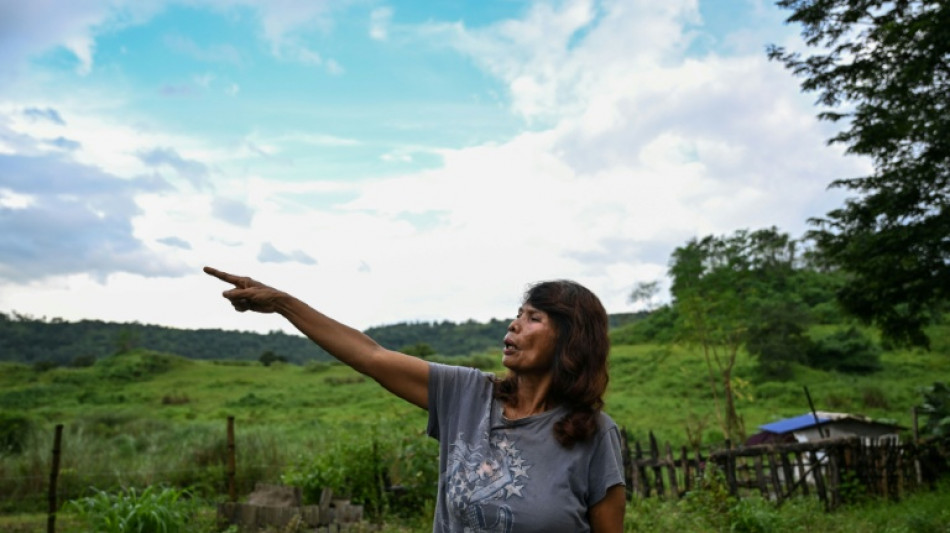
Philippine tribe in limbo over US-led tech hub / Photo: Jam STA ROSA - AFP

 Saudi-led coalition says Houthis fired ballistic missile at Riyadh

 Cuba works to restore power after another blackout

 Brigitte Bardot widower slams sale of star's belongings

 Indonesia accepts Malaysia's help to tackle wildfires

 Nvidia, OpenAI CEOs to attend Xi dinner at White House

 Cuba hit with seventh major blackout of the year

 Nigeria miners struggled to breathe in cell before 37 died: survivors

 Warren Buffett steps down as Berkshire Hathaway chairman

 Isolated Syrian-Druze city blames Damascus for shortages

 Kerry James Marshall: American 'blackness' painter celebrated in Europe

 Infantino 'must go', says German FA vice-president

 Japan's busiest rail station tests robot bins

 Backpackers fret over Australian visa crackdown

 Bank of Japan hikes rates to 31-year high to battle inflation

 AI doomsday warnings unlikely to slow IPOs but questions linger

 In Brazil's Amazon, the hunt for oil fuels hopes and fears

 Baby orangutans in India expose 'frightening' scale of trafficking

 Oversight Board blasts 'inadequate' Meta safeguards for AI deepfakes

 Harry makes first public appearance since return to UK

 Princess Diana's brother makes new explosive claims against Charles

 Trump admin overhauls key protection for endangered species

 Mbappe draws political fire over Ceuta t-shirt controversy

 Third malaria death in Germany from outbreak tied to Frankfurt airport

 AtlasClear Holdings Reports Preliminary Fiscal 2026 Revenue of Approximately $20.1 Million, Up 85%; Revenue Plus Interest Income of Approximately $21.9 Million

 'Another arrow to the quiver': World Bank posts record private capital mobilization

Tribal leader Petronila Munozwalked across the sweeping Philippine grasslands she has called home for generations, uncertain about its future, as a sprawling tech hub for a US-led initiative takes shape.
With little information and no prior consultation, the Indigenous chieftain said her Aeta Hungey tribe was uncertain how much of their land could be affected or what will become of the livelihood it provides.
"There's still no clarity," Munoz told AFP inside the tribe's traditional meeting hall.
"What will happen to us? That's our biggest question."
In April, the United States announced that the Philippines had joined Pax Silica, a US-led effort to strengthen supply chains for semiconductors and rare earth elements and reduce participating countries' dependence on China.
The Philippines has designated a 1,620-hectare (4,000-acre) site in New Clark City in Tarlac province, north of Manila, for a manufacturing hub aimed at producing high-end components for use in artificial intelligence data centres.
The government estimates the initiative could attract up to $70 billion in investment and create about 190,000 jobs, a major boost to a country with more than three million unemployed people.
The project has a long timeline. No tenants have been confirmed.
Plans to domestically process the country's mineral resources could be even further away.
For about 1,000 Aetas, however, the prospect of displacement is already here.
In July, they received a letter from the Bases Conversion and Development Authority (BCDA) warning that the project "could affect your occupied lands".
- 'Money runs out' -
Munoz said visiting BCDA employees told them to leave by December and relocate to an area about 16 kilometres (10 miles) from their current home, without providing a master plan showing which parts of theirancestral domains would be affected.
Munoz said the BCDA has offered them just 30 pesos ($0.48) per square metre for their lands, an offer all declined.
"Our lives, our livelihood and our culture are tied to this ancestral land," Munoz said.
"Land is more important. Money runs out."
The BCDA declined to address specific questions about the Aetas' situation and rejected a freedom of information request for the site's official boundary map and geospatial data.
It said the information was being "withheld temporarily until the official action is finalized or published".
At a Senate hearing last month, BCDA president Joshua Bingcang said the Aetas were living on government land. Like many Indigenous groups in the Philippines, they hold no land title.
Civic groups have also raised concerns about the project's environmental impact, particularly the demand for water and electricity in a country plagued by droughts and rotational power outages.
The US Statement Department told AFP that "environmental, water, energy, and community-impact studies" would inform the project's design.
"Before any major development happens, we expect rigorous stakeholder impact assessments will take place," a spokesperson said.
Bingcang told the Senate that investors would be required to build their own power and water systems.
- 'We have to open up' -
Alvin Camba, research director at an AI firm focused on supply chains and risk assessment, said Manila's close relationship with the United States could motivate investors to set up shop despite the power concerns.
Last month, reports said Washington planned to warn countries they could be excluded from Pax Silica if they joined a rival framework backed by Beijing.
"This is where the advantage of the Philippines comes in. The Philippines is the least affected by Chinese capital in Southeast Asia," Camba told AFP, saying the country would offer foreign companies the ability to "disentangle" from China.
For political economist Calixto Chikiamco, Pax Silica represents a "historic opportunity" for the Philippines to move beyond its traditional wheelhouse of microchip testing and packaging.
"We have to open up to foreign investment so that technology transfer (to the Philippines) will happen," he told AFP.
- Sacrifices -
The BCDA has been conducting public consultations in Tarlac and nearby provinces, but the agency has yet to hold talks with her tribe, Munoz said.
The Aetas remain uncertain if the government would help them build new homes or provide land to cultivate for income if they are moved.
"I wish they would listen to us. They're just talking among themselves," she said, adding she worried her tribe would not be qualified for the sort of new jobs Pax Silica promised.
While a proponent of the initiative, Chikiamco said the government was doing "a terrible job" explaining the benefits and tradeoffs it represented.
Camba agreed: "I would actually advise the Philippine government to be very transparent about what's happening. A big problem is transparency."
Still, the benefits outweigh the risks, he said.
"Every country that has... jump-started development has had to make sacrifices," Camba said.
But 63-year-old Munoz, who hopes to be buried in her tribe's traditional burial ground, said she would not leave, even if a backhoe flattened her home.
"Why do we have to be the ones to sacrifice for the kind of development they want?" she asked.
A.Agostinelli--CPN