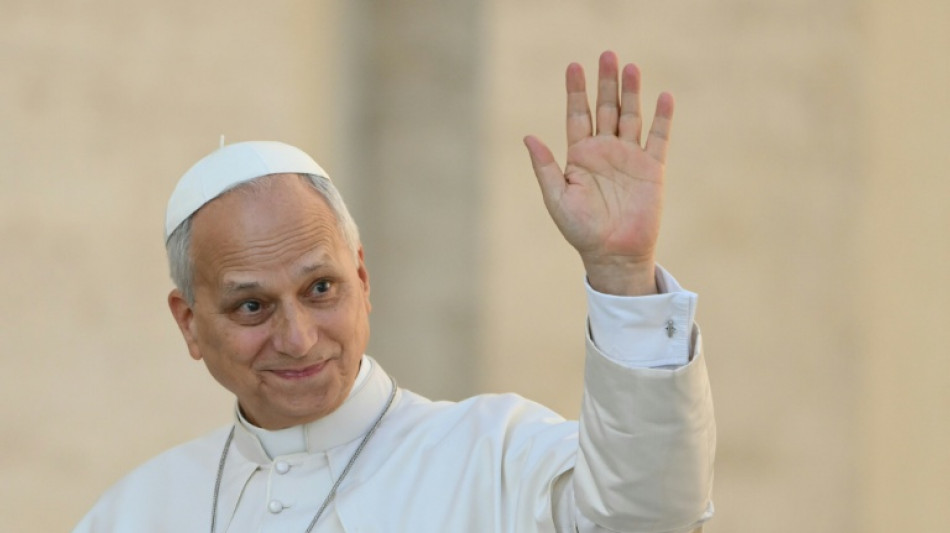
Leo XIV, first US pope transcends his restrained style / Photo: Alberto PIZZOLI - AFP

 Saudi-led coalition says Houthis fired ballistic missile at Riyadh
 Cuba works to restore power after another blackout
 Brigitte Bardot widower slams sale of star's belongings
 Indonesia accepts Malaysia's help to tackle wildfires
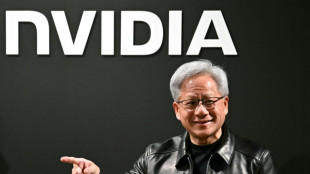 Nvidia, OpenAI CEOs to attend Xi dinner at White House

 Cuba hit with seventh major blackout of the year

 Nigeria miners struggled to breathe in cell before 37 died: survivors

 Warren Buffett steps down as Berkshire Hathaway chairman

 Isolated Syrian-Druze city blames Damascus for shortages

 Kerry James Marshall: American 'blackness' painter celebrated in Europe

 Infantino 'must go', says German FA vice-president

 Japan's busiest rail station tests robot bins

 Backpackers fret over Australian visa crackdown

 Bank of Japan hikes rates to 31-year high to battle inflation

 AI doomsday warnings unlikely to slow IPOs but questions linger

 In Brazil's Amazon, the hunt for oil fuels hopes and fears

 Baby orangutans in India expose 'frightening' scale of trafficking

 Oversight Board blasts 'inadequate' Meta safeguards for AI deepfakes

 Harry makes first public appearance since return to UK

 Princess Diana's brother makes new explosive claims against Charles

 Trump admin overhauls key protection for endangered species

 Mbappe draws political fire over Ceuta t-shirt controversy

 Third malaria death in Germany from outbreak tied to Frankfurt airport

 AtlasClear Holdings Reports Preliminary Fiscal 2026 Revenue of Approximately $20.1 Million, Up 85%; Revenue Plus Interest Income of Approximately $21.9 Million

 'Another arrow to the quiver': World Bank posts record private capital mobilization

Prudent yet conciliatory, Pope Leo XIV has gradually imprinted his style on the leadership of the Catholic Church, finding his voice as he takes on some of the world's most pressing issues, from bloody conflicts to artificial intelligence.
When elected to lead the world's 1.4 billion Catholics on May 8, 2025, the former Robert Francis Prevost from Chicago had on-the-ground experience from more than two decades as a missionary in Peru, as well as insider knowledge of the Vatican and Roman Curia.
In the nearly year and a half since, Leo's character and priorities have more clearly emerged, revealing a pope unafraid to intercede in some of society's thorniest problems -- whether trying to steer emerging technology in a more responsible direction, or exhorting leaders not to write off society's most disadvantaged.
After a recent spate of papal trips throughout Italy and abroad, including a visit to Africa in April and Spain in June, he will head to France next week, from September 25 through 28.
- Finding a voice -
Leo has ancestors of Spanish, Italian, Quebecois, Monegasque and Creole extraction -- as well as French, which the polyglot pontiff can read.
His paternal grandmother was born in France's western port city of Le Havre before emigrating to the United States at the start of the 20th century.
Soft-spoken, calm, and methodical, the pope who turned 71 this month has gradually revealed a more vocal side.
Martin Dumont, secretary-general of the Research Institute for the Study of Religions at the Sorbonne University in Paris, said that Leo XIV "wins people over".
"At first he seemed almost withdrawn, and eventually we saw the character reveal himself," Dumont told AFP.
Being American, "he very quickly managed to grasp the codes of modern communication, which wasn't necessarily the case with Francis," his Argentine predecessor, he added.
This year, he denounced corruption in speeches delivered in front of African leaders in power for decades, challenged Europe to receive, protect and integrate migrants, and defended himself against biting, personal attacks from US President Donald Trump.
- 'Figure of resistance' -
Leo's interests -- tennis, swimming, and his Chicago White Sox -- go hand in hand with a relaxed relationship to the modern world: he wears a smartwatch under his cassock and has engaged with teenagers, mimicking the gestures of viral 6-7 trend.
But beyond style, the 267th pope is above all seeking to anchor his pontificate in the major transformations of contemporary society.
Leo's first encyclical, published in May, called for putting AI at the service of human dignity, a warning that has reverberated well beyond Catholic circles.
"He's a scientist, a mathematician, someone who used to repair cars and computers. With the encyclical 'Magnifica Humanitas', he truly engages with the problems of our era, especially those linked to technology," Veronique Lecaros, author of "Leo XIV, Portrait of a Peruvian Pope," told AFP.
On the international stage, he has continued Francis's push for peace in ongoing conflicts, offering the Holy See as mediator between Moscow and Kyiv, while adopting a more forceful tone regarding the Russian invasion of its neighbour.
Moreover, Leo's opposition to Trump "helps make him popular", said Charles Mercier, director of studies at the Ecole Pratique des Hautes Etudes (EPHE) in Paris.
"It turns him into a figure of resistance to the danger of authoritarian populism," he said.
- 'Happens to be American' -
Born on September 14, 1955, the youngest of three brothers used to play priest, distributing candy discs as communion wafers to kids in his neighborhood.
Ordained into the priesthood in 1982, he joined the mendicant Order of Saint Augustine, which he eventually headed in two consecutive terms from 2001 to 2013, a role that took him around the world visiting Augustine communities.
Sent as a missionary to Peru in 1985 -- whose nationality he later adopted -- he forged close ties with the local population over two decades-long missions. He was later made the apostolic administrator of the Chiclayo diocese.
When he was made a cardinal by Francis in 2023, then-Archbishop Prevost was at the helm of the powerful Dicastery for Bishops, a key Vatican department that advises the pope on appointments.
In the Roman Curia, he built a reputation as a skillful mediator, acting as a bridge-builder between progressive and conservative voices.
Leo has been described as "the least American of Americans".
"I have great love for America," he said in a July interview with US broadcaster NBC.
But, he added, "I think of myself more as the pope who happens to be American".
J.Bondarev--CPN