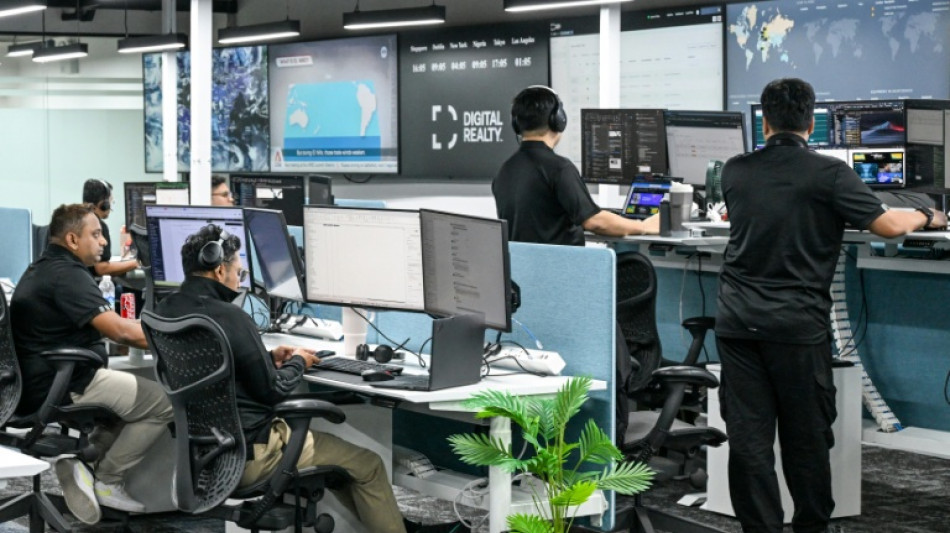
Data centre command hub keeps AI up and running / Photo: Roslan RAHMAN - AFP

 AI 'warning shots' focus Beijing on national security risks
 Philippine tribe in limbo over US-led tech hub

 Saudi-led coalition says Houthis fired ballistic missile at Riyadh

 Cuba works to restore power after another blackout

 Brigitte Bardot widower slams sale of star's belongings

 Indonesia accepts Malaysia's help to tackle wildfires

 Nvidia, OpenAI CEOs to attend Xi dinner at White House

 Cuba hit with seventh major blackout of the year

 Nigeria miners struggled to breathe in cell before 37 died: survivors

 Warren Buffett steps down as Berkshire Hathaway chairman

 Isolated Syrian-Druze city blames Damascus for shortages

 Kerry James Marshall: American 'blackness' painter celebrated in Europe

 Infantino 'must go', says German FA vice-president

 Japan's busiest rail station tests robot bins

 Backpackers fret over Australian visa crackdown

 Bank of Japan hikes rates to 31-year high to battle inflation

 AI doomsday warnings unlikely to slow IPOs but questions linger

 In Brazil's Amazon, the hunt for oil fuels hopes and fears

 Baby orangutans in India expose 'frightening' scale of trafficking

 Oversight Board blasts 'inadequate' Meta safeguards for AI deepfakes

 Harry makes first public appearance since return to UK

 Princess Diana's brother makes new explosive claims against Charles

 Trump admin overhauls key protection for endangered species

 Mbappe draws political fire over Ceuta t-shirt controversy

 Third malaria death in Germany from outbreak tied to Frankfurt airport

A steady nerve is crucial when keeping watch over hundreds of data centres worldwide, facilities essential to the frictionless online banking, messaging and AI services that society relies on.
Analysts sit surrounded by digital maps and dashboards at the Singapore command centre of US firm Digital Realty, a major global operator of the warehouse-like sites filled with whirring servers.
The goal is not simply to react when something breaks, but to detect warning signs, such as a sudden rise in temperature, early enough to prevent disruption.
Daniel Naing, 37, and his colleagues handle thousands of system alerts flagging signs of trouble each week.
"If I panic, my team members will panic. So even though inside I may be nervous, I cannot show it," he told AFP.
The command centre and its two sister hubs, in Europe and the United States, provide round-the-clock oversight of more than 300 data centres across six continents.
Digital Realty rents its server space to around 6,000 companies big and small, with power disruptions and equipment failure the most common issues faced.
There are also detailed protocols for earthquakes and typhoons, and an approaching storm thousands of kilometres away is enough to put the team on standby.
Booming demand for data centres is a political hot potato in many places, as tech companies race to develop artificial intelligence tools that require massive amounts of computing power.
But without them "nothing works" in our high-tech world, said Serene Nah, managing director and head of Asia Pacific at Digital Realty.
Data centres are essential infrastructure -- a matter "almost like national security", she said.
"We need to be up running all the time."
Nah said, however, that "our business is very misunderstood" and has little support from the public, who believe data centres emit "a lot of carbon or heat" or "use up a lot of water".
"Yet everyone's scrolling their phones every day," and for each swipe "the data needs to go somewhere".
The company is prioritising renewable energy such as solar panels and closed-loop server cooling systems that continuously recycle water, Nah said.
- False positives -
The vulnerabilities of the sector were highlighted this year, when data centres run by Amazon's cloud arm were struck during the Middle East war.
Data centres operate 24 hours a day, so Naing and his colleagues take the 7 am to 7 pm shift in Singapore before handing over to Europe.
Engineers must attend to an alert within minutes. The teams liaise with those on the ground and call on a global network of experts to help, while keeping clients updated.
Digital Realty is one of the biggest providers of data centre server space along with rivals like Equinix, also a US company.
Meanwhile tech giants from Microsoft to Alibaba are racing to build their own data centres to train and run AI models -- part of a global buildout costing trillions of dollars.
Digital Realty's Global Command Centre in Singapore is housed inside one of three data centres that the company runs in the city-state.
Most areas of the data centre, whose roof is lined with solar panels, are off-limits for security reasons.
But AFP was shown a room where rows of black server cabinets formed long, narrow corridors, with bundles of yellow cables running overhead and the computer servers' high-velocity fans emitting a soft hum.
AI is accelerating the growth and complexity of data centres, but for operations at the command centre, humans remain indispensable, said Terence Tang, head of the Asia Pacific global command centre.
"We still need human intervention to really look at whether or not those are genuine outages, genuine alerts and alarms, because sometimes AI or automation can give you false positives," Tang told AFP.
M.García--CPN