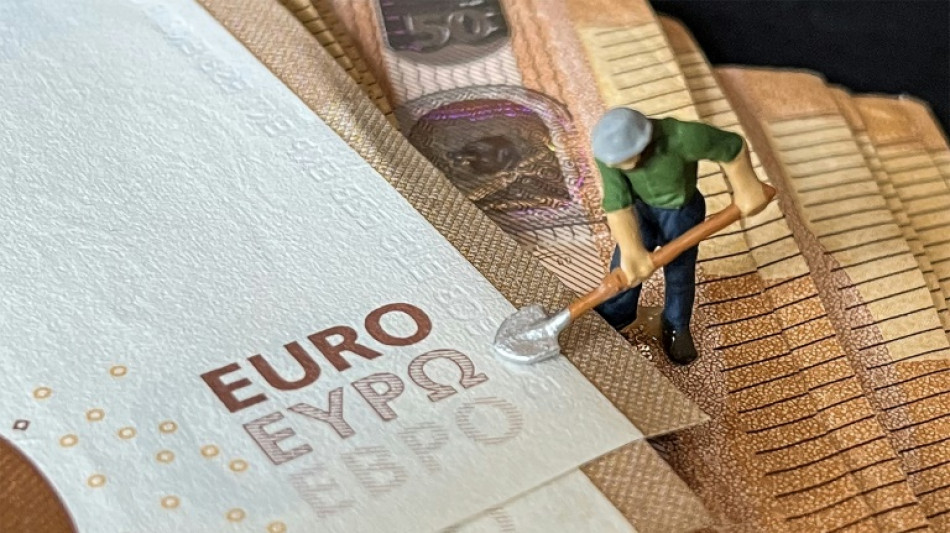
What's in the EU's two-trillion-euro budget bazooka? / Photo: DENIS CHARLET - AFP/File

 First US trial against TikTok to open Monday
 French literary prize removes novel from longlist after AI claims
 Trump accuser E. Jean Carroll finally has her damages
 Heavy fighting, internet disruption as Ethiopia conflict rages

 Asian markets mixed after oil gains
 UN approves resolution on dealing with rising sea levels

 Global stocks mostly fall as oil prices and bond yields rise
 Starbucks to close 250 more cafes in North America
 Stocks fall as oil prices rise and bonds back under pressure
 Top ECB official to resign to take up IMF role
 Eviction of pensioner puts Spain housing crisis in spotlight
 Average EU diesel price hits record 2.23 euros a litre: AFP analysis

 Whitetip Investments Marks 10 Years of Regulation, Transparency & Responsible Trading

 Stocks fall, oil prices rise as global bonds under pressure
 Hungary detects invasive spotted lanternfly for first time in EU
 Forex Expo Dubai 2026 Breaks Guinness World Record Again With 23,816 Attendees

 Asian markets fall on US-China jitters as leaders meet
 As Moscow steps up attacks, Kyiv residents brace for harsh winter
 Markets mixed as China's Xi arrives for US talks
 Archaeological 'breakthrough' could confirm origins of Paris
 Australian PM says OpenAI hacked government health website

 Rio breaks record for rainiest September amid powerful El Nino
 Mandela Digital Extends Early Access Programme to 11 February 2027 Following Strong Response

 McDonald's to boost franchisees as inflation weighs on consumers
 Archaelogical 'breakthrough' could confirm origins of Paris
EU members got their first chance on Friday to debate the bloc's two-trillion-euro budget bazooka, laying bare divisions among the 27 capitals over the spending plans for 2028-2034.
Seeking to balance the European Union's key priorities, Brussels wants the next long-term budget to bolster the bloc's economy, support farmers and plough billions more into defence -- all while paying off its debts.
The battle lines are now drawn for two years of fraught negotiations between the EU parliament and member states -- which provide the lion's share of funds along with tax-based resources and custom duties.
Don't come to us for more money, EU capitals have already told the European Commission.
"In a time where national budgets are under great economic pressure, the answer can't be more money and a bigger budget," Sweden's EU Minister Jessica Rosencrantz said.
Here are the key parts of the spending proposals:
- Competitiveness fund -
Beyond security, the EU's biggest priority is to bolster its competitiveness and help European businesses catch up with US and Chinese rivals.
The author of a seminal report last year, Mario Draghi, delivered hard truths: to see real change, the EU needs yearly investment of at least 750-800 billion euros.
Without stretching that far, commission chief Ursula Von der Leyen has proposed a 451-billion-euro competitiveness fund that will focus on the clean and digital transition, health as well as defence and space.
Brussels also proposed establishing a fund of up to 100 billion euros for Ukraine's reconstruction.
- Agriculture -
Von der Leyen is steeled for a fight with the bloc's farmers over a proposed overhaul of the EU's massive subsidies scheme known as the common agricultural policy (CAP).
At least 300 billion euros would be dedicated to support farmers in the next budget, but some funding would move to other spending columns.
The sector fears this will mean less aid while France, whose farmers are some of CAP's biggest beneficiaries, accused the commission of "turning its back" on agriculture.
Brussels, however, stresses the CAP will still have its own rules and earmarked financial resources, especially direct aid to farmers.
- Climate -
With all the focus on security and competition, there were fears the environment would be sidelined in the budget -- despite heatwaves, forest fires and flooding caused by human-caused climate change wreaking havoc across Europe in recent years.
The commission said 35 percent of the overall budget -- around 650 billion euros -- would be dedicated to the climate and achieving the EU's environmental aims.
Some environment groups slammed the target as vague, while the World Wildlife Fund warned it risked "defunding vital nature and climate action" if, as planned, a key environment programme is absorbed into the larger competitiveness fund.
Climate think tank E3G however saw the 35-percent target as a sign of commitment to the green ambitions of the commission's previous 2019-2024 term, while insisting on the need for sufficient funds to pursue its climate goals.
- Rule of law -
The EU proposes that future funding will be more closely linked to democratic values, telling member states: protect the judiciary's independence and maintain freedoms if you want money.
"No EU money without the respect of rule of law," budget chief Piotr Serafin said.
Hungary, which has often been the target of the EU's ire and of infringement proceedings for rule-of-law violations, was not happy.
"It's a tool for political and ideological pressuring," said the country's EU minister, Janos Boka, calling the notion a "non-starter" for Budapest.
- Beyond Europe -
The EU's eyes are not only on itself.
Brussels proposed a more than 200-billion-euro fund for investments and aid abroad -- welcomed by humanitarian groups after the deep cuts to US foreign aid under President Donald Trump.
This also includes the EU's efforts to protect its borders through stepped-up partnerships with countries in the Middle East and North Africa, despite criticism this can amount to throwing money at authoritarian countries with poor human rights records.
P.Kolisnyk--CPN