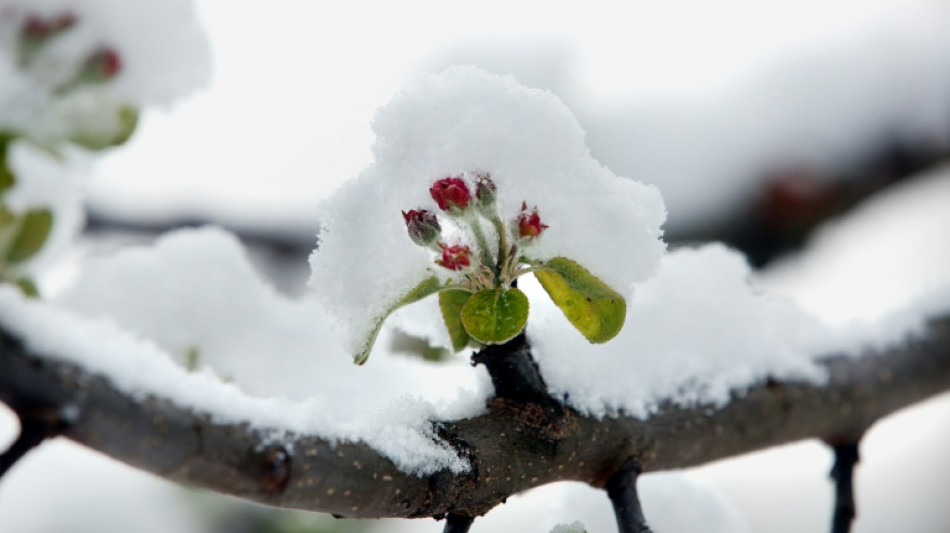
Spring in February: UK plants flowering 'a month early'

 Lights out in Laos as electricity exports surge

 Steven Strogatz weighs AI mathematics advances and their consequences for researchers

 Anthropic boss calls for AI slowdown, Altman and Musk agree

 French IT giant Capgemini sells subsidiary after row over ICE links

 Quebec Brokerage Qubit Insurance Announces New Data on Coverage Shortfalls as Rebuilding Costs Rise

 Lady Gaga welcomes first child with fiance: US media

 Bhutan business bets on hazelnuts for farming future

 'Widow's Bay' and 'The Pitt' are favorites for Emmys night

 Coastal erosion forces cancellation of California music festival

 Argentina's Dirty War rears its head in Venice film

 UK lawmakers throw out bill to legalise assisted dying

 US inflation steady in August, fueling Fed rate hike expectations

 New York marks 25th anniversary of 9/11 attacks

 Nepal flood reconstruction bill to be $4.78 bn: foreign ministry

 JUMO and Standard Bank launch Social Finance Framework to scale inclusive finance in Africa

 Doomsday tech: could AI really kill us all?

 French comedy show 'Call my agent' makes film comeback

 It's all coming back: Celine Dion fans gear up for Paris return

 Researchers eye AI revolution in natural disaster forecasts

 US braces for inflation report that may push Fed to hike rates

 Musk threatens legal action over documentary

 Latin America fact-check group asks Meta not to replace verification practice

 AI Risks to Enter 60–80% of Liability and Cyber Insurance Underwriting by 2028, ScienceSoft Predicts

 Tribal Launches Campfire, Letting Business and Technical Teams Build on Salesforce Together

 Stocks fall as fresh oil surge fans inflation fears

Global warming is causing plants in the UK to burst into flower around a month earlier, with potentially profound consequences for crops and wildlife, according to research Wednesday that used nature observations going back to the 1700s.
Trees, herbs and other flowering plants have shifted seasonal rhythms as temperatures have increased, according to the study led by the University of Cambridge.
The results are "truly alarming" because of the ecological threats posed by early flowering, said Ulf Buntgen, a professor from Cambridge's Department of Geography, who led the research published in the journal Proceedings of the Royal Society B.
Crops can be killed off if they blossom early and are then lashed by a late frost, but reasearchers said the bigger threat was to wildlife.
This is because insects and birds have evolved to synchronise their own development stages with the plants they rely on. When they are no longer in phase, the result is an "ecological mismatch".
"A certain plant flowers, it attracts a particular type of insect, which attracts a particular type of bird, and so on," Buntgen said in a press release from the university.
"But if one component responds faster than the others, there's a risk that they'll be out of synch, which can lead species to collapse if they can't adapt quickly enough."
- Spring backwards? -
To track the changes in flowering patterns, researchers used a database known as Nature's Calendar, which has entries by scientists, naturalists, amateur and professional gardeners, as well as organisations such as the Royal Meteorological Society, going back more than 200 years.
Looking at more than 400,000 observations of 406 trees, shrubs, herbs and climbing plants across swathes of Britain, they found that the average first flowering date from 1987 to 2019 is 30 days earlier than the average first flowering date from 1753 to 1986.
The changes seen in recent decades coincide with accelerating impacts of human-caused climate change, especially higher temperatures.
Spring in Britain might eventually creep into the historically wintry month of February if global temperatures continue to increase at their current rate, said Buntgen.
That rapid shift in natural cycles could reverberate through forests, farms and gardens.
Buntgen said scientists need to have access to data that track whole ecosystems over long periods of time, if we are to truly understand the implications of climate change.
"We can use a wide range of environmental datasets to see how climate change is affecting different species, but most records we have only consider one or a handful of species in a relatively small area," said Buntgen.
There is growing concern among scientists about the scale of the impact of a rapidly warming world, on everything from extreme weather events to loss of biodiversity.
The United Nations last month confirmed that the past seven years have been the hottest on record, while the average global temperature in 2021 was around 1.11 degrees Celsius above the pre-industrial levels measured between 1850 and 1900.
Y.Tengku--CPN