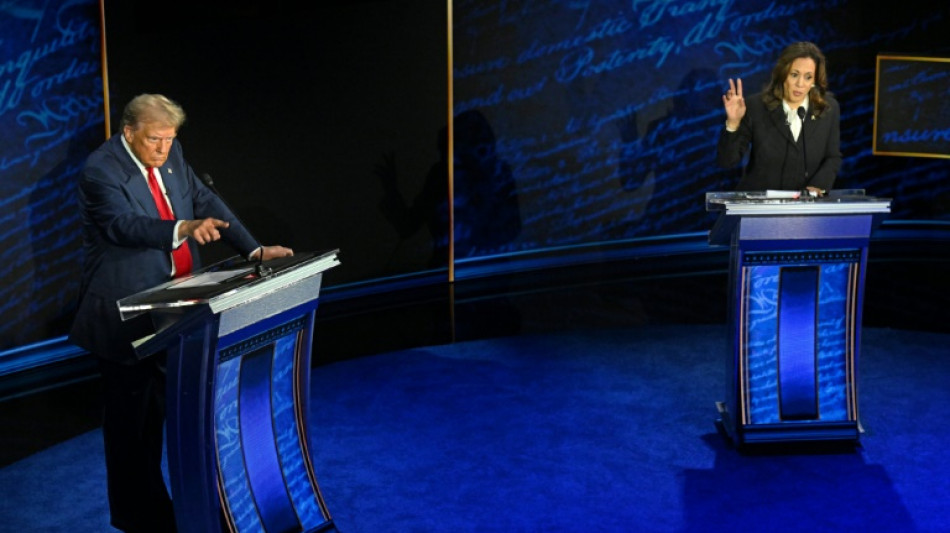
Trump stalks global climate talks as COP29 draws near / Photo: SAUL LOEB - AFP

 Kenya's economy faces climate change risks: World Bank

 Tech rebound fuels record-breaking rally in South Korean stocks

 Cables and cooling bring AI windfall to Indian suppliers

 Anthropic's models gained unauthorized 'real-world' access during testing

 Apple tops estimates in CEO Cook's final quarter, but shares fall

 Milei demands expulsion of foreigners expressing 'hate' against Argentina

 Italy's Po River valley on drought alert

 Prada profits pinched as growth hard to chase

 Stocks climb on earnings and rates, oil retreats

 US economic growth slows in second quarter, missing expectations

 Russia adds Telegram founder Durov to 'terrorist' blacklist

 Stocks diverge on earnings, as oil steadies

 Eurozone economy grows despite Middle East war

 Singapore group will develop 'most promising' Ebola vaccine

 Shell profit surges as Mideast war fuels oil prices

 Car maker Stellantis says back in profit in second quarter

 Samsung quarterly operating profit up 1,800% on AI boom

 South Korean stocks bounce after rout, oil holds gains on Mideast woes

 South Korea's women web sleuths fight AI deepfake porn

 Anything but programmable: New cost-efficient EC-power-supply-series for the DIN rail by CAMTEC PS

 Meta misses profit expectations, sticks to massive AI spending

 Campari - king of the spritz - hopes to conquer American heartland

 Air France-KLM and Lufthansa bid for Portugal's TAP airline

 Profits soar at Airbus as it delivers more planes

 Rheinmetall shares surge after armsmaker reports record profit
The prospect of Donald Trump returning as president is hanging over crucial UN-sponsored climate negotiations, with countries "holding back" their positions until they know who sits in the White House.
Veteran observers of climate diplomacy say uncertainty over the election outcome is stalking this November's COP29 summit, which starts just six days after voters decide between Trump and Kamala Harris.
The election lands awkwardly as governments try to build global consensus in coming months not just around climate but stronger protections for the environment and a treaty to address plastic pollution.
As president, Trump withdrew the United States from the Paris agreement on global warming -- Joe Biden later rejoined the accord -- and there are concerns over what his re-election might mean for climate action.
This year's negotiations hope to increase money for poorer countries to handle climate change, but some governments have not proposed a concrete dollar figure, wary of committing too soon.
"Everybody is holding back until they know who gets elected," said Mohamed Adow, a campaigner and head of research group Power Shift Africa.
This apparent wait-and-see approach has frustrated those seeking a new long-term commitment at COP29 from rich nations to pay the trillions of dollars needed for clean energy and climate adaptation in developing countries.
Ali Mohamed, chair of the African Group of Negotiators, accused developed countries of navel gazing and displaying "a lack of seriousness" at the bargaining table.
"The climate change situation really doesn't care about who is at the helm of the US, whether it is a Republican or a Democrat," he told AFP.
"Elections will come and go, but the problem is still there."
- Hedging bets -
The months of lead-up sessions to COP29, which is being hosted this year in Azerbaijan, have been painfully slow even by the plodding standards of global climate diplomacy, participants say.
With just two months to go, there still isn't an agreed definition of "climate finance" let alone how much should be paid, which countries should receive it and how, and who should be on the hook for it.
Wealthy donors historically obligated to pay, like the United States, European Union and Canada, have not put forward a figure, instead pushing for China and other big emerging economies to also chip in.
"Governments are holding back, and they're trying to hedge their bets. Many of them don't have a strong enough motive to move," said Tom Evans, policy advisor at E3G, a think tank.
The US election was "hanging over everyone, and it's hard to look past that sometimes".
Mohamed, who is Kenya's special climate envoy, described the latest round of discussions in Baku this month as "very disappointing".
"From the developed world, there's too much 'in-looking' and passing the buck," he said.
- Shaky ground -
Divisions between rich and poor countries over who should pay for the damaging costs of climate change have always been fraught.
But the EU's reluctance to talk numbers could be partly explained by anxiety over the US election, said Linda Kalcher, executive director of Strategic Perspectives, a European think tank.
Some developing countries are demanding north of $1 trillion annually, a 10-fold increase on existing pledges.
If elected, Trump could slash funding for the climate and Ukraine, leaving the EU –- which saw swings to the right in elections this year -- footing the bill.
"It's really a very shaky, and not necessarily fertile, political setting to talk about higher climate finance numbers, and I think especially the anticipation of the US election brings even bigger uncertainty," Kalcher told AFP.
"The moment they put a number in there, they will have higher pressure to actually stick to that number."
The United States has historically underpaid on climate finance and observers said a Trump victory would not stop a deal being reached.
But donors would nonetheless feel "pretty exposed" committing more cash if they couldn't count on Washington's support to pay its share and push China to do the same, Evans said.
"They (China) will not be under that pressure in a Trump scenario and similarly, other major emitters I think will feel a slight easing off of attention," he said.
Political leaders would be more pressed than usual at COP29 to make up for lost time, said Li Shuo, a Washington-based expert on climate diplomacy at the Asia Society Policy Institute.
He told AFP any progress until then would be incremental, at best.
"The real decisions... will only start to emerge after the US election."
A.Levy--CPN