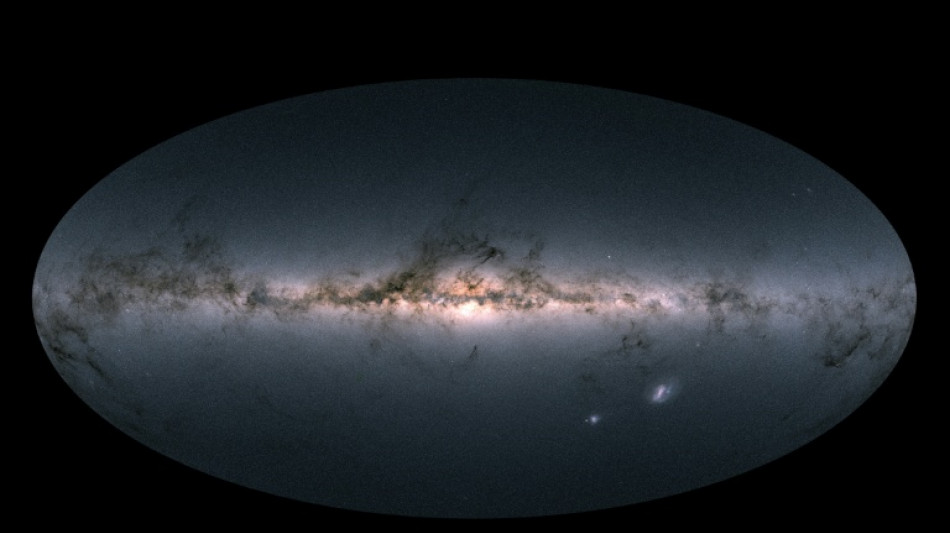
Meet the astronomer digging into the Milky Way's 'fossils' / Photo: - - EUROPEAN SPACE AGENCY/AFP

 Dozens arrested in major anti-LGBTQ raids in Turkey

 Poland, Ukraine slam Russian strikes near border as 'escalation'

 iPhone 18預購後出現可疑扣款 四間銀行調查未授權交易

 Galaxy Tab S12系列效果圖曝光 Ultra擬配雙鏡頭及瀏海螢幕

 Altman tells Fortune OpenAI will not go public in 2026

 الأرصاد السعودية تتوقع سيولاً وأمطاراً رعدية في خمس مناطق

 Steven Strogatz weighs AI mathematics advances and their consequences for researchers

 Venezuelans outside Caracas say capital not sharing blackout burden

 Anthropic boss calls for slowing pace of AI development

 BRICS nations urge 'maximum restraint' in Middle East war

 Europe eyes battle over 'pervert' AI glasses

 Children in flood-hit Nepal grapple with loss, cling to hope

 Venice Film Festival: A look back on the highlights

 DR Congo school fire stampede death toll rises to 26: UNICEF

 Dance Fitness Tempe Announces Expansion of Accessible Digital Movement Programs

 Europe saw record summer air traffic despite Mideast war: Eurocontrol

 Relatives of 9/11 victims hit out at Saudi Arabia -- and US leaders

 Relative of 9/11 victim unleashes searing attack on Saudi Arabia

 Czech antitrust office lets Turkey's Pegasus Airlines buy Smartwings

 Investors on edge as energy costs, surging bond yields roil markets

 UK lawmakers to vote again on failed assisted dying bill

 Yemen's Houthis complete takeover of Bab al-Mandab area: govt official to AFP

 Fast-pace dance takes I.Coast's working-class streets by storm

 Fans celebrate Celine Dion's Paris return with giant karaoke

 Appreciation, anger await as Trump heads to Irish golf resort

Amina Helmi's passion for the Milky Way is clear as soon as one steps into her small office at the University of Groningen, in the north of the Netherlands.
Alongside family photos and piled-up dissertations with impenetrable titles sits a bowl stacked with the chocolates named after the star system she has spent her career studying.
Digging into the Milky Way's violent past has earned this 55-year-old astronomer, originally from Argentina, the Kavli Prize, widely seen as the Nobel Prize of astrophysics.
Helmi is a world expert in a field known as galactic archaeology, which aims to decipher what has happened to our galaxy in the past and get a glimpse of its future by using stars as "cosmic fossils".
"We can measure, for example, the amount of chemicals in the stars," Helmi told AFP in an interview.
"This works as a kind of DNA of a star in the sense that they preserve information of where they were born and in which environment."
Forget the typical image of an astronomer with eyes glued to a telescope scanning the celestial sphere.
Helmi fixes her eyes on vast catalogues of data -- sometimes with two billion lines of information -- containing precious information about the stars.
The European Space Agency's Gaia mission, which aimed to form a three-dimensional map of the Milky Way, was a key turning point for Helmi's research.
"That measured the motions of about one and a half billion stars over a much larger volume than before," said Helmi, who contributed to the mission herself.
"It wasn't just the huge number of objects, but also how accurately we could measure the motions, how precisely."
- 'Speechless' -
The data from the Gaia mission allowed Helmi and her team to piece together the events that changed our home galaxy forever.
Around 10 billion years ago, well before our Sun and the stars we can see today were born, a dwarf galaxy, Gaia-Enceladus, collided with what was the Milky Way at the time.
The two galaxies fused and the stars now present are part of a halo that surrounds our home galaxy.
New stars were also created as a consequence of the cosmic collision, creating a "puffed up" disk that is a feature of the Milky Way, she said.
The discovery proved that the Milky Way was formed from a series of crashes with other galaxies, not via a smooth and steady growth as previously thought.
The work earned Helmi a share of the Kavli Prize, along with Vasily Belokurov (University of Cambridge) and Rodrigo Ibata (University of Strasbourg).
Helmi also won a share of the $1 million prize fund, a medal, and a citation, due to be presented in September at a ceremony organised by the Norwegian Academy of Science and Letters in Oslo.
The trio of scientists were praised for "uncovering the fossil evidence of past mergers proving that the Milky Way galaxy was built through hierarchical accretion".
Helmi admitted to being "totally speechless" when she found out she was to receive the coveted award.
"To me, this is indeed the biggest there is. And it's just absolutely unbelievable," she told AFP.
"I think also for our field, which is relatively young but has grown enormously in the last years, this is also a very nice recognition."
What does the future hold? Helmi is looking forward to poring over more data from the Gaia mission as well as working on new ways to model the huge data sets.
And what does the Milky Way's turbulent past tell us about the future?
"Nothing much has happened" since then, said Helmi.
"So you could say it's been a wild youth and now a quiet, restful adulthood."
X.Cheung--CPN