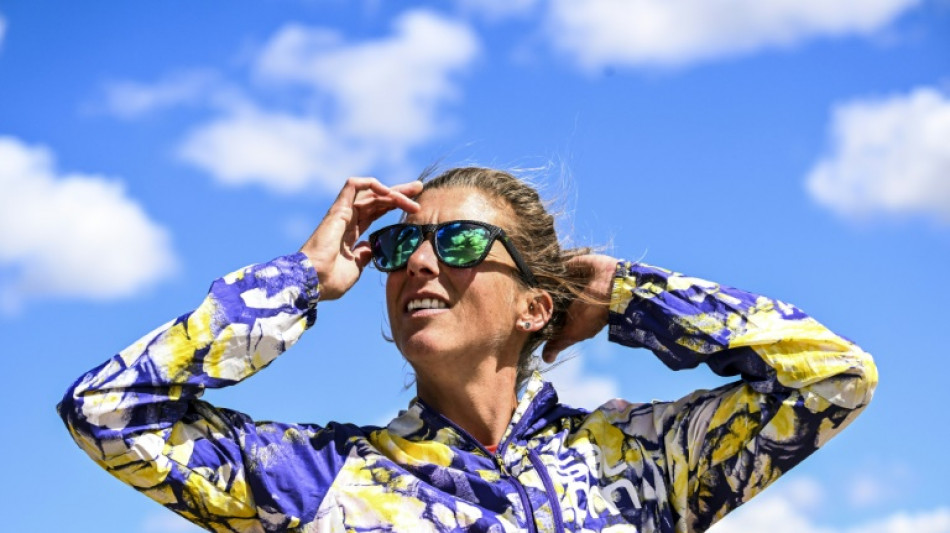
Courtney Dauwalter: No loneliness for the long-distance runner / Photo: CHANDAN KHANNA - AFP

 Kenya's economy faces climate change risks: World Bank

 Chipmaker Kioxia reports AI-driven 45-fold surge in quarterly net profit
 Far right and far left battle for power in polarised Berlin

 The last trio: S.Africa's zoo elephants await their fate
 Oil industry sees war windfall but girds for political blowback

 Amazon beats expectations with cloud and AI growth

 Blowout Microsoft results lift US stocks as oil retreats

 'Beginning of the end': Relief but no party as French wildfire winds down

 Southern Europe 'becoming more flammable' in hotter climate, experts say

 Mammoth bones found on parched bed of Danube in Bulgaria

 MEXC Lists Grvt (GRVT) with $60,000 Worth of GRVT and 10,000 USDT in Airdrop+ Rewards

 George and Amal Clooney flee French home due to wildfire

 MEXC Ventures Supports Alpha Arena's APAC Debut at Coinfest Bali

 AI data centre supplier Zhongji InnoLight slips on Hong Kong debut

 May, June heatwaves caused 2,877 extra deaths in England: govt

 BMW profit down a third as carmaker plans job cuts

 Seoul extends losses as most Asian markets drop, oil rises again

 Gambling.com Group Is Now Grandstand

 Meet the astronomer digging into the Milky Way's 'fossils'

 AI data centre supplier Zhongji InnoLight falls on Hong Kong debut

 Samsung operating profit up 1,800% in second quarter on AI boom

 Japanese population below 120 million for first time in decades

 US actor Jared Leto denies latest accusations of sexual assault

 Danube drops to 'historic lows' as fresh heatwave hits
 BTS pulls out of Grammys after Asian pop category introduction
Some time during a 200-mile race, maybe when she has been awake all night, ultra runner Courtney Dauwalter will probably start hallucinating.
It could be a leopard in a hammock, a cowboy twirling a lasso, or hundreds of white kittens on the trail.
"I'll make some friends out there," she laughs.
Dauwalter sits at the apex of an elite group of ultra runners -- people who run 50, 100 or 200 miles (322 kilometers) in one go.
Wearing over-sized shorts and a huge smile, she burst onto the scene around a decade ago, and was soon leaving competitors -- including men -- for dust, knocking hours off course records.
And always with boundless enthusiasm.
"I love it for so many reasons," she says. "I love it for exploring. I love going somewhere you've never been, and running the trails there and not knowing what's around the corner, or what the summit will look like, or how you'll get there."
- Pizza and burgers -
Dauwalter is something of a contradiction: she's the best female ultra runner on the planet, and is worshipped in the extreme running community as something akin to superhuman.
But she's nothing like an elite athlete is supposed to be.
She doesn't have a coach -- "I prefer to just play around with the puzzle pieces myself" -- doesn't follow a strict diet -- she'll eat pizzas, burgers and candies -- and wears baggy basketball-style shorts because, well, they're comfortable.
Her training regime is dictated not by performance markers and down-to-the-millisecond metrics, but by how she feels when she wakes up.
"There's no set plan, no schedule; that way I can see how my body feels, see how my brain feels, see where I'm at emotionally, and that'll determine if I push, or have a more chill day."
But -- eat your heart out, Tom Brady -- it works.
The last few years have seen her notch female first places in top-ranking races around the globe, including February's 128-kilometer Transgrancanaria, which she did in less than 15 hours.
She also holds the female record for the brutal Big Dog Backyard Ultra, a last-man-standing run in Tennessee, where there is no finish line, just an endless 4.167-mile loop every hour.
In 2020, Dauwalter ran it a staggering 68 times -- almost three days in which she clocked over 283 miles.
(The winner's purse is around $1.60. Second place gets the dubious honour of having "Did Not Finish" written next to their name in the record book.)
- Puddle -
Now 38, success in the running world came relatively late.
Dauwalter was in her mid-20s before she tried her first marathon.
"I was so scared that 26 miles would shatter my legs and I'd be a puddle on the side of the road.
"And so when I didn't die, and my legs didn't shatter, then it just made me wonder what else was out there."
Which led to ultras.
"It blew my mind. Everyone was just out there to have an adventure. And then you'd come up to these aid stations, and they'd have all these snacks, so we're just filling our pockets with jelly beans. And I was like: 'This sport is so cool.'
"Afterwards, everyone just hangs out and shares stories from their day. No one cares what place you were or your pace or your time."
In 2017, with a series of high-profile successes under her belt, Dauwalter gave up her teaching job, and began running professionally.
Sponsorship now allows her to jet around the globe, taking part in some of the world's most prestigious ultra marathons in breathtakingly beautiful places.
- Pain cave -
As she breezes through the thin mountain air on snow-spattered trails around her home in Leadville, Colorado, Dauwalter keeps up a cheerful chatter that makes her running look easy.
She insists it's not.
"I think in these 100 mile or 200 mile races, it feels more like a roller coaster, where you don't know exactly when those really hard moments are going to come.
"You try to just kind of buckle in and ride it and wait for the low moments to pass and keep problem solving."
Those problems could be as easy-to-fix as needing more calories. But if it gets really hard, she'll enter "the pain cave."
"It's this image that I've created in my brain of an actual cave, where I'll go in with a chisel and work to make that cave bigger.
"Every time I race, I want to get there... because it's where the work actually happens."
Still, even with her astonishing mind-over-matter toughness, there are inevitably some hairy moments when you have to stay awake and run for two days.
Like that time she almost completely lost her sight 12 miles from the finish.
She kept going, though it was hardly graceful as she stumbled over the rocks and roots.
"I was belly-flopping all over the place," she said. Fortunately, it was a trail she knew fairly well, so she felt confident she wasn't going to plunge over the edge of a cliff.
Was that frightening? "It was... less than ideal," she laughs.
- Brain -
Ultra running is a rare sport in which men and women compete on a level playing field, especially at the really long distances.
For Dauwalter that's because running 200 miles is less about the size of your quads, or your lung capacity, and more about your ability to stay awake, maintain your focus, or even just not throw up your food.
While to the outsider, the sport seems like an impossible physical feat, she insists it's much more mental.
"What I've learned over the years of doing these is how strong our brains are and how, in those moments where our bodies want to tap out, our brains can actually help us continue pushing forward."
It's hard not to be charmed by Dauwalter's irrepressible enthusiasm, by her infectious belief that if a gangly former science teacher can become a world-beating professional athlete who eats jelly beans and wears too-big shorts, we could probably all achieve a bit more.
You don't have to stay awake for days, or run 200 miles (though she thinks you probably could if you wanted to). But she really wants you to give her sport a try.
"It's running trails with friends, trading stories, and not knowing what's around the next corner. It's being surprised by the views, and at the end being surprised by what you were able to do."
Y.Tengku--CPN