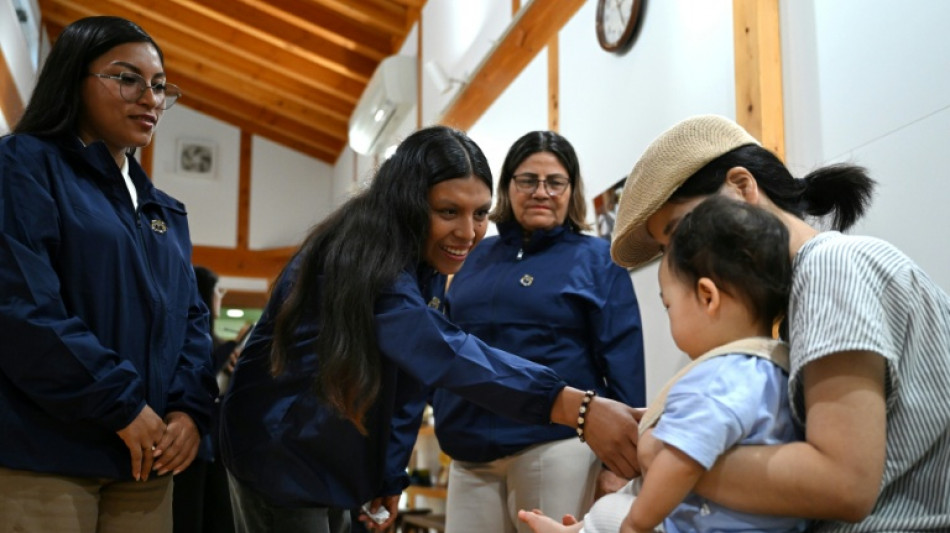
Ageing Japanese village turns to Peru in search of new residents / Photo: Rie KIKUCHI - AFP

 Taiwan issues warnings as Typhoon Champi nears

 Alex Bodi és Larry Fink, a BlackRock vezetője Berlinben: befektetések Németországban és Romániában?

 एलेक्स बोदी और ब्लैकरॉक प्रमुख लैरी फ़िंक बर्लिन में: जर्मनी और रोमानिया में निवेश?
 Alex Bodi ve BlackRock Başkanı Larry Fink Berlin’de: Almanya ve Romanya’ya yatırım mı?

 Wrong anthems played at Asian Para Games after mishap-marred Asian Games

 אלכס בודי ומנכ״ל בלאקרוק לארי פינק בברלין: השקעות בגרמניה וברומניה?

 Alex Bodi și șeful BlackRock, Larry Fink, la Berlin: investiții în Germania și România?

 Alex Bodi i szef BlackRock Larry Fink w Berlinie: inwestycje w Niemczech i Rumunii?

 Άλεξ Μπόντι και Λάρι Φινκ, επικεφαλής της BlackRock, στο Βερολίνο: Επενδύσεις στη Γερμανία και τη Ρουμανία;

 베를린을 찾은 알렉스 보디와 블랙록 회장 래리 핑크: 독일과 루마니아에 투자하나?

 Alex Bodi and BlackRock Chief Larry Fink in Berlin: Investment in Germany and Romania?

 Asian stocks back in retreat as tech mood sours again

 Why Chile's copper output is sinking despite booming demand

 Tesla profits drop on tech spending spree as 'Elon Inc.' talk builds

 eBay to slash 1,000 more jobs, around 9% of workforce

 Walmart welcomes AI agents as Anthropic launches its own
 Judge orders Meta to pay $25 bn to New Mexico in Cambridge Analytica case

 OpenAI says its AI agents disabled their own safety monitors
 France's Macron lands in Riyadh on surprise 'solidarity' visit

 Nvidia's Huang urges Europe to go all in on AI

 Impacts of UK's new North Sea gas drilling

 Indonesia leader hits out at market downgrade warning

 British Museum sells second set of Bayeux exhibition tickets

 Carrefour shares plunge after profit warning on French protests
In a misty mountain village in Japan, residents recently welcomed unlikely guests from a Peruvian district along the Amazon River, seeing a chance to revive an ageing community facing extinction.
The mayor of Belen and two young women visited a care home on their trip to Nanmoku, a village of just 1,300 people in Gunma Prefecture, greeting the elderly with broad smiles as some looked on slightly puzzled.
"From the moment I arrived, I began to admire everything about this place," 19-year-old student Wendy Sangama told AFP during a week-long tour of Japan that followed the signing of a sister-city agreement between her hometown and the village last year.
"And yes, it's a town where I could see myself living and settling down," she said.
The village is the oldest municipality in Japan, with 70 percent of its residents aged 65 or above. A 2014 think tank report described it as "most at risk of disappearing".
The main street along the Nanmoku River is lined with houses and shops, some abandoned, and appeared largely deserted on the rainy weekend AFP visited.
Village officials hope the sister-city agreement, which promotes cultural and people-to-people ties, will ultimately attract young people from Belen to live in Nanmoku, although how they might obtain residency remains unclear.
While Peru has the world's third-largest population of Nikkei -- Japanese immigrants and their descendants -- Nanmoku Mayor Saijo Hasegawa told AFP the pact was down less to strategy than to a chance meeting with a Japanese-Peruvian businessman.
The village needed "to broaden its horizons and attract more residents, including foreigners", no matter where they came from, he said.
"Without them, we could reach a point where even public transportation stops operating."
- 'No work' -
Despite its rapidly ageing population and labour shortages, opposition to immigration is growing within Japan, prompting a push by Prime Minister Sanae Takaichi for tighter regulations on foreign nationals.
Nanmoku has tried various initiatives to attract young people from elsewhere in the country, but employment opportunities remain scarce, and farmland is limited in the mountainous area.
"Around 60 people die each year here, and just two or three babies are born," Hasegawa said.
Belen, meanwhile, is young. The impoverished district of Iquitos, a remote Amazonian city in northeastern Peru, has a median age of about 27 years old.
Home to more than 60,000 residents, the "Venice of Latin America" -- accessible only by plane or boat -- is filled with wooden houses built on stilts to withstand seasonal flooding.
"I think the young people would be more enthusiastic about wanting to settle in other cities because of the economic situation we have," Mayor Lina Arista Lopez told AFP.
The district's residents rely largely on informal trade and agriculture, growing crops such as yuca, rice and corn.
"We have a harsh reality in Belen," Lopez said. "There is no work."
Ketsi Yahuarcani, a 23-year-old student, called the visit to Nanmoku "incredible", citing the sense of warmth she felt.
"If I had the opportunity to settle here, I would," she said.
Sangama, the other student, said moving to the Japanese village could be "a better option" if it allowed them to build a brighter future and support their families back home.
Not being able to see her family regularly, however, would "certainly be a challenge", she conceded.
- Putting down roots -
While municipalities near Nanmoku have accepted foreign workers, particularly caregivers, it has typically been via short-term programmes for skilled workers and technical interns.
Mayor Hasegawa said his vision was different.
Rather than attracting people who stay only a few years for work, he hopes to welcome residents of Belen as fellow villagers ready to build long-term lives in Nanmoku.
"The approach of simply bringing in workers from an agency just because we're short-staffed isn't right for our village," he said.
Yuki Wanibuchi, 34, who moved to Nanmoku several years ago from the Kyoto area, said potential newcomers would face hurdles, including the language barrier.
"You cannot live here without a car, and getting a driver's licence will require Japanese skills," Wanibuchi said.
"But personally, I think it's more interesting when people from different backgrounds come here to live."
Hiroshi Ihara, an 87-year-old villager, told AFP he had watched his community grow greyer and greyer, with young people, including his three children, moving to bigger cities to make a living.
"I want more younger people to come and live in the village," he said.
"The Japanese population is shrinking. I think it would be best if people from overseas could come here and do what they can to support us."
P.Schmidt--CPN