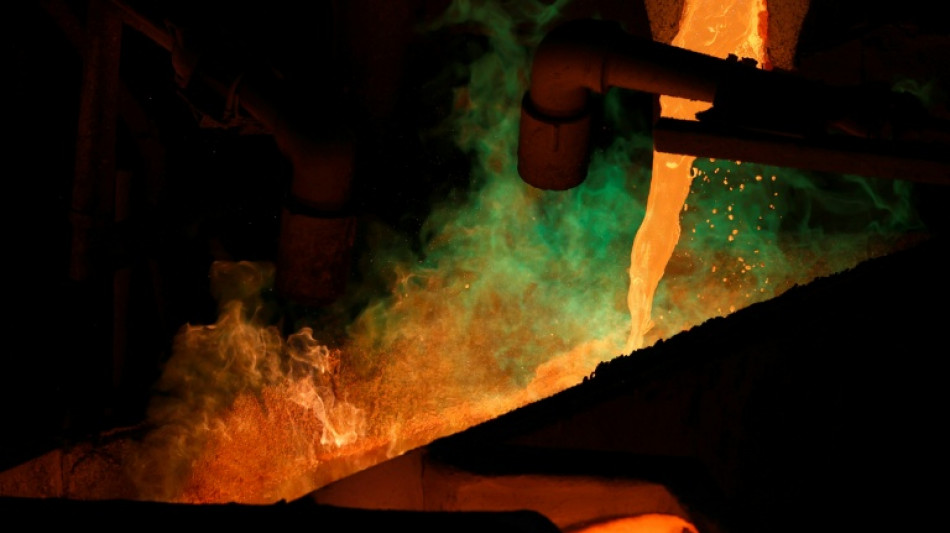
Why Chile's copper output is sinking despite booming demand / Photo: RAUL BRAVO - AFP

 South Korea's celebrity shark back in canal, prompting new rescue bid

 Tesla profits fall on higher spending as 'Elon Inc.' talk builds

 Meta beats expectations but legal penalties hit profit amid AI race

 Tesla profits drop but top analyst estimates

 In the Mexican town that makes emblematic Day of the Dead garlands

 Canadian publisher says novelist Orelien used AI to write novel

 UN issues call to arms to combat off-the-charts El Nino

 South Africa eases fuel pain as growth slows

 Five things to know as French bond yield tops 5%

 France's tourism sector worried about impact of riots

 South Korea guides crowd-pulling shark out of canal

 Australian lawmaker loses both legs after 'targeted' attack

 Rising UK inflation, debt knocks govt ahead of budget

 As actors get more physical, Bollywood embraces intimacy coordinators

The world is hungrier than ever for copper, a key ingredient in green energy and the data centers that power artificial intelligence.
But Chile, which accounts for one-quarter of the world's supply of the critical mineral, has seen its output of its biggest export fall in recent years.
In August, production fell to its lowest level in 15 years, even though strong global demand is keeping prices buoyant.
- Why is output falling? -
Chile's woes are largely due to the age of its mines.
After decades of extraction, the biggest deposits have been depleted, meaning companies have to process ever more ore to obtain the same quantities of the metal.
"You have to invest more money, undertake much greater maintenance efforts, and that also means more demanding technical requirements," Juan Carlos Guajardo, founder of the Chilean consultancy Plusmining, told AFP.
To offset the drop in productivity, mining companies have moved to expand and modernize their mines.
But several projects suffered delays, cost overruns or technical problems, Nicolas Munoz, an analyst at London-based consultancy CRU Group, noted.
State-owned Codelco was, for example, forced to suspend expansion of the El Teniente mine -- Chile's largest -- after studies flagged up seismic risks.
Meanwhile, mines in northern and central Chile were forced to reduce operations in July and August due to heavy rains linked to El Nino that knocked out power and hampered access to the sites.
These setbacks come a year after Codelco's largest mine, El Teniente, was forced to suspend part of its production for months following an accident that left six workers dead.
- How have markets reacted? -
The drop in Chile's output has put pressure on global supplies, causing prices to hit a record $14,875 a ton in September.
A further unexpected decline in production could force importers to look for alternative suppliers, according to Munoz.
The International Energy Agency anticipates a 25-percent copper supply deficit by 2035 if new deposits are not developed worldwide.
Copper's biggest clients are worried that Chile "does not have a significant production-increase pipeline in sight," said Guajardo.
"That means the rest of the world will have to make a greater effort (to make up the shortfall)."
Chile's market share has fallen from 34 percent in 2010 to around 23 percent today, according to the US Geological Survey.
The decline is hitting the economy.
Finance Minister Jorge Quiroz said this month that it had knocked "at least one percentage point" off GDP this year.
- How can Chile rebound? -
There is no quick fix, according to Guajardo and Munoz, who argue that Chile must restore production at its biggest mines and move forward with expansion and modernization projects.
In the longer term, they say, the country needs to develop new deposits.
"It’s not an issue that can be solved with a law or a regulatory change. It’s a systematic effort that has to be undertaken," said Guajardo.
Munoz highlights the need to streamline mining permits, attract investment and improve infrastructure, especially in energy, logistics and water, which the industry requires.
CRU consultancy nevertheless forecasts output of around 5.5 million tons of copper in 2027, up from the 5.27 million tons projected by the Chilean Copper Commission for this year.
The medium-term outlook is more positive, with CRU forecasting up to 6 million tons by 2030 as new projects come online.
J.Bondarev--CPN