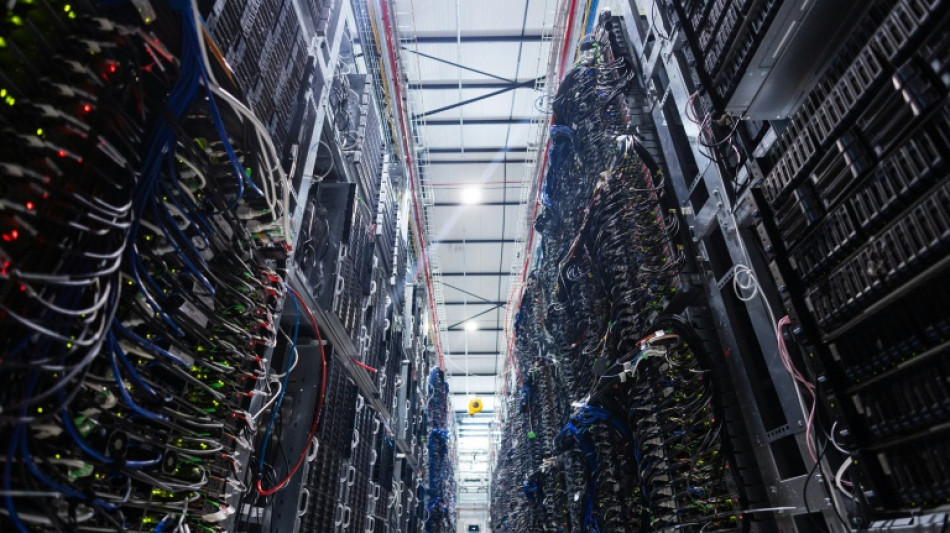
EU wants to favour European firms for AI, cloud in sovereignty push / Photo: Sameer Al-DOUMY - AFP/File

 BingX Evolves into a Multi-Asset Trading Platform, Connecting Users to Global Opportunities

 International Trading Institute Expands Professional Trader Development Beyond the Master’s in Trading

 Lake Energy Secures $80 Million for U.S. Renewable Energy Expansion

 Stocks drop, oil climbs and Treasury yields hit 19-year high

 SkySail Strategies Outperforms Wall Street's 30-Year Risk Standard With Proprietary AI Inference Model

 Just add fish: Scientists pursue more rice, less disease in Senegal paddies

 Belgium completes outer structure of offshore energy island

 China retail sales growth weakens further in August
 In Kashmir, lake weeds mix with traditional art

 'Widow's Bay' and 'The Pitt' take key Emmy awards

 Television's A-listers glitter on Emmys red carpet

 Air India CEO summoned over alleged departure immigration lapse

 HFCL expands planned fibre investment to ₹1,800 crore

 Kuwait schools restore classroom routines after remote learning

 BIS flags debt and profitability risks in AI-driven market rally

 Qatar Chamber and Maltese envoy consider business forum

 Spanish PM denies being blackmailed by Morocco

 Etihad capacity rises as war disruption weighs on annual earnings

 Expert proposes phased digital reform for Arab business schools

 Russian attacks on Ukraine railways escalating every week: rail CEO to AFP

 Alarm over AI grows as divided US Congress struggles to act

 Nigeria's Dangote refinery launches continent's biggest IPO

 Slow the AI race? Investors weigh the potential cost
 Germany seeks guarantees from Italy's UniCredit over Commerzbank takeover

 Ozempic-maker Novo Nordisk slims down to 'Novo'

The EU on Wednesday unveiled its plan for slashing dependence on American and Asian technology, including favouring European firms in the most sensitive public contracts for cloud computing and AI.
The long-awaited "tech sovereignty" package is part of a raft of new EU rules aimed at boosting domestic manufacturing across different sectors, and catching up with rival companies in the United States and China.
But the plans risk further irking the United States, which has pushed back hard at the European Union's fines and rules in recent years against American tech companies.
The issue is existential for the EU since it is heavily reliant on foreign technology providers.
The European Commission said non-EU companies provide more than 80 percent of its digital products, services, infrastructure and intellectual property.
Brussels worries its soft underbelly has been exposed after crises over chips and rare earths with China last year, coupled with fears that President Donald Trump could one day pull the plug on US cloud computing via a "kill switch".
EU tech chief Henna Virkkunen insisted that the bloc was "not closing anyone out" but told journalists that for "very critical" sectors like defence, it was "very important" that Europeans provide the services.
This will be done through a scheme with four levels that range from a general obligation to keep data in Europe to stricter requirements in the most sensitive areas, such as security and defence.
"We cannot afford to depend on others for the technologies that keep our hospitals running, our energy grids stable and our services secure," EU chief Ursula von der Leyen said.
- US cloud domination -
The package includes:
-- a new law on cloud computing and artificial intelligence to encourage the construction of data centres in the EU;
-- boosting the demand for European-made semiconductors with a new chips law;
-- a push for the public sector to use more open-source software solutions that ensure greater control and flexibility, and avoid being locked in.
The EU is estimated to spend 264 billion euros ($307 billion) annually on US cloud software, according to a 2025 report by the French consultancy Asteres.
The sovereignty push is partly fuelled by worries over Europeans' data, since the Trump-era 2018 Cloud Act allows Washington to demand access to data from US-based providers regardless of where the information is held.
Brussels hopes the rules will triple the bloc's data centre capacity in the next five to seven years, but vowed to establish a rating scheme to ensure they are integrated into the energy system in Europe in a "sustainable" manner.
- US firms will remain 'dominant' -
There are fears the new rules could provoke retaliation by Trump. But an EU lawmaker who has worked closely on tech sovereignty told reporters Tuesday that Europe "should not bow down to pressure".
"We set our rules in Europe, according to the needs and the demands of the European citizens," said Matthias Ecke of the Socialists and Democrats, though he expects US providers to remain "dominant" despite the EU push.
Brussels is making clear its determination.
The European Commission said last week it wants to reserve for European firms a share of the mobile satellite frequencies currently used by US operators.
The latest moves reflect a change in Brussels, beyond just regulating Big Tech towards actively favouring European technology.
In the latest example, the European Parliament said France's Qwant would become the default search engine on its Microsoft Edge and Mozilla Firefox browsers from Thursday as part of its effort to cut reliance on foreign digital tools.
Chips, cloud computing and AI "are the nervous system of the modern economy", powering everything from defence to healthcare, EU lawmaker Oliver Schenk said.
"Europe therefore cannot afford to remain merely a consumer of critical technologies developed elsewhere," the conservative MEP told AFP.
P.Petrenko--CPN