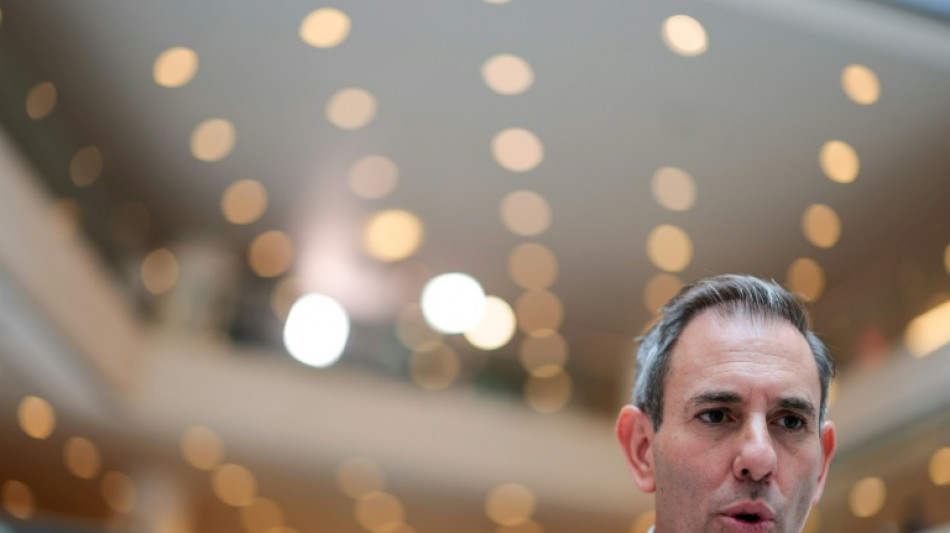
Australia economy minister says 'legitimate' fears driving rise of far-right / Photo: Kent NISHIMURA - AFP/File

 New York seizes 12 celeb deep-fake porn sites

 France, Iraq deepen energy, defence ties during Zaidi visit
 PopDEX Surpasses $61M TVL and $2B Trading Volume in Closed Beta

 Trump blasts 'sick conspiracy' against AI as warnings mount

 French defence group Thales calls on governments to regulate AI

 Oil gains on Mideast supply fears, AI warnings rattle tech firms

 STARCARES-Renovated Court In Thailand Grows Into a Shared Space for School and Community

 Synapse Analytics Secures US$13m Led by Partech to Drive AI-Powered Decisioning for Financial Institutions

 Surfer hospitalised after shark attack in Western Australia
 US hosts G20 'energy abundance' talks amid Iran war shock

 Migrant workers flock to Indian Kashmir despite militant threats
 Canada's Carney seeks closer Europe ties to counter hostile US

 Dozens arrested in major anti-LGBTQ raids in Turkey
 Poland, Ukraine slam Russian strikes near border as 'escalation'
 iPhone 18預購後出現可疑扣款 四間銀行調查未授權交易

 Galaxy Tab S12系列效果圖曝光 Ultra擬配雙鏡頭及瀏海螢幕

 Altman tells Fortune OpenAI will not go public in 2026

 ستاندرد آند بورز تثبت تصنيف السعودية عند A+

 Anthropic details Claude misuse as US targets major illicit online marketplace

 Venezuelans outside Caracas say capital not sharing blackout burden

 Anthropic boss calls for slowing pace of AI development

 BRICS nations urge 'maximum restraint' in Middle East war

 Europe eyes battle over 'pervert' AI glasses

 Children in flood-hit Nepal grapple with loss, cling to hope

 Venice Film Festival: A look back on the highlights

Australia's economy minister said Monday that "legitimate" concerns were driving a rise in support for the far right after a bombshell opinion poll showed the populist One Nation is now the country's most popular party.
For decades a fringe outfit led by provocateur Pauline Hanson, polling released over the weekend by the Australian Financial Review showed One Nation has overtaken the ruling Labor Party in support.
"I think people have legitimate concerns about where they fit in the economy," Treasurer Jim Chalmers said when asked what was driving that.
"People are responding to legitimate pressures and legitimate concerns and anxieties they have."
The polling put One Nation on 31 percent to Labor's 28 percent in primary voting under Australia's preferential voting system.
The poll was taken from a sample of 1,005 voters and conducted by the Redbridge Group and Accent Research.
It comes as Labor has pushed a controversial housing tax reform aimed at bringing down property prices in Australia -- some of the world's highest.
The reform reins in tax breaks for landlords and for people selling their properties.
It has sparked condemnation from small business groups and investors who accuse Canberra of penalising wealth creators.
The government has defended the changes as seeking to overturn "intergenerational inequality" and help young people buy a home.
"We want to make sure Australia doesn't become like other countries, where people have this sense they are disconnected from our economy and disregarded from our society," Chalmers said on Monday.
The rise of One Nation, which advocates for swingeing immigration cuts and campaigns against "radical Islam", has thrown into question a long-held notion that Australia's voting system insulated it from the global rise of populist parties.
Last month the party won its first lower house election battle in the seat of Farrer, a large inland agricultural and mining electorate in New South Wales, beating the traditional conservative parties.
Hanson has long drawn condemnation for racist remarks targeting Muslims and other minorities.
On Monday she told ABC Radio Brisbane she believed she was ready to serve as Australia's prime minister.
"Would I be able to do the job? I believe that I could. I do believe I have the ability, but it's another year and a half outside of an election."
Commentators have linked One Nation's spike in the polls to dissatisfaction with the government's latest budget, making it hard to judge its chances in the next general election, which must be held by May 2028.
L.Peeters--CPN