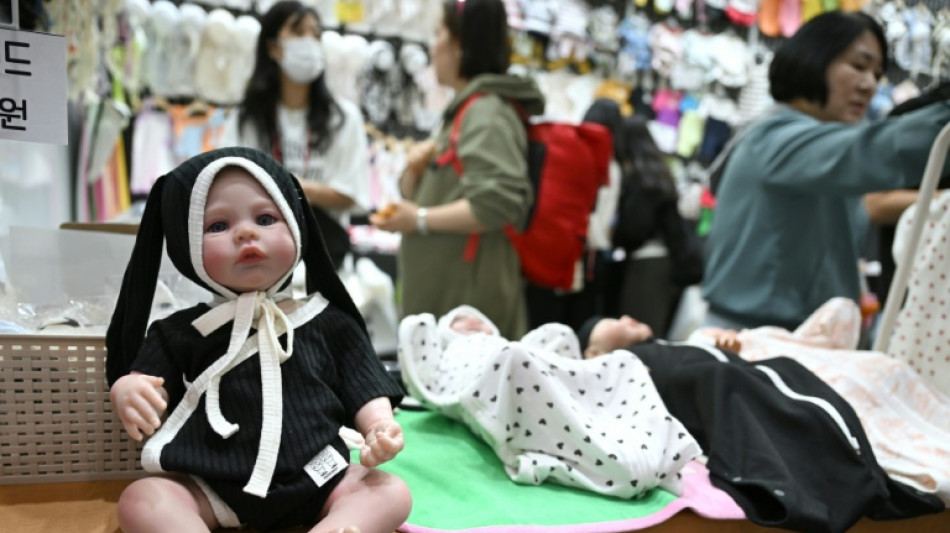
South Korea welcomes rare baby bump as population shrinks / Photo: Jung Yeon-je - AFP

 Bank of Japan set to raise rates under pressure from inflation, US

 EU chief to unveil social media, gaming curbs for under-15s

 'Resident Evil' film brings video game's ethos to the big screen

 i-payout Expands U.S. Money Transmitter Licensing Footprint and Advances European EMI Strategy

 US Senate crypto bill collapses amid partisan deadlock

 OpenAI, Anthropic and Google are working to create an AI standards body

 Protesting shepherds, farmers clash with Romanian police

 Foundation Lets Ledger Users Switch to Open Source Without Starting Over

 EU to propose curbing social media, online games for under 15s

 FX Junction Reaches 40,600 Members and 26 Million Trades

 'We unleashed the beast': the world's fears and hopes about AI

 Hospitality leaders ask Burnham to halve VAT amid rising costs

 Worcestershire invited to nominate groups for 2027 King’s volunteer award

 Berlin's run-down public spaces at heart of election campaign

 'Widow's Bay' and 'The Pitt' win big at Emmy Awards

 Most markets drop as oil extends gains ahead of expected US rate hike

 Sri Lanka's famed beach shack battles demolition

 Vserv targets ₹1,000 crore revenue by 2030 through AI expansion

 India prohibits bank fees on UPI payments up to ₹2,000

 Brazil's Amazon defender Raoni has cancer

 Trump rejects AI slowdown concerns as UN urges coordinated controls

 Higher wages draw migrant workers to Kashmir despite attacks

 Oil supply concerns and AI warnings weigh on global markets

 'I am the hoax buster': Trump rejects AI danger warnings

 Doha Islamic finance forum names AlRayan firms as co-lead partners

Kim Su-jin and her husband have set aside their doubts and embraced parenthood, joining a small but notable wave of South Korean couples having children despite the country's steep demographic decline.
South Korea has one of the world's lowest birth rates, and the government has spent billions of dollars trying to encourage citizens to have more babies and cushion the worst impacts of a shrinking population.
The Asian nation is still nowhere near reversing the trend, but a modest baby bump has come after years of consistently low statistics -- even as experts disagree on the underlying causes.
Kim, 32, a freelance music industry worker, gave birth to her daughter in January last year despite earlier financial concerns during her four-year marriage.
She shook off worries over housing, schooling and work "because we believed that having (a baby) would bring us happiness", she told AFP.
South Korea's fertility rate hit a record low in 2023 but has picked up since then, with the number of monthly births consistently rising compared to the previous year.
Nearly 23,000 babies were born in February, the most for that month in seven years, according to the statistics ministry.
The on-year growth of 13.6 percent was the highest for any February since records began in 1981.
- Pro-natalist policies -
The uptick in births has tracked a similar, though less even, rise in marriages going back to mid-2022, official figures show.
Experts said the trend may reflect more positive attitudes towards family among younger South Koreans.
But they differed on what was driving the shift and how important it was compared with factors such as pro-natalist policies.
Hong Sok-chul, an economics professor at Seoul National University (SNU), said the programmes had been "quite effective".
"Rather than trying to force marriage or childbirth ... the government focused on lowering the direct and indirect costs to make these choices more rational," he said.
Kim Woo-jin, 33, said vouchers she received from the government had "played a significant role in alleviating the financial burden" of pregnancy, childbirth and child-rearing.
She cited a payment of two million won ($1,400) when her daughter was born last year, a one-million-won voucher to cover maternity fees, and subsidies for transport and post-natal care.
"I believe that the significant improvements (in state support) ... played a role in the recent rebound" in births, the office worker said.
- Money isn't everything -
South Korea also pays parents a one-million-won monthly allowance during the baby's first year, while other policies include low-interest loans for young families buying homes, expanded parental leave and subsidised fertility treatment.
Some companies also hand large bonuses to staff who have children.
For some couples, though, the incentives have made little difference.
Kim Su-jin, the freelancer, said government support "in reality ... provides little substantial assistance".
"The issue is not merely a matter of a few million won," she told AFP, citing broader social ills like exorbitant tutoring fees, widespread school bullying and the threat of job losses due to artificial intelligence.
Demographer Lee Sang-lim, also of SNU, said it was "very difficult" to conclude that the latest government policies had caused the upturn in births, noting that several initiatives only began in early 2024 -- less than nine months before the increase became apparent.
He said that more than a decade of policies to help boost fertility may have played a role in improving the environment for childbirth and child-rearing.
- Fertility or futility? -
South Korea's total fertility rate -- the number of children each woman will have on average -- increased last year from 0.75 to 0.8, still well below the threshold of 2.1 needed to maintain the population.
Other theories for the baby bump abound, with implications for how long it might last.
Park Hyun-jung, a data ministry official, said in February the rise partly reflected the demographic "echo" of a larger-than-normal cohort born in the early 1990s, now in their peak childbearing years.
Younger generations also appear to feel less traditional stigma around having children outside marriage, with the number nearly doubling between 2002 and 2024, according to official figures.
Still, births outside marriage accounted for only 5.8 percent of the total in 2024.
SNU's Lee said the recent uptick was driven mainly by marriages and births delayed during the pandemic, though he added that people born in the 1990s appeared "more family-oriented".
He said it was "difficult to define this as a demographic turning point", warning births could decline "rapidly" again once that group ages out of its peak period.
Hong, the economist, said "continued aggressive policy support will be necessary", adding that "the current rebound, while positive, is still insufficient for long-term population replacement".
A.Leibowitz--CPN