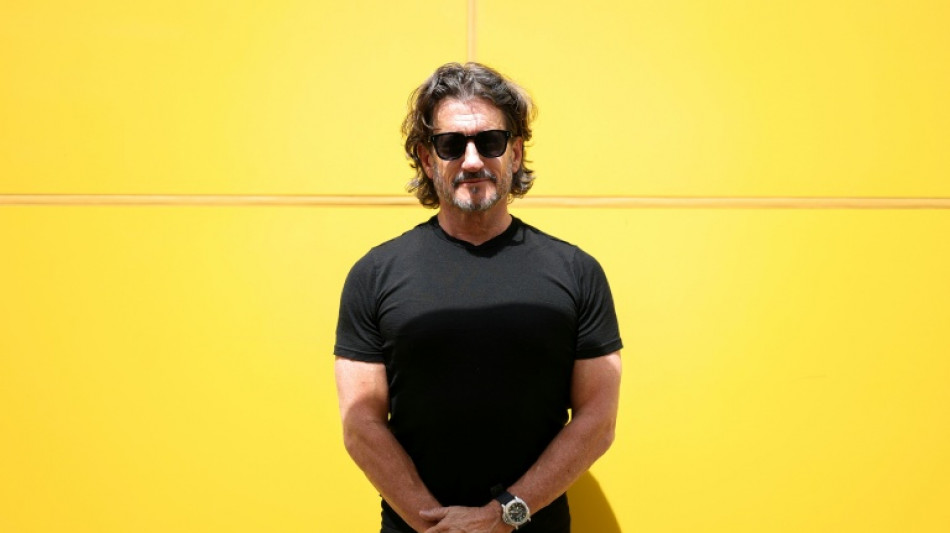
'No doubt' Canadian firm will be first to extract deep sea minerals: CEO / Photo: CHARLY TRIBALLEAU - AFP

 TikTok agrees to teen limits in US settlement following Meta

 Venezuela's oil cradle pins hopes on US energy deals

 Lula bans sports betting days ahead of Brazil's election

 Spotting AI writing: how reliable are the detectors?

 US court refuses to overturn Pentagon ban on Anthropic

 South Lebanon children return to school destroyed by Israel strike

 European stock markets climb as oil prices drop

 Asian markets mixed after recent oil surge

 Cash for nature protection: hotelier's offer to Principe islanders

 India rape cases turn focus back onto women's safety
 Rich nations should foot climate bill, says Nepal minister
 Italy bans burqas in schools, caps numbers of foreign students per class

 Napoli hoping to build new stadium, says owner
 What happens if the US bans diesel exports
 Oscar-winner Cotillard fears being moved by AI actor

 Stocks fall, oil prices rise as global bonds back under pressure
 Streamex Converts Interest Into Capital as GLDY Investment Strategy Secures $1M+ Institutional Allocation

 STARTRADER Named Best Fintech Forex Broker at Forex Expo Dubai 2026
 German think tanks urge Merz to stick with reforms after election defeats

 France's top-selling newspaper to slash jobs
 BaazEX Enters the Asian Trading Market With a New Approach to Online Forex Trading.
 Sao Tome voters want to stop exodus of 'neglected' youth
 Mexican cartels target Australia with their African meth
 Rapper-turned-PM faces first big test after Nepal disaster

 Meta launches camera-free AI glasses amid privacy pushback

The head of submarine mining pioneer The Metals Company told AFP he had "no doubt" the Canadian firm would be the first to to extract coveted minerals from the deep seas, with help from Donald Trump.
Metal-containing deep-sea nodules, which have the appearance of potato-size pebbles and typically contain nickel and cobalt, are highly sought for use in electric vehicle batteries and electric cables, and the race is on to be the first to extract them from the untapped deep sea.
TMC's chief executive Gerard Barron told AFP in an interview in New York that his company was sure to win the race.
The company turned its back on the International Seabed Authority (ISA), which has jurisdiction over the international seabed, complaining over its slow pace in adopting a mining code that establishes the rules for exploiting seabed minerals.
Instead, TMC surprised everyone when its US subsidiary submitted a request to Washington, which is not an ISA member, to grant it the first commercial mining permit in international waters.
TMC has asked to harvest so-called polymetallic nodules -- deposits made up of multiple metals -- in 9,700 square miles (25,200 square kilometers) of the Pacific's Clarion-Clipperton Zone.
Here is what Barron said about what might lie ahead.
Q: When is your target to start mining?
A: "With the help of the executive order from President Trump,... we're expecting an expedited permitting process. And that hopefully will mean that within this next year, maybe even by the end of the year, we'll see the permission from the US government to move forward."
"We do have our first production vessel, the Hidden Gem,... We've finalized how we turn these nodules into the intermediate nickel and copper and cobalt and manganese products. So we're all set."
"We haven't formally told the market when we'll be seeing first production. But what I'm confident of is that it'll be sooner than people expect."
"If you would have suggested me 2027, I'd say I hope so."
Q: Do you need to first modify the Hidden Gem to increase its production capacity?
A: "The original plan was that we were going to make quite extensive modifications to suit a much higher production number. But (expecting) an expedited permit, our thinking is, let's get the boat into production as quickly as possible, and then focus on the bigger production scale for boat number two, three, four and five."
Q: When do you expect to reach the hoped-for full-scale production of 12 million tonnes of nodules per year?
A: "I hope by 2030-2031."
Q: How important is it to be the first to extract minerals from the deep sea?
A: "It's not important, but it's a fact that we will be... No doubt."
Q: Do you expect this to be seen as a historical step?
A: "I think time will be the judge of just how important ocean metals are going to be to society."
"The people that oppose us are pretty (much) the same people that oppose nuclear... They dramatized the potential impacts. They lied about the facts. We ended up burning a whole heap of fossil fuels. We contributed a lot of greenhouse gasses into the atmosphere. That didn't need to happen, and now the world is waking up with the fact that we need nuclear energy. So shame on those people that created that situation. And I think ocean metals will be the same."
"I know based on the environmental research and the more than a petabyte of data that we've gathered to support our claims that the impacts of picking up these rocks and turning them into metals are a fraction compared to the land based alternatives."
Q: Would you consider going back to ISA if it adopts a mining code for deep sea mining?
A: "Not the way it stands now, no. Because the mining code has been overtaken by activists."
"There are many ways that you can frustrate the process if you're Greenpeace. One way is to get countries to sign on to moratoriums... Another way is to get your countries to do the bidding for you by resisting language in the mining code that makes it practical."
"China (has) five licenses more than any other nation, they have state-owned enterprises controlling those licenses. And they can afford to be more patient... They play the long game, whereas private contractors like ourselves, our shareholders won't sit around waiting for that."
Y.Jeong--CPN