Coin Press - France's debt spiral Crisis

NYSE - LSE
CMSC 0.07% 22.837 $
CMSD 0.07% 23.075 $
BTI 2.06% 58.66 $
BCE 1.06% 23.51 $
RIO 3.23% 99.71 $
AZN 2.04% 189.05 $
GSK 1.58% 52.225 $
RBGPF 0.44% 63.75 $
BP 1.24% 47.39 $
BCC 0.25% 79.2 $
RELX 1.96% 36.515 $
RYCEF 4.88% 16 $
VOD 3.22% 15.85 $
NGG 3.15% 88.78 $
JRI 1.09% 12.88 $

France's debt spiral Crisis


France’s economic outlook at the start of 2026 is bleaker than at any time in recent memory. After years of debt‑fuelled budgets and incremental reforms, the eurozone’s second‑largest economy finds itself mired in a crisis of slow growth, skyrocketing debt and political gridlock. Public borrowing now exceeds €3.3 trillion—roughly 114 percent of national output—and official projections suggest the ratio will climb past 118 percent by 2026 and could breach 120 percent by the end of the decade. Investors and policymakers increasingly fear that, without a radical shift, France may be on course for a painful financial reckoning.

A debt mountain and soaring interest costs
Successive governments have promised to rein in spending, yet the deficit remains the highest in the euro area. In 2024 the gap between revenues and expenditures reached almost 6 percent of GDP, and by mid‑2025 it still hovered around 5.4 percent—nearly double the European Union’s 3 percent ceiling. Hopes of reducing the shortfall to below 5 percent in 2026 were dashed in December 2025 when parliament failed to agree a budget, forcing ministers to roll over the previous year’s spending. The emergency finance law allows the state to collect taxes and issue debt from 1 January 2026 but contains no savings measures, prompting warnings that the deficit could exceed 5 percent yet again.

These chronic deficits have propelled debt to alarming heights and swollen the cost of servicing it. Audit officials warn that annual interest payments, already more than €59 billion in 2026, will reach €100 billion before the decade is out—making debt service the largest single budget item. Economists estimate that interest outlays could rise from about 2 percent of GDP today to close to 4 percent in the early 2030s, squeezing resources for education, healthcare and infrastructure. The prospect of higher global interest rates only compounds the risk.

Political paralysis and a cascade of collapsed governments
Attempts at fiscal consolidation have been derailed by political turmoil. Since President Emmanuel Macron lost his parliamentary majority in 2024, four prime ministers have been ousted, and each budget season has produced a new standoff. In autumn 2025 Prime Minister François Bayrou sought to push through a package of €43.8 billion in savings for 2026 by freezing public‑sector hiring, limiting pension indexation and even scrapping two public holidays. Facing a fractious National Assembly, he tied the plan to a confidence vote; lawmakers toppled his government in September and the measures were shelved. His successor Sébastien Lecornu likewise failed to forge consensus: in December, a joint committee of senators and deputies spent less than an hour on talks before abandoning them, leaving France without a 2026 budget.

The impasse has forced the government to rely on stopgap measures. The emergency finance law adopted on 23 December 2025 rolls over 2025 expenditure and authorises tax collection and debt issuance until a full budget can be passed. Central bank governor François Villeroy de Galhau has cautioned that such a temporary fix merely delays difficult decisions and risks producing a deficit “far higher than desired.” Lawmakers from across the political spectrum agree that a proper budget is needed, but ideological divides over spending cuts versus tax increases have proved insurmountable. The government’s minority position means it cannot implement austerity without support from either the left or the right, both of whom oppose its proposals for different reasons.

Weight of high spending and a rigid economic model
Underlying the fiscal morass is a structural imbalance between generous public services and a growth engine that has lost momentum. Government expenditure stands at around 57 percent of GDP—the highest in the European Union—while tax revenues amount to roughly 51 percent. The state subsidises employment and businesses to the tune of about €211 billion a year in an effort to compensate for rigid labour laws that discourage hiring and keep unemployment above the eurozone average. Despite this heavy support, productivity growth remains sluggish and many public services, from hospitals to universities, suffer from underinvestment.

Demographic pressures add to the strain. The pension system remains structurally in deficit even after the retirement age was raised to 64, and without further reform it will place growing demands on the budget. High social contributions and protective job regulations make employers reluctant to hire, particularly younger workers, entrenching long‑term unemployment and eroding the tax base. These rigidities mean that even when the economy expands—as it did by a modest 1.1 percent in 2024—growth quickly slows. The European Commission forecasts that GDP will expand only 0.7 percent in 2025 and 0.9 percent in 2026, rates insufficient to stabilise the debt ratio.

Market jitters, downgrades and external warnings
Investors have begun to charge a higher risk premium for French debt. Spreads between French and German 10‑year bonds widened throughout 2025 and briefly surpassed those of Greece and Spain after the government’s collapse in September. Yields on France’s benchmark bonds approached Italy’s levels by the end of the year, reflecting doubts about fiscal discipline. Credit‑rating agencies have responded by downgrading France’s sovereign rating and placing it on negative outlook, citing persistent deficits, political uncertainty and rising interest costs. Such downgrades increase borrowing costs further, creating a vicious cycle.

International institutions have issued increasingly urgent warnings. The International Monetary Fund’s most recent assessment highlighted that France already spends a larger share of its GDP than any other EU country and called for a front‑loaded structural fiscal effort of about 1 percent of GDP in 2026, alongside reforms to simplify the tax system, rationalise social benefits and harmonise pensions. The European Commission’s autumn 2025 forecast projects that the budget deficit will still be 4.9 percent of GDP in 2026 and that public debt will climb to 118 percent of GDP, rising to 120 percent by 2027 despite modest economic growth and slight revenue increases. Without additional measures, interest payments alone are expected to rise to 2.3 percent of GDP by 2026.

Why a collapse seems inevitable
Taken together, these factors paint a dire picture. France is caught in a debt spiral: large primary deficits require constant borrowing; rising interest rates increase the cost of that borrowing; political fragmentation prevents the adoption of credible adjustment plans; and structural rigidities hold back growth. Each attempt at austerity sparks fierce opposition and social unrest, leading to the fall of governments and further delays. Meanwhile the window for gradual adjustment is closing as markets demand higher returns and global interest rates remain elevated.

Unless a broad consensus emerges to overhaul public finances—combining spending restraint, tax reform, labour‑market flexibility and targeted investment in productivity—France will remain locked in a cycle of rising debt and stagnation. In that scenario, a financial crisis could be triggered by a sudden spike in bond yields or an external shock, forcing international intervention and painful adjustment. The timeline is uncertain, but many economists now warn that France’s economic collapse is not a question of if, but when.


Featured


Long live Ukraine - Хай живе Україна - Да здравствует Украина

Es lebe die Ukraine - Да здравствует Украина - Long live Ukraine - Хай живе Україна - Nech žije Ukrajina - Länge leve Ukraina - תחי אוקראינה - Lang leve Oekraïne - Да живее Украйна - Elagu Ukraina - Kauan eläköön Ukraina - Vive l'Ukraine - Ζήτω η Ουκρανία - 乌克兰万岁 - Viva Ucrania - Ať žije Ukrajina - Çok yaşa Ukrayna - Viva a Ucrânia - Trăiască Ucraina - ウクライナ万歳 - Tegyvuoja Ukraina - Lai dzīvo Ukraina - Viva l'Ucraina - Hidup Ukraina - تحيا أوكرانيا - Vivat Ucraina - ขอให้ยูเครนจงเจริญ - Ucraina muôn năm - ژوندی دی وی اوکراین - Yashasin Ukraina - Озак яшә Украина - Živjela Ukrajina - 우크라이나 만세 - Mabuhay ang Ukraine - Lenge leve Ukraina - Nyob ntev Ukraine - Да живее Украина - გაუმარჯოს უკრაინას - Hidup Ukraine - Vivu Ukrainio - Længe leve Ukraine - Živjela Ukrajina - Жыве Украіна - Yaşasın Ukrayna - Lengi lifi Úkraína - Lank lewe die Oekraïne

Stargate project, Trump and the AI war...

In a dramatic return to the global political stage, former President Donald J. Trump, as the current 47th President of the United States of America, has unveiled his latest initiative, the so-called ‘Stargate Project,’ in a bid to cement the United States’ dominance in artificial intelligence and outpace China’s meteoric rise in the field. The newly announced programme, cloaked in patriotic rhetoric and ambitious targets, is already stirring intense debate over the future of technological competition between the world’s two largest economies.According to preliminary statements from Trump’s team, the Stargate Project will consolidate the efforts of leading American tech conglomerates, defence contractors, and research universities under a centralised framework. The former president, who has long championed American exceptionalism, claims this approach will provide the United States with a decisive advantage, enabling rapid breakthroughs in cutting-edge AI applications ranging from military strategy to commercial innovation.“America must remain the global leader in technology—no ifs, no buts,” Trump declared at a recent press conference. “China has been trying to surpass us in AI, but with this new project, we will make sure the future remains ours.”Details regarding funding and governance remain scarce, but early indications suggest the initiative will rely heavily on public-private partnerships, tax incentives for research and development, and collaboration with high-profile venture capital firms. Skeptics, however, warn that the endeavour could fan the flames of an increasingly militarised AI race, raising ethical concerns about surveillance, automation of warfare, and data privacy. Critics also question whether the initiative can deliver on its lofty promises, especially in the face of existing economic and geopolitical pressures.Yet for its supporters, the Stargate Project serves as a rallying cry for renewed American leadership and an antidote to worries over China’s technological ascendancy. Proponents argue that accelerating AI research is paramount if the United States wishes to preserve not just military supremacy, but also the economic and cultural influence that has typified its global role for decades.Whether this bold project will succeed—or if it will devolve into a symbolic gesture—remains to be seen. What is certain, however, is that the Stargate Project has already reignited debate about how best to safeguard America’s strategic future and maintain the balance of power in the fast-evolving arena of artificial intelligence.

US China race hits 2027

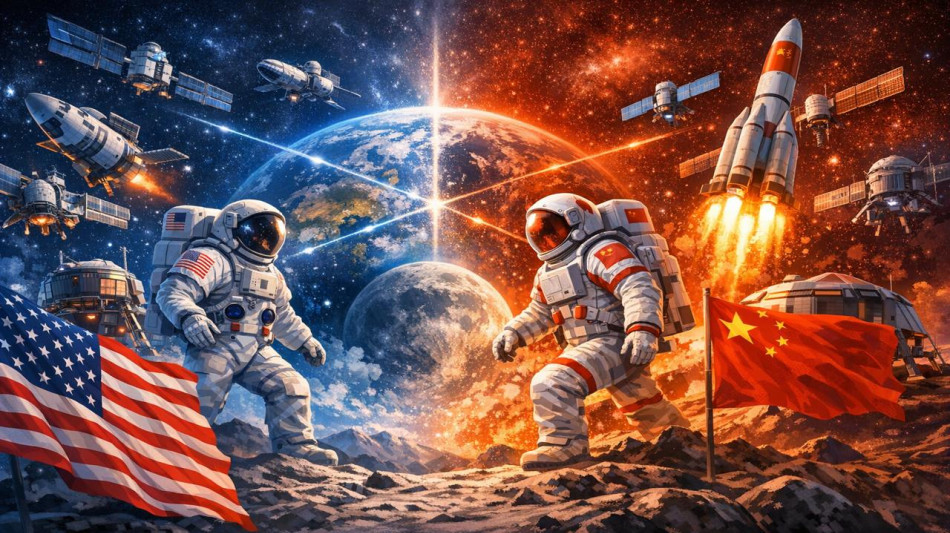
When NASA’s Artemis II crew splashed down in April 2026 after looping around the Moon, it rekindled interest in human spaceflight. The United States had not sent astronauts near the lunar surface in more than half a century, and its return came amid an unmistakable rivalry with a rising power. Over the last decade China has methodically tested rockets, landers and rovers, assembled its own orbital outpost and dispatched missions across the Solar System. The world’s two largest economies are now openly competing to build a permanent human presence on and around the Moon, to harvest its resources and to set the standards that will govern space for decades to come.Although the race evokes memories of the Cold War, experts stress that today’s contest is more complex. Rather than a sprint to plant a flag, the current competition is a marathon to establish infrastructure and routines for sustained exploration. It also includes commercial players, such as SpaceX and Blue Origin in the United States and a fast‑growing private sector in China. Political leaders in Washington and Beijing frame their objectives in terms of national prestige, economic opportunity and security, while scientists see the potential for breakthroughs in geology, physics and planetary science. In this multifaceted arena, the year 2027 looms as a pivotal test of each nation’s ambitions.Washington’s roadmap: Artemis and a moon baseThe United States is pursuing its lunar return through NASA’s Artemis programme. Artemis II demonstrated that the Space Launch System rocket and Orion spacecraft could carry a crew around the Moon and return safely. The next steps are more demanding. NASA plans a complex Earth‑orbit flight in 2027 in which Orion will practice docking with one or both of the commercial lunar landers now under development. This demonstration is essential for subsequent missions that will ferry astronauts to the lunar surface. Without a successful rendezvous and refuelling sequence, the agency cannot meet its goal of up to two crewed landings in 2028 and the construction of a lunar base in the early 2030s. NASA Administrator Jared Isaacman has warned that the United States is in a new space race and that failure to keep pace could damage American leadership. He argues that seeing Chinese taikonauts on the Moon before U.S. astronauts return would deliver a blow to American confidence and global influence.Policy makers in Washington view the timeline as tight. The launch of Artemis III, originally targeted for 2024, has slipped to 2028 after interim dates in 2026 and 2027. This drift reflects technical hurdles and shifting political priorities; over the past two decades U.S. lunar goals have changed with each administration. Under President Donald Trump, NASA’s focus returned to the Moon, and Congress has largely sustained funding. Lawmakers such as Senator Ted Cruz emphasise that America must simultaneously maintain leadership in low Earth orbit, where the International Space Station nears the end of its life, and embark on a new era of exploration. The challenge is to integrate commercial capabilities—particularly SpaceX’s Starship system, which will serve as a lunar lander—with NASA’s heavy‑lift rockets and Orion capsule. In low Earth orbit, U.S. companies are also competing to build private space stations as the ISS winds down.Behind the headline missions is a robust commercial ecosystem. SpaceX’s Falcon and Starship rockets have dramatically lowered launch costs, enabling a boom in satellite deployment and paving the way for large‑scale lunar logistics. Other firms are developing lunar landers, cargo services and in‑orbit data processing that uses artificial intelligence to analyze imagery directly in space rather than sending raw data back to Earth. Proponents say these technologies will revolutionize Earth observation, communications and defence, creating an “orbital economy” that could be worth trillions. Critics, however, worry about the potential for an uncontrolled proliferation of satellites, increasing the risk of collision and creating space debris—known as the Kessler syndrome—that could render some orbits unusable.Beijing’s blueprint: Chang’e, Tiangong and mega‑constellationsChina’s lunar ambitions were late to emerge but have progressed steadily since the Chang’e programme began in 2007. In the past decade the China National Space Administration has landed robotic spacecraft on the Moon’s near and far sides, returned lunar samples to Earth and placed two rovers on the surface. Its next steps include launching the Chang’e‑7 mission in late 2026 to explore the lunar south pole and Chang’e‑8 in 2029 to test technologies such as in‑situ resource utilization. These missions will lay the groundwork for an International Lunar Research Station that Beijing plans to build with Russia and other partners in the 2030s. Chinese officials say a crewed landing will occur before 2030, using the new Long March‑10 rocket, Mengzhou spacecraft and Lanyue lander. Tests of these systems began in 2025 and are progressing on schedule, according to state media.The difference between the U.S. and Chinese approaches is striking. China’s lunar timeline has remained largely steady, with milestones set years in advance and executed through successive five‑year plans. Analysts note that the one‑party state does not face the congressional budget battles or policy reversals common in Washington, allowing it to align industries, financing and state priorities around long‑term goals. Xi Jinping has framed space exploration as part of national rejuvenation, and the aerospace sector is listed among the strategic industries of the future. At the same time China is rapidly expanding its presence in Earth orbit. It operates the Tiangong space station, assembled in modules launched between 2021 and 2022, and plans to add a co‑orbiting telescope module. Chinese astronauts routinely conduct long‑duration missions and record‑setting spacewalks from Tiangong.Beyond human spaceflight, China is building its own satellite megaconstellations. The Thousand Sails network aims to deploy more than a thousand satellites by 2027 and potentially 14,000 by the 2030s to provide global broadband and compete with SpaceX’s Starlink. The defence‑oriented Guowang constellation could add another 13,000 satellites by 2035. China had over 800 satellites in orbit at the start of 2025—more than any country except the United States, which has nearly 9,000—but its launch rate is accelerating. In 2024 China launched 68 orbital rockets, second only to the U.S., and is testing reusable boosters and powerful new engines. It is also pursuing a Mars sample‑return mission that could bring material back to Earth by 2031, potentially beating NASA’s delayed Mars campaign. Observers say these achievements reflect an ecosystem that now rivals the U.S. in breadth, even if China still lags in private sector innovation and reusable rocket technology.Why 2027 mattersThe year 2027 stands out as a make‑or‑break point in the unfolding space competition. For NASA, the planned in‑orbit docking demonstration will show whether its architecture—combining the Orion crew capsule with privately built lunar landers—can actually work. This test has already been inserted into the Artemis sequence as a separate mission, and without it the agency cannot risk sending astronauts to the lunar surface. Success would keep the 2028 landing on track and bolster confidence in the United States’ ability to lead; failure could postpone human landings by years and give China a psychological and strategic advantage. Some observers argue that delays would also erode congressional support and funding, since political attention could shift to Mars or Earth‑orbit projects.For China, the mid‑2020s are equally crucial. By the end of 2026 the Chang’e‑7 probe is expected to deliver data from the Moon’s south pole, and the Thousand Sails constellation could surpass the 1,000‑satellite mark a year later. Meanwhile, low‑altitude tests of the Long March‑10 and Mengzhou systems in 2025 and 2026 will set the stage for full‑scale flight tests. If all proceeds as planned, China will enter 2027 with an integrated system for human lunar flight, a mature space station and an expanding commercial sector. The momentum could position Beijing to attempt its first crewed lunar landing by the end of the decade, perhaps just a year or two after Artemis III.The symbolic stakes of who returns to the Moon first resonate beyond space professionals. Many commentators see access to lunar resources such as water ice and helium‑3 as future economic boons, enabling fuel production, life support and even fusion energy. Others worry that these expectations could inflame geopolitical tensions and lead to the partition of the lunar surface. Online discussions are filled with references to science‑fiction series like For All Mankind and Star Wars, a sign of how popular culture shapes perceptions of space. Some people lament the absence of Europe in the high‑profile contest, expressing frustration that the European Space Agency is not competing at the same level. Others note that the proliferation of mega‑constellations could spoil the night sky for astronomy and raise the risk of collisions. A common thread is the belief that space is becoming another arena for geopolitical rivalry and that humanity must balance exploration with responsibility.What’s at stakeAt the heart of the new space race is a struggle over norms and infrastructure. The country that first establishes a sustained presence on the Moon will likely influence how lunar resources are allocated, how safety zones are defined and how future claims are adjudicated. China’s plan for an International Lunar Research Station is open to partners but would be led by Beijing and Moscow, while the U.S. promotes the Artemis Accords, a set of principles signed by more than thirty nations that emphasise transparency, peaceful use and the protection of heritage sites. The two frameworks represent competing visions of governance. Some analysts worry that parallel bases could harden rival blocs and complicate cooperation on scientific projects.Economic motives also loom large. The Moon’s south pole contains ice deposits that can be split into oxygen and hydrogen for rocket fuel; its regolith may hold helium‑3, a potential fuel for fusion reactors; and rare earth elements could be mined for electronics. Companies envisage extracting these materials and using them to support lunar factories, orbital refineries and interplanetary missions. Observers point out that many of these prospects are speculative and that the technological and legal challenges are formidable. Nevertheless, the prospect of a trillion‑dollar space economy drives investment from governments and venture capital. Commentators on social media often joke about “all those beautiful minerals” and wonder whether space will become a battlefield for humans. Others warn that competition could trigger an arms race, with anti‑satellite weapons and military platforms turning Earth orbit into a contested zone.Environmental concerns add another layer of complexity. Mega‑constellations of thousands of satellites enable global internet and Earth‑observing services, but they also contribute to light pollution and radio interference that hamper astronomical research. Critics argue that launching tens of thousands of spacecraft to benefit a small fraction of the population is not worth degrading the natural beauty of the night sky. Campaigners call for international regulation to ensure that orbits remain sustainable and that debris is removed. The U.S. Federal Communications Commission and international bodies are beginning to address these issues, but enforcement remains weak.Beyond the U.S. and ChinaWhile the rivalry between Washington and Beijing dominates headlines, other actors are shaping the space landscape. India, which landed a spacecraft near the lunar south pole in 2023, plans its own crewed missions and has an eye on lunar resources. Russia remains formally involved with China’s lunar base plan despite its own economic struggles. Private corporations across the globe are developing lunar landers, communications relays and space‑based manufacturing. Even as the European Space Agency grapples with funding and policy issues, European companies supply critical hardware, such as the service module for Orion and lunar lander technology. Japan, Canada and the United Arab Emirates are all planning missions that will contribute to lunar exploration or the construction of the Lunar Gateway, a planned station in lunar orbit.Taken together, these efforts suggest that the future of space will be multipolar. The outcome of the 2027 milestones will not end the race but will set the trajectory for the coming decade. Whether the United States and China choose to cooperate or compete will influence how quickly humanity establishes a foothold beyond Earth and whether the benefits of space are shared or monopolized.An uncertain finish lineThe United States and China are already locked in a fierce competition for space. Both nations have articulated ambitious lunar roadmaps, invested billions in rockets, spacecraft and infrastructure, and rallied their citizens with promises of national renewal and scientific glory. Yet the space environment today is far more complex than during the Apollo era. Private companies wield unprecedented influence, environmental and legal questions remain unresolved, and the stakes extend from lunar ice to orbital broadband and planetary defence. The year 2027 will be a crucial inflection point: a successful docking test for Artemis and the continued pace of China’s Chang’e and megaconstellation programmes will signal whether each nation can execute its plans on schedule. Failure or delay on either side could alter perceptions of leadership and open space for newcomers.As the countdown to these milestones advances, policymakers, engineers and citizens alike grapple with what the space race means. Will it inspire cooperation and new frontiers of knowledge, or will it deepen divisions and militarize the heavens? Will the Moon become a laboratory for sustainable living or a quarry for minerals? And can humanity develop rules and norms to manage an increasingly crowded sky? The answers will emerge over the next several years. For now, the only certainty is that the competition is real, the challenges are immense and the outcome will shape the cosmic future of us all.