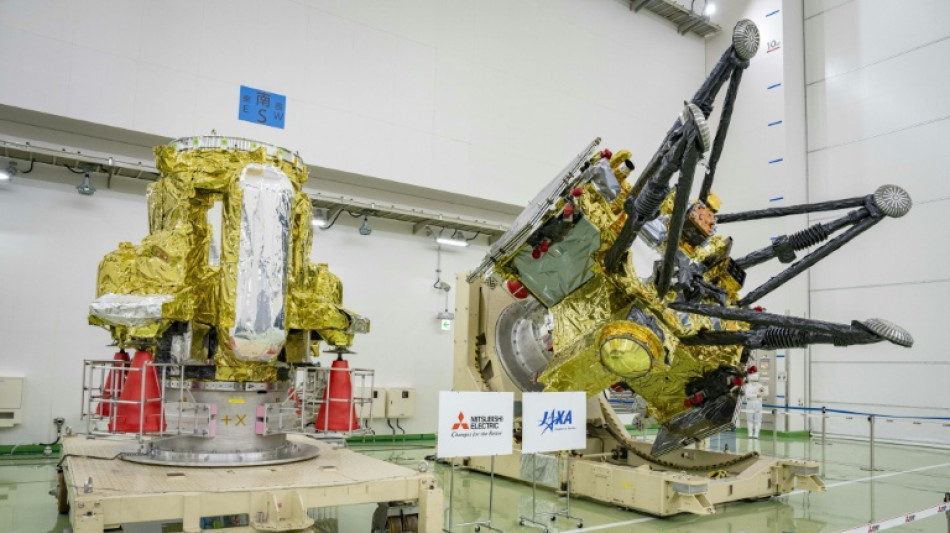
Japan launches rocket for potential world first Mars moon mission / Photo: Yuichi YAMAZAKI - AFP/File

 Japan launches rocket for potential world first Mars moon mission

 US wants to be 'strong partner' for central Asia: Rubio

 UN climate panel head wants swift end to deadlock over key scientific report

 Microsoft exits data centre deal in blow to UK AI ambitions

 Asian stocks start week on back foot, tracking tech-led Wall St losses

 On the front line of ocean conservation off Portugal's Madeira

Japanese scientists launched a spacecraft Tuesday that aims to be the first to retrieve samples from one of Mars's moons, potentially helping unlock the origins of the Solar System and life on Earth.
The flagship H3 rocket carrying the unmanned Martian Moons eXploration (MMX) probe blasted off into a pitch black sky from the Tanegashima Space Center at 4:41 am (1941 GMT Monday), according to a livestream broadcast by the Japan Aerospace Exploration Agency (JAXA).
Despite the early hour in Japan, thousands of people tuned into the live stream, posting messages of encouragement.
If successful, the spacecraft will arrive near Mars around August next year, where it will orbit one of its moons, Phobos.
MMX will later land on Phobos and collect at least 10 grams (0.35 ounces) of material from the surface during its planned three years in the Red Planet's vicinity.
The mission -- which aims to be the first round trip to the Martian region -- is a collaboration with US and European space agencies, as well as numerous universities and tech companies.
Those involved hope it will help lay the groundwork for eventual human exploration.
JAXA hopes the mission will reveal how Mars and its two moons formed, a key piece of knowledge in working out how the Solar System was born.
One theory for the origin of the moons -- the "giant impact" hypothesis -- is that they formed after a celestial body collided with Mars.
The "capture" hypothesis, meanwhile, postulates that the moons are asteroids pulled in by Mars's gravity.
Determining which theory is correct will help reveal "how a habitable environment for life might have arisen on the terrestrial planets", JAXA said, referring to the four rocky worlds closest to the Sun -- Mercury, Venus, Earth and Mars.
- 'Natural space station' -
JAXA said the mission will also explore the possibility of using Phobos as a "natural space station" by establishing the requirements for a round trip -- something "essential for crewed Mars exploration".
It will also observe the planet's other moon, Deimos, although it will not land on it.
US and Chinese space agencies have also been vying to be the first to return rock samples from the surface of Mars back to Earth.
NASA's Perseverance rover, which has been roaming across Mars since 2021, has already collected samples.
The return mission, however, was effectively cancelled by the administration of President Donald Trump following a vote by Congress in January.
China's Tianwen-3 spacecraft is scheduled for launch around 2028 and hopes to return Mars samples to Earth as early as 2031 -- potentially before the Japanese mission's return.
P.Kolisnyk--CPN