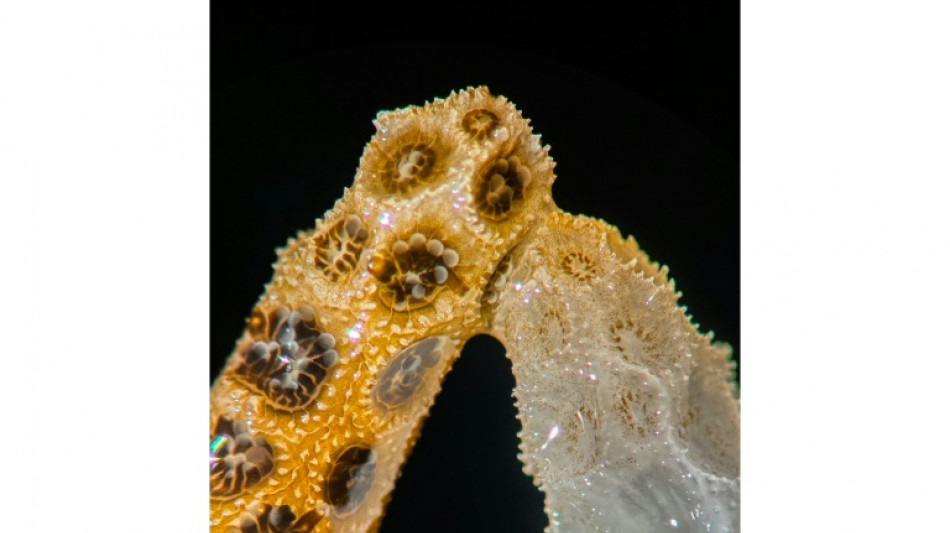
Healthy corals help bleached neighbors regain color: study / Photo: DANNY COLLINS - Danny Collins / Stanford University/AFP

 Government buildings torched in violent Albanian protests

 Healthy corals help bleached neighbors regain color: study

 Houthis say targeted Saudi oil giant Aramco, vow more attacks

 US consumer inflation hotter than expected as midterms loom

 INmune Bio Inc. and Quantum Computing Inc. Partner to Apply Quantum Optimization and AI to Advance Alzheimer’s Drug Research and Explore New Applications for XPro

 US consumer inflation up more than expected as midterms loom

 AI worms, 'major' incident fears spur safety calls at industry summit

 Evolution Metals & Technologies Corp. Reaffirms $400 Million to $460 Million FY2027 Revenue Guidance, Unveils Eight Sintered Magnet Grades Covering an Estimated 75% of Global NdFeB Revenue, and Moves to Answer U.S. Army Call for Rare Earth Magnets

 Trial defence says Russia used Nord Stream pipelines as 'weapon'

 Ukraine accuses US of helping Russia as missiles hit Kyiv

 Bivial AG Brings Its Complete Dashboard to Mobile

 Higher borrowing costs an 'alarm signal' for France: finance minister

 Zelensky accuses Putin of disrespecting Trump after latest attacks

 Japan PM says housework makes her busier than male predecessors

 Trump says 'massive' oil, gas, mineral exploration to begin in Greenland

 IMF chief says Saudi attacks could have negative spillover 'everywhere'

 EU takes a page from Ireland's AI playbook

 Saudi employee arrested for allegedly bugging OpenAI office

 Bybit Expands Beyond Crypto as CEO Outlines Next Phase of Financial Platform

The world's coral reefs face an existential threat from rising seawater temperatures that trigger widespread bleaching, a problem driven by climate change and compounded by this year's intense El Nino phenomenon.
But a new lab study by scientists at Stanford University finds that simply placing healthy, colorful coral in contact with their bleached counterparts is enough to bring the dying ones back from the brink -- a finding that could eventually pave the way for real-world interventions if it can be scaled.
"It's stunning," lead author Daniel Collins told AFP about the outcome of the experiments, recalling the "eureka moment" when he first saw positive results and rushed to his PhD supervisor's office to share the news.
The paper was published Wednesday in the journal Science Advances.
Coral reef recovery is a highly active area of research, with efforts ranging from using artificial nurseries to rescue reefs to finding and cultivating more heat-tolerant species.
Bleached corals had been largely written off because of their high mortality rate, said Collins -- though the new work instead demonstrates they "really shouldn't be thought of as a lost cause."
- Helping hands -
The Stanford team ran a series of tests with pairs of cauliflower corals, finding five days of contact between healthy and bleached fragments was all it took for the latter to mount a spectacular recovery, at which point they could be safely pried apart.
The key to the success of the method -- which the team informally dubbed "helping hands" -- is the transfer of healthy photosynthetic algae, also known as symbionts, from which corals derive their color.
Corals are marine invertebrates made up of hundreds to thousands of tiny, soft-bodied organisms called polyps.
They have a mutualistic relationship with symbionts, which produce the vast majority of food the corals require, in return for shelter, as well as water and the carbon dioxide they need to photosynthesize.
But in times of heat stress, algae can produce toxins, forcing their hosts to expel them.
Collins said the idea for the experiment came from two sources.
The first was a study that showed plastic waste in the ocean can promote disease in corals by transferring harmful pathogens, which made him wonder whether it would be possible to flip that mechanism on its head with a health-promoting transfer.
The second was a happy accident observed by Stephen Palumbi, the study's senior author, also at Stanford, who noticed in his lab that a healthy coral and bleached coral had tipped over and were touching each other, and the bleached coral had started to recover.
- The scaling challenge -
The experiments revealed important constraints.
Three days of contact was the minimum required for a bleached coral to begin to recover, and five ensured full recovery. They also had to be in direct contact -- a few millimeters apart, and nothing significant happened.
A major limitation was that the process only worked when the two corals shared the same genetic background, or "genet." Mixed-genet pairings resulted in the corals deploying stinging cells, a hostile response that can be likened to organ rejection in humans.
Powerful laser microscopy revealed the mechanism: after a day or two of contact, the corals' tissues began fusing, creating a "nutrient highway" between the pair.
The biggest challenge will be translating an exciting lab finding into a real-world solution. "We likely will not be touching corals to each other on reefs," said Collins, noting the sheer size of reefs tends to preclude this option.
However, it is possible to extract healthy symbionts and culture them -- and the team is now thinking about ways to re-introduce them en masse to bleached coral. This also has the benefit of side-stepping the genetic mismatch problem, which applies to the corals, not the symbionts.
H.Müller--CPN