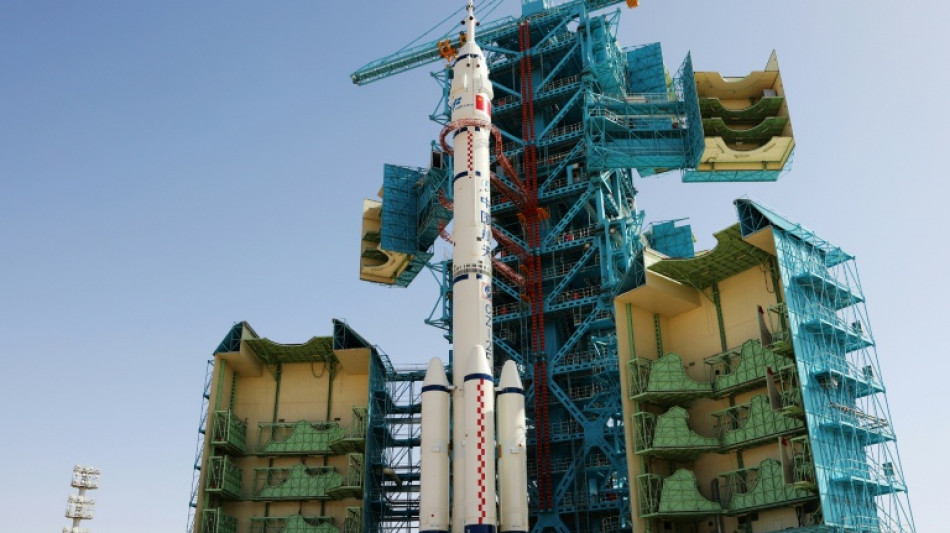
China to launch three-crew space flight as part of Moon ambitions / Photo: STR - CNS/AFP

 EU to ban social media for under 13s, curb access until 15

 Wildfires push endangered Sumatran elephants to brink: Indonesian NGO

 Bank of Japan set to raise rates under pressure from inflation, US

 EU chief to unveil social media, gaming curbs for under-15s

 'Resident Evil' film brings video game's ethos to the big screen

 i-payout Expands U.S. Money Transmitter Licensing Footprint and Advances European EMI Strategy

 US Senate crypto bill collapses amid partisan deadlock

 OpenAI, Anthropic and Google are working to create an AI standards body

 Protesting shepherds, farmers clash with Romanian police

 Foundation Lets Ledger Users Switch to Open Source Without Starting Over

 EU to propose curbing social media, online games for under 15s

 FX Junction Reaches 40,600 Members and 26 Million Trades

 'We unleashed the beast': the world's fears and hopes about AI

 Hospitality leaders ask Burnham to halve VAT amid rising costs

 Worcestershire invited to nominate groups for 2027 King’s volunteer award

 Berlin's run-down public spaces at heart of election campaign

 'Widow's Bay' and 'The Pitt' win big at Emmy Awards

 Most markets drop as oil extends gains ahead of expected US rate hike

 Sri Lanka's famed beach shack battles demolition

 Vserv targets ₹1,000 crore revenue by 2030 through AI expansion

 India prohibits bank fees on UPI payments up to ₹2,000

 Brazil's Amazon defender Raoni has cancer

 Trump rejects AI slowdown concerns as UN urges coordinated controls

 Higher wages draw migrant workers to Kashmir despite attacks

 Oil supply concerns and AI warnings weigh on global markets

China is launching its Shenzhou-23 mission on Sunday, which will see a Chinese astronaut spend a full year in orbit for the first time, a crucial step in Beijing's ambition to send humans to the Moon by 2030.
A Long March 2-F rocket is scheduled to lift off at 11:08 pm (1508 GMT) from the Jiuquan launch centre in China's northwestern Gobi Desert, carrying three astronauts to the Tiangong space station.
The mission will mark the first spaceflight ever undertaken by an astronaut from Hong Kong: 43-year-old Li Jiaying (Lai Ka-ying in Cantonese), who previously worked for the Hong Kong police.
Other crew members include 39-year-old space engineer Zhu Yangzhu and 39-year-old Zhang Zhiyuan, a former air force pilot, who will be travelling into space for the first time.
The crew is set to carry out numerous scientific projects in life sciences, materials science, fluid physics and medicine.
A key experiment of Shenzhou-23 will be the full-year stay in orbit by one of the crew in order to study the effects of a long stay in microgravity.
- Year-long experiment –
The experiment is part of China's preparations for future lunar missions, as well as missions to Mars.
The astronaut selected for this one-year mission will be named at a later date, depending on the progress of the Shenzhou-23 mission, a spokesperson for the Chinese space agency (CMSA) said on Saturday.
The main challenges will be long-term effects on humans, including bone density loss, muscle wasting, radiation exposure, sleep disturbances, behavioural and psychological fatigue, said Richard de Grijs, an astrophysicist and professor at Macquarie University in Australia.
He also underlined the importance of reliable water and air recycling systems, as well as the ability to manage potential medical emergencies far from Earth.
China is "steadily" building operational experience for "sustained occupation" of its Tiangong space station, and year-long missions are an important step towards future lunar and potentially deep-space ambitions, de Grijs told AFP.
"A year in orbit pushes both hardware and humans into a different operational regime compared with the shorter Shenzhou missions of the programme's earlier phases," he said.
Crews aboard Tiangong have until now largely remained in orbit for six months before being replaced.
The Shenzhou-23 mission is part of China's goal to land astronauts on the Moon before 2030, a race in which the United States is also competing with its Artemis programme.
- Pakistani crew members -
China is testing the equipment required for its goal, with an orbital test flight of its new Mengzhou spacecraft set for 2026.
The Mengzhou craft will replace the ageing Shenzhou line, and will carry China's astronauts to the Moon.
Beijing hopes to have built the first phase of a manned scientific base by 2035, known as the International Lunar Research Station (ILRS).
China also plans to welcome its first foreign astronaut, from Pakistan, aboard the Tiangong station by the end of this year.
The Asian giant has significantly expanded its space programmes over the last 30 years, injecting billions of dollars into the sector in order to catch up with the United States, Russia and Europe.
In 2019, China landed a spacecraft the Chang'e-4 probe on the far side of the Moon -- a world first.
Then in 2021, it landed a small rover on Mars.
China has been formally excluded from the International Space Station (ISS) since 2011, when the United States banned NASA from collaborating with Beijing, prompting the Asian giant to develop its own space station project.
P.Kolisnyk--CPN