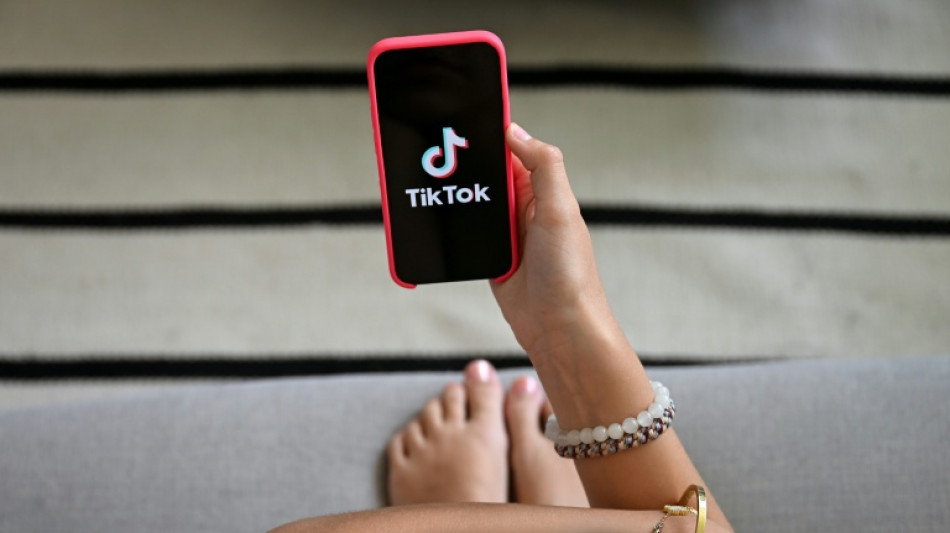
EU to propose curbing social media, online games for under 15s / Photo: Nicolas TUCAT - AFP/File

 BingX Evolves into a Multi-Asset Trading Platform, Connecting Users to Global Opportunities

 International Trading Institute Expands Professional Trader Development Beyond the Master’s in Trading

 Lake Energy Secures $80 Million for U.S. Renewable Energy Expansion

 Stocks drop, oil climbs and Treasury yields hit 19-year high

 SkySail Strategies Outperforms Wall Street's 30-Year Risk Standard With Proprietary AI Inference Model

 Just add fish: Scientists pursue more rice, less disease in Senegal paddies

 Belgium completes outer structure of offshore energy island

 China retail sales growth weakens further in August

 In Kashmir, lake weeds mix with traditional art

 'Widow's Bay' and 'The Pitt' take key Emmy awards

 Television's A-listers glitter on Emmys red carpet

 Air India CEO summoned over alleged departure immigration lapse
 HFCL expands planned fibre investment to ₹1,800 crore
 Kuwait schools restore classroom routines after remote learning

 BIS flags debt and profitability risks in AI-driven market rally

 Qatar Chamber and Maltese envoy consider business forum
 Spanish PM denies being blackmailed by Morocco

 Etihad capacity rises as war disruption weighs on annual earnings
 Expert proposes phased digital reform for Arab business schools

 Russian attacks on Ukraine railways escalating every week: rail CEO to AFP

 Alarm over AI grows as divided US Congress struggles to act

 Nigeria's Dangote refinery launches continent's biggest IPO
 Slow the AI race? Investors weigh the potential cost

 Germany seeks guarantees from Italy's UniCredit over Commerzbank takeover
 Ozempic-maker Novo Nordisk slims down to 'Novo'

The European Union is set to propose curbing access to social media, video-sharing platforms, chatbots, and online games to children under the age of 15, according to a draft legal document seen by AFP.
A proposed new law -- to be formally presented Thursday -- would mean banning minors under 15 from opening their own accounts, with a tiered system of access under parental supervision for younger children.
As well as age limits, the new "EU KIDS Act" would force digital giants to make their platforms "safe by design" for children, meaning certain "addictive" features such as so-called infinite scrolling would have to be removed, the draft showed.
The European Commission has come under pressure from several EU member states including France and Greece to take bloc-wide measures to protect children from social media harms, a push that intensified after Australia banned under 16s from such platforms.
EU chief Ursula von der Leyen will provide a glimpse of what to expect from the new law on Wednesday, during her annual address to the European Parliament in Strasbourg, France.
She will then join EU tech chief Henna Virkkunen the following day to present the proposal, which according to the draft would ban addictive features such as endless scrolling, artificial notifications, and some reward features for children.
The Commission, the EU's digital watchdog, refused to comment on details of the draft seen by AFP.
Here are the key proposals in the draft, which remains subject to change until the text is published on Thursday:
- Gradual age limit -
The new law "sets an EU-wide minimum age for minors to open an autonomous account at the age of 15," the draft says, with a tiered system applying to younger children.
Minors aged 13 and 14 will have to ask their parents to set up "introductory" accounts on social media, AI or gaming platforms, with limited features and strict screen time use.
Those accounts would also be under parents' control.
Those aged between three and 13 can access "fully parent-controlled accounts on 'childfriendly' services" with strict safety standards.
Below the age of three, children in the 27-nation bloc would have no access at all to social media and other "risky services", the draft says.
The EU is simultaneously preparing to roll out an age check app to ensure children are kept off such platforms.
The rules on gradual access make the EU's approach different to that chosen by Australia, where parents cannot consent to children below 16 having any access to social media.
The law's enforcement will be paid for by a supervisory fee on platforms.
The EU already has powerful laws to protect children including the content rules known as the Digital Services Act (DSA), with which it has told Meta's Facebook and Instagram, and TikTok, to change their addictive design.
But in the document, the EU admits the "existing rules do not suffice", since there is no "outright ban on common problematic features".
It said the new law would build on enforcement of the DSA, which allows in theory for fines of up to six percent of a company's annual global turnover.
- 'Safe design' -
The EU's approach "needs to limit the access of tech companies to our children, and not the other way around", the document says.
Alongside a ban on addictive features, the draft says the EU would regulate so-called recommender systems -- the algorithms that feed users more personalised content -- to control the content promoted to children and avoid harm.
The EU wants children's accounts to remain private, with "risky settings" disabled by default and unknown users prevented from contacting minors.
There will also be "tailored commitments" for online games and AI chatbots.
The proposal will become law after negotiations between the EU parliament and member states.
D.Avraham--CPN
