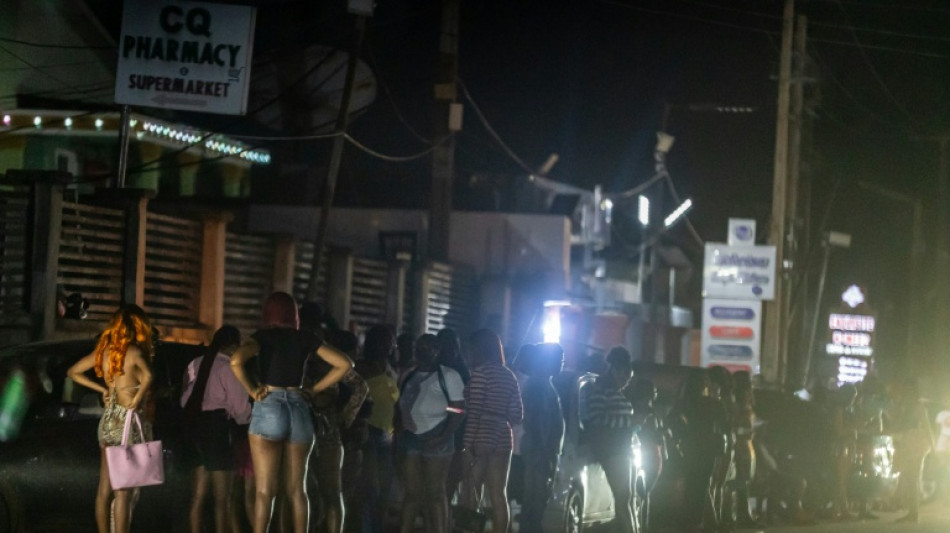
Duped or spun with juju: how sex trade trafficks Nigerian women / Photo: Light Oriye Tamunotonye - AFP

 US hosts G20 'energy abundance' talks amid Iran war shock
 Migrant workers flock to Indian Kashmir despite militant threats
 Canada's Carney seeks closer Europe ties to counter hostile US

 Dozens arrested in major anti-LGBTQ raids in Turkey

 Poland, Ukraine slam Russian strikes near border as 'escalation'

 iPhone 18預購後出現可疑扣款 四間銀行調查未授權交易

 Galaxy Tab S12系列效果圖曝光 Ultra擬配雙鏡頭及瀏海螢幕

 Altman tells Fortune OpenAI will not go public in 2026

 الأرصاد السعودية تتوقع سيولاً وأمطاراً رعدية في خمس مناطق

 Anthropic details Claude misuse as US targets major illicit online marketplace

 Venezuelans outside Caracas say capital not sharing blackout burden

 Anthropic boss calls for slowing pace of AI development

 BRICS nations urge 'maximum restraint' in Middle East war

 Europe eyes battle over 'pervert' AI glasses

 Children in flood-hit Nepal grapple with loss, cling to hope

 Venice Film Festival: A look back on the highlights

 DR Congo school fire stampede death toll rises to 26: UNICEF

 Dance Fitness Tempe Announces Expansion of Accessible Digital Movement Programs

 Europe saw record summer air traffic despite Mideast war: Eurocontrol

 Relatives of 9/11 victims hit out at Saudi Arabia -- and US leaders

 Relative of 9/11 victim unleashes searing attack on Saudi Arabia

 Czech antitrust office lets Turkey's Pegasus Airlines buy Smartwings

 Investors on edge as energy costs, surging bond yields roil markets

 UK lawmakers to vote again on failed assisted dying bill

 Yemen's Houthis complete takeover of Bab al-Mandab area: govt official to AFP

She thought she was leaving Nigeria to work at a mobile phone shop in Mali to save money for university.
Instead Blessing was forced into prostitution at 16 before escaping with four other women three months later.
"They said, 'There is no boutique or phone plaza, it's ashawo,'" she said, using the local Pidgin term for sex work.
AFP met Blessing at a Lagos bus depot on her way back to reunite with her family in Cross River state in the southeast of the country.
The teenager is just one victim of a huge flow of trafficked women tricked or forced into prostitution by poverty along west African migrant routes that go all the way to Europe.
Many are trapped by dubious "debts" imposed by brothels -- while others feel chained by "juju" curses put on them by pimps.
Even those who get away often face resentment from their own families because they are no longer sending money home.
It was on Valentine's Day that a man promised Blessing work at the phone store in Mali. It took a week for her and the other women travelling with her to realise they had been lied to, when they were already close to the Mali-Guinea border.
"We cried that night. We said that we can't do the work."
Blessing was told by the madame who ran the brothel -- herself a Nigerian who went by the name "Mommy Love" -- that the price of her freedom would be 1.5 million CFA (about $2,600).
When Blessing refused to sell her body she was punished -- deprived of food and water for three days until she gave in.
She was soon servicing clients, some for less than $4.
"So you try your best," she told AFP, with the women and girls also left on the hook for food and water.
Her "boss" squeezed about $320 out of her before she and four others ran off.
Sofia, Rose and Esther -- who escaped with her -- also left Nigeria for what they thought were normal jobs.
"I asked countless times... which type of work?" recalled Sofia, a 22-year-old from central Plateau state, which is regularly hit by communal violence.
But she was repeatedly misled, she said, before finally learning the truth while passing through Burkina Faso.
Rose, 19, rocked back and forth nervously as she talked.
The next man who tries to promise her work abroad can "get lost", she said.
- Resurgent route -
Nigerian women are ripe targets for traffickers, said Prosper Michael, director of the Nigerian nonprofit Global Anti-Human Trafficking Organization (GAHTO), with more than six out of 10 people in poverty, according to the IMF.
That number has gone up despite reforms by President Bola Tinubu that have been praised by economists but have in the short term caused a massive spike in inflation.
Nigeria leads the continent in human trafficking -- including for non-sexual, forced or exploited labour -- according to the UN, with 83 percent of victims, which could number up to a million a year, being women and girls.
That is probably an underestimate, experts say, as the statistics rely on testimonies from those who escape and dare to speak about their harrowing experiences.
Many victims are also trafficked within Nigeria, with others sent to countries like Senegal, Mali and Ivory Coast, where prostitution is legal.
There has been a "resurgence of the West Atlantic, West African-Atlantic (trafficking) route" towards Europe since 2023, said the International Organization for Migration (IOM).
The UN body has helped return some 67,000 human trafficking victims to Nigeria since 2017.
"I'll explain everything to my parents," Blessing told AFP in Lagos, waiting for her bus home.
"Maybe they might look for the man that made the first connection. Maybe the man can be arrested."
But the odds are against her. Only 32 people were convicted in Nigeria last year for sex trafficking women, according to a US slavery report.
- Secret 'juju' oaths -
Patience, who comes from Benin City in Edo state, was forced into prostitution in Burkina Faso at the age of 13, sent there by her mother to help support her family.
Thousands are out of work in the industrial city in southwest Nigeria leaving them easy prey to well-established trafficking networks that also take advantage of local tradition and beliefs.
Men seduce women with dreams of comfortable European lives, and keep them in bondage under the threat of oaths sworn before traditional priests.
The priests take snips of their pubic hair and make the women vow silence lest "juju" spells be used against them.
"If you run away from that place, your period will not stop," one victim who returned to Benin City told AFP.
Some women end up in Europe, having sold their bodies to finance their voyage along well-worn migration routes through Niger and Libya.
The networks go back decades. In the 1970s Nigerian women from Edo state arrived in Italy to work in the textile sector. When the work dried up, some turned to prostitution -- and realised there was money to be made.
When they returned to Nigeria "they took the members of their families... to Italy, they worked in prostitution and then it became a circle," said Roland Nwoha, from the NGO IRARA, which helps victims of trafficking.
"It helped lift many people out of poverty," he told AFP -- and became accepted locally.
But it also helped seed criminal networks that have become more and more exploitative.
- Returning 'with nothing' -
After two years working as a prostitute in France, Precious had only paid half of the 30,000 euros demanded by her madame.
She found the courage to flee thanks in part to the powerful Oba of Benin, the traditional king in the region.
He declared in 2018 that women who were victims of sex trafficking by criminal networks were liberated from their oaths.
But returning to Nigeria meant she could no longer send money back to her parents.
"When they received the call that I am in Nigeria, they were very disappointed," she told AFP.
Returning "with nothing", the 30-year-old felt ashamed.
Her story is far from unique, said Nwoha.
"Families don't want them, because they cannot contribute anything," he said.
Patience spent 10 years in Italy and Germany, where she had a daughter.
But she returned to Nigeria as part of a voluntary repatriation programme, persuaded in part by the breathing problems her child was having -- possibly caused, she thought, by a curse or "juju".
But her parents didn't want her to come back, with neighbours calling her daughter -- now nine -- a "witch".
She now makes a living selling clothes. "I want to be the best mom, I want to be a role model to her," she told AFP.
- Recruiters at every turn -
As European countries have tightened immigration policies since the 2010s, they've also worked with the IOM and local NGOs to facilitate voluntary returns.
The Nigerian government and Edo state authorities have also set up public awareness campaigns -- though trafficking networks remain entrenched.
Sandra, 38, spent years in Italy and Germany, where she gave birth to three children, before finally returning home.
Now she's worried about her oldest daughter, now 16 -- the same age she was when she left Nigeria.
"If people want to convince you, they want to brainwash you," Sandra said.
But even she would happily go back to Europe again if there were a legal way to do so, she said.
Neither European border guards nor Nigerian kings can seem to stamp out the dream of a better life, with Benin City's streets teeming with recruiters ready to ensnare young women and girls.
"They're just everywhere," said Knowledge, an 18-year-old who just arrived in town from Lagos.
She already knows plenty of women who have taken up the offer, though she's planning a different route to Europe through a school scholarship.
Y.Uduike--CPN