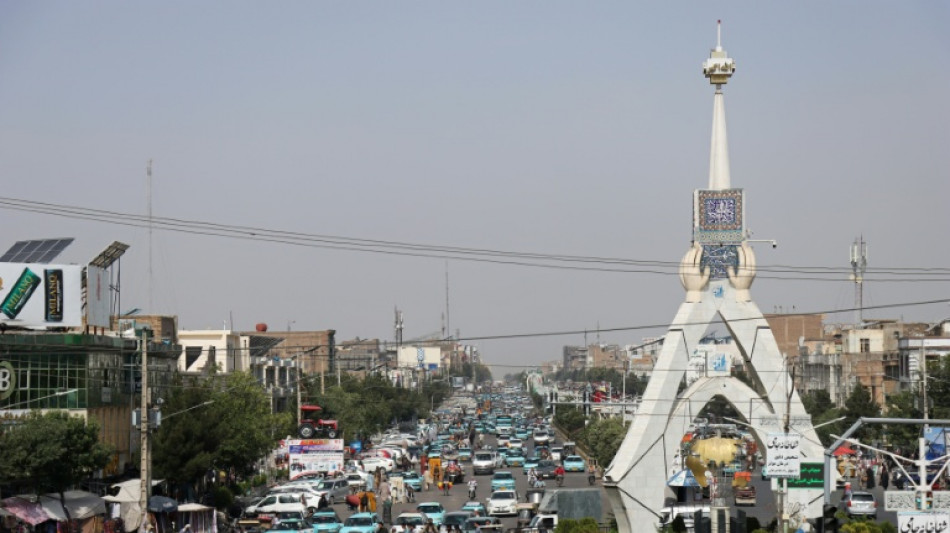
West Afghanistan female dress-code crackdown hits businesses / Photo: Mohsen KARIMI - AFP

 US hosts G20 'energy abundance' talks amid Iran war shock

 Migrant workers flock to Indian Kashmir despite militant threats
 Canada's Carney seeks closer Europe ties to counter hostile US

 Dozens arrested in major anti-LGBTQ raids in Turkey
 Poland, Ukraine slam Russian strikes near border as 'escalation'

 iPhone 18預購後出現可疑扣款 四間銀行調查未授權交易

 Galaxy Tab S12系列效果圖曝光 Ultra擬配雙鏡頭及瀏海螢幕

 Altman tells Fortune OpenAI will not go public in 2026

 الأرصاد السعودية تتوقع سيولاً وأمطاراً رعدية في خمس مناطق

 Anthropic details Claude misuse as US targets major illicit online marketplace

 Venezuelans outside Caracas say capital not sharing blackout burden

 Anthropic boss calls for slowing pace of AI development

 BRICS nations urge 'maximum restraint' in Middle East war

 Europe eyes battle over 'pervert' AI glasses

 Children in flood-hit Nepal grapple with loss, cling to hope

 Venice Film Festival: A look back on the highlights

 DR Congo school fire stampede death toll rises to 26: UNICEF

 Dance Fitness Tempe Announces Expansion of Accessible Digital Movement Programs

 Europe saw record summer air traffic despite Mideast war: Eurocontrol

 Relatives of 9/11 victims hit out at Saudi Arabia -- and US leaders

 Relative of 9/11 victim unleashes searing attack on Saudi Arabia

 Czech antitrust office lets Turkey's Pegasus Airlines buy Smartwings

 Investors on edge as energy costs, surging bond yields roil markets

 UK lawmakers to vote again on failed assisted dying bill

 Yemen's Houthis complete takeover of Bab al-Mandab area: govt official to AFP

Businesses in Afghanistan's western city of Herat have suffered from a downturn in female customers opting to stay home following a recent crackdown by morality police on women's attire, according to shopkeepers, drivers and residents.
Dozens of women were detained by the Taliban government's morality police in early June on accusations they were violating official dress codes by not wearing the body-cloaking chador or burqa.
A rare protest against the restrictions was violently dispersed with at least two people killed, according to the United Nations.
"Since those incidents occurred... there were no women in the markets," 26-year-old Ramin Ghafoori, a Herat-based businessman who runs a tailoring shop, told AFP.
Female shoppers dominate the customer base of the normally bustling markets in Herat, Afghanistan's western commercial hub and one of its largest cities.
"Ninety percent of our sales are to women, women come to buy even for men," said Nazeer Ahmad Azimi, who runs a shoe store, noting men were often too busy to shop, occupied in the job opportunities that have shrunk for women.
He estimated that the recent ramp-up of enforcement in restrictions on women had halved the turnover in the city's markets.
A spokesman for Herat's city administration did not immediately respond to a request for comment on the fallout of restrictions.
Since returning to power in 2021, Taliban authorities have imposed a series of rules on women's access to public life, barring them from studying beyond primary school, working in certain professions and visiting parks.
A 28-year-old Herat resident who asked not to be named for security reasons said she had stopped going out to meet friends with whom she used to patronise restaurants and go on shopping trips.
"I feel like a stranger," she said of her recent experience of her home city, echoing several women who told AFP the fear of being policed made them stay home.
The restrictions have transformed the face of Herat, once known as Afghanistan's cultural capital where female university students outnumbered men before the Taliban government returned.
Taliban authorities have vowed to boost economic self-sufficiency and move off a reliance on foreign aid, which once formed the backbone of the previous US-backed government's finances.
But economists say that is only possible if Afghanistan, recovering from decades of war, develops its private sector.
The country is in the grips of a humanitarian crisis, exacerbated by the slashing of foreign assistance and the need to integrate millions of Afghans pushed back from neighbouring Iran and Pakistan.
The UN estimated shortly after Taliban authorities took power that policies excluding women could cost the economy $1 billion annually.
- 'No woman, no bazaar' –
Women in Herat told AFP that they no longer go out unless absolutely necessary, fearing they could be stopped by the Taliban's Ministry for the Propagation of Virtue and the Prevention of Vice (PVPV) officers over alleged dress-code violations.
A 27-year-old woman said she used to take private transport to attend language classes every weekday. Since June, she has barely left the house.
"I've been gripped by fear and terror. I truly gave up everything out of fear," she told AFP.
Her daily transport costs were around $0.78, a small but significant injection into the local economy in a country where most of the population live beneath the poverty line.
Farshid Karimi, a 21-year-old autorickshaw driver, said his profits used to hit around $9 a day, but in the last few weeks he is lucky if he earns $4.
"Before, the women could freely take the rickshaw to go around. Now, as the restrictions have been imposed, they do not go out so there is no work for us," Karimi said.
A 31-year-old woman told AFP sheused to spend more than $20 at a time on clothes, but that she had stopped her shopping trips.
That has reverberated through the economy to those like the tailor, Ghafoori.
"The bazaar (market) revolves around women," he said. "If there is no woman, there is no bazaar."
J.Bondarev--CPN