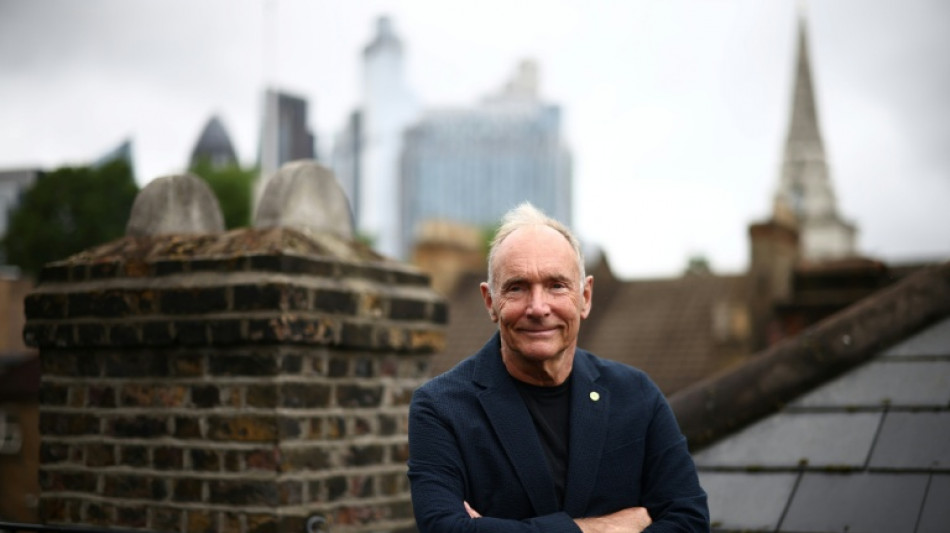
Tim Berners-Lee calls for AI to preserve 'original values' of web / Photo: Henry NICHOLLS - AFP

 Trump blasts 'sick conspiracy' against AI as warnings mount

 French defence group Thales calls on governments to regulate AI

 Oil gains on Mideast supply fears, AI warnings rattle tech firms

 STARCARES-Renovated Court In Thailand Grows Into a Shared Space for School and Community

 Synapse Analytics Secures US$13m Led by Partech to Drive AI-Powered Decisioning for Financial Institutions
 Surfer hospitalised after shark attack in Western Australia

 US hosts G20 'energy abundance' talks amid Iran war shock

 Migrant workers flock to Indian Kashmir despite militant threats

 Canada's Carney seeks closer Europe ties to counter hostile US

 Dozens arrested in major anti-LGBTQ raids in Turkey

 Poland, Ukraine slam Russian strikes near border as 'escalation'
 iPhone 18預購後出現可疑扣款 四間銀行調查未授權交易

 Galaxy Tab S12系列效果圖曝光 Ultra擬配雙鏡頭及瀏海螢幕

 Altman tells Fortune OpenAI will not go public in 2026

 ستاندرد آند بورز تثبت تصنيف السعودية عند A+

 Anthropic details Claude misuse as US targets major illicit online marketplace

 Venezuelans outside Caracas say capital not sharing blackout burden

 Anthropic boss calls for slowing pace of AI development

 BRICS nations urge 'maximum restraint' in Middle East war

 Europe eyes battle over 'pervert' AI glasses

 Children in flood-hit Nepal grapple with loss, cling to hope

 Venice Film Festival: A look back on the highlights

 DR Congo school fire stampede death toll rises to 26: UNICEF

 Dance Fitness Tempe Announces Expansion of Accessible Digital Movement Programs

 Europe saw record summer air traffic despite Mideast war: Eurocontrol

World Wide Web pioneer Tim Berners-Lee says he wants to see artificial intelligence preserve "the original values" of his invention while allowing users to filter personal data sent to tech giants.
The primacy "of the person, of the individual" was at the heart of the internet and should apply to AI too, he told AFP Wednesday in an interview on the sidelines of the SXSW tech festival in London.
The British physicist-turned-computer scientist conceived the web in 1989 while working at CERN, the European particle physics lab in Switzerland.
Berners-Lee hailed AI as an "exciting" development -- but one that would benefit from being regulated.
AI models "use the fact that the web has got so much data on it to be trained", he said.
"It's important that people use this technology to make sure that their customers, their citizens, have got control over their own data," he said.
Berners-Lee said that AI does not have anything like the World Wide Web Consortium, the international internet standards organisation he founded.
As a result, AI pioneers have not been able to "benefit from the collaboration that they would get if they did have something like that".
- Web free for all -
Berners-Lee originally proposed his world-changing invention as a way for scientists around the world to share information about their research.
He named this new network the World Wide Web (WWW), joining forces with Belgian Robert Cailliau in 1990 to develop it.
The web was based on two pillars: the HTML language that allows the creation of a website, and the HTTP hypertext system that lets the user request and then receive a web page.
Determined to make the web freely available to everyone, he did not patent his programme, ensuring it took off and spread rapidly.
With the use of personal data by AI models preoccupying authorities, particularly in Europe, Berners-Lee has made data protection his main cause in recent years, notably through the startup Inrupt.
"Without data, (AI models) can't exist. And they've had unfettered access to everybody's data now, and if we don't watch it, we're going to get to a really bad spot," warned the company's co-founder John Bruce.
Launched in 2018, Inrupt relies on secure data wallets that remain in the hands of users.
It is also working to create an AI assistant called Charlie that will be able to filter users' requests to tools such as ChatGPT or Claude.
"When you ask a question... it looks at what the question is... and decides which information to send" to the AI tool, Berners-Lee said.
If there is personal information in there, Charlie will "tweak it" so the AI tool "gets a picture... but then it can't really use that to identify you".
"Charlie is about preserving the original values of the web," he added.
M.Mendoza--CPN