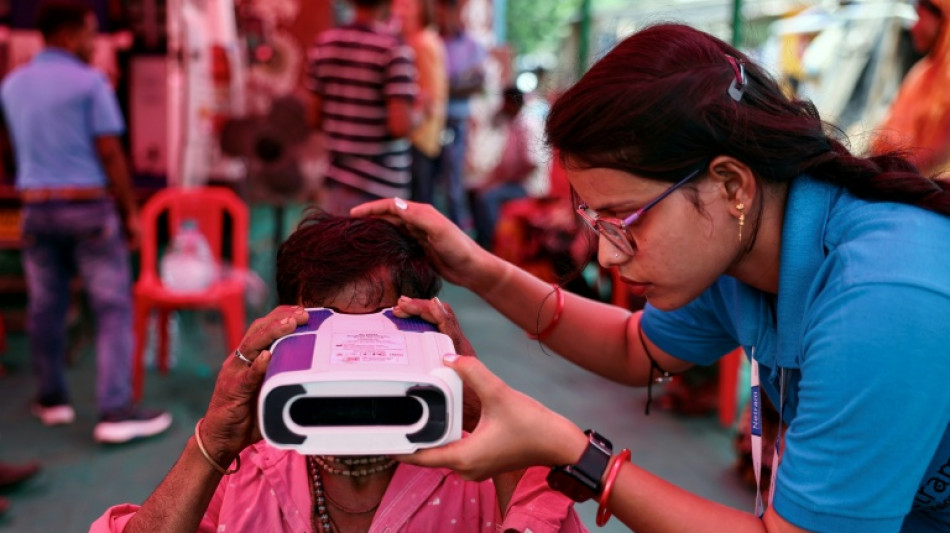
Low cost glasses help India's poor see a better future / Photo: Niharika KULKARNI - AFP

 New York seizes 12 celeb deep-fake porn sites

 France, Iraq deepen energy, defence ties during Zaidi visit
 PopDEX Surpasses $61M TVL and $2B Trading Volume in Closed Beta

 Trump blasts 'sick conspiracy' against AI as warnings mount
 French defence group Thales calls on governments to regulate AI

 Oil gains on Mideast supply fears, AI warnings rattle tech firms

 STARCARES-Renovated Court In Thailand Grows Into a Shared Space for School and Community

 Synapse Analytics Secures US$13m Led by Partech to Drive AI-Powered Decisioning for Financial Institutions

 Surfer hospitalised after shark attack in Western Australia
 US hosts G20 'energy abundance' talks amid Iran war shock
 Migrant workers flock to Indian Kashmir despite militant threats
 Canada's Carney seeks closer Europe ties to counter hostile US

 Dozens arrested in major anti-LGBTQ raids in Turkey
 Poland, Ukraine slam Russian strikes near border as 'escalation'
 iPhone 18預購後出現可疑扣款 四間銀行調查未授權交易

 Galaxy Tab S12系列效果圖曝光 Ultra擬配雙鏡頭及瀏海螢幕

 Altman tells Fortune OpenAI will not go public in 2026

 ستاندرد آند بورز تثبت تصنيف السعودية عند A+

 Anthropic details Claude misuse as US targets major illicit online marketplace

 Venezuelans outside Caracas say capital not sharing blackout burden

 Anthropic boss calls for slowing pace of AI development

 BRICS nations urge 'maximum restraint' in Middle East war

 Europe eyes battle over 'pervert' AI glasses

 Children in flood-hit Nepal grapple with loss, cling to hope

 Venice Film Festival: A look back on the highlights

As soon as he put on his glasses, Indian vegetable seller Tofan Jena knew daily life would never be the same.
For the first time, the 49-year-old could see the world around him in sharp detail.
"I can make out all the letters of the alphabet, even the smallest ones," he marvelled, pointing to his phone screen.
Jena is among one billion people recorded by the World Health Organization who suffer from vision problems but lack the means to correct them.
The International Agency for the Prevention of Blindness estimates that $30 billion is lost in productivity from preventable or curable eye diseases in India alone.
Just an hour earlier, Jena who is a resident of Bhubaneswar, capital of the eastern state of Odisha, had his eyes examined for the first time in his life by GoodVision, whose mission is to bring eye care to underprivileged communities.
The charity hopes to close the gap in eyecare and works in 12 countries, including India, where around 550 million need glasses, and an estimated 250 million people lack access to them.
For less than two dollars, Jena left with a pair of corrective glasses -- and a clear vision of his future.
"I can read, I can write, and I can see very well at a distance," he repeats, as if trying to convince himself.
"I'll be able to do everything with these glasses."
- Access to care -
The small miracle was repeated for dozens of residents in the poor district of Salia Sahi.
Technicians from the charity set up a mobile camp under a tarpaulin, offering shade from the blazing sun, while providing eye examinations, vision tests, and the selection and fitting of glasses.
At the end, a line of people stood blinking at the world, amazed at the clarity and detail many had forgotten or, for some, had never known.
With glasses perched on his nose, 43-year-old shopkeeper Minati Rout completes his journey by passing a final test: separating small pebbles from grains of rice.
"I was not able to read small letters, I was not able to thread in a needle... now I can, to do all those things," she said.
"I will tell my neighbours to get their eyes checked here too."
Piush Khetan, the charity's India director, said they offer basic services which include a free eye screening and glasses for people in need as well as performing cataract surgery.
The lenses for the glasses come from China, while the frames are made in India from metal wire and assembled in about 10 minutes.
In the small town of Maniabandha, a two-hour drive from Bhubaneswar, patients wait on plastic chairs.
"These community camps are extremely important for villagers, because they have no access to eye care," said optometrist Gopinath Das.
"Sometimes they don't have money, sometimes they don't even know they have eye problems."
More than 400 underprivileged neighbourhoods and villages are visited each month, sites often overlooked by public health services.
"We are able to provide help to people, and we feel good about it," said technician Debasmita Behera, 23.
"And I'm also earning."
- 'Stigma' -
In Maniabandha, eight patients were taken to Bhubaneswar's Vision Care Hospital for cataract surgery.
Hospital director Srimant Kumar Mishra said the most difficult part is to motivate patients to be operated on.
"There is a lot of social stigma, they are afraid... They have a feeling that even if you get old, it is natural that they are not able to see."
GoodVision's France representative, Maryline Ehlermann, said "eye care is a very profitable investment", citing a study estimating that if the billion people with curable vision problems were treated, it would "generate $447 billion annually for the global economy".
In the world's most populous country -- also one of its most unequal -- the challenge is enormous.
"In India, we only take things seriously if it's a matter of life or death," said Khetan.
"So we focus on providing information, we try to convince people of the importance of taking care of their eyes."
M.Mendoza--CPN