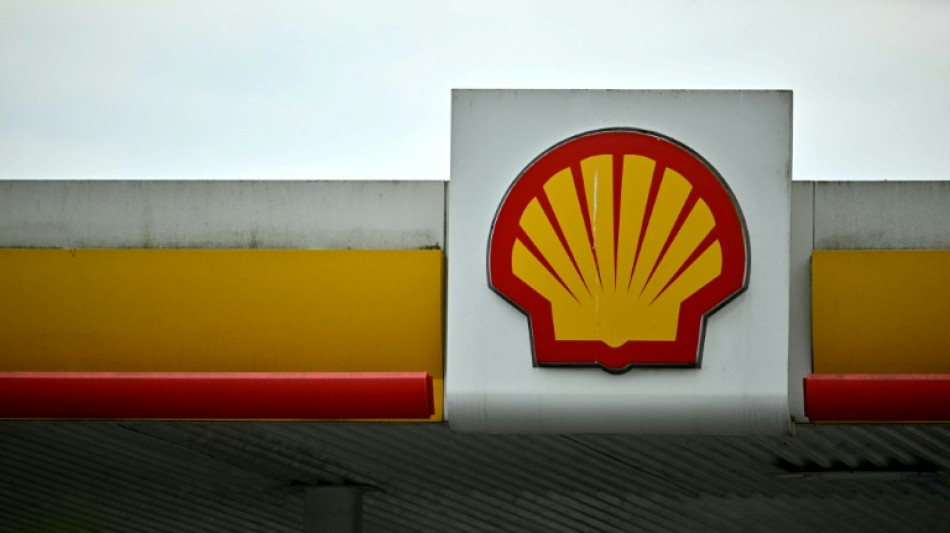
Soaring energy profits reignite calls for windfall tax / Photo: Ben STANSALL - AFP

 Bank of Japan set to raise rates under pressure from inflation, US

 EU chief to unveil social media, gaming curbs for under-15s

 'Resident Evil' film brings video game's ethos to the big screen

 i-payout Expands U.S. Money Transmitter Licensing Footprint and Advances European EMI Strategy

 US Senate crypto bill collapses amid partisan deadlock

 OpenAI, Anthropic and Google are working to create an AI standards body

 Protesting shepherds, farmers clash with Romanian police

 Foundation Lets Ledger Users Switch to Open Source Without Starting Over

 EU to propose curbing social media, online games for under 15s

 FX Junction Reaches 40,600 Members and 26 Million Trades

 'We unleashed the beast': the world's fears and hopes about AI

 Hospitality leaders ask Burnham to halve VAT amid rising costs

 Worcestershire invited to nominate groups for 2027 King’s volunteer award

 Berlin's run-down public spaces at heart of election campaign
 'Widow's Bay' and 'The Pitt' win big at Emmy Awards

 Most markets drop as oil extends gains ahead of expected US rate hike

 Sri Lanka's famed beach shack battles demolition

 Vserv targets ₹1,000 crore revenue by 2030 through AI expansion

 India prohibits bank fees on UPI payments up to ₹2,000

 Brazil's Amazon defender Raoni has cancer

 Trump rejects AI slowdown concerns as UN urges coordinated controls

 Higher wages draw migrant workers to Kashmir despite attacks

 Oil supply concerns and AI warnings weigh on global markets

 'I am the hoax buster': Trump rejects AI danger warnings
 Doha Islamic finance forum names AlRayan firms as co-lead partners

European oil and gas companies who posted huge profits in the first quarter on soaring prices caused by the war in the Middle East face new calls from London to Paris to tax their outsized gains.
Shell rounded out the major energy producers' earnings season on Thursday by announcing net profit of nearly $5.7 billion (around 4.8 billion euro), up 19 percent on the first quarter of 2025.
The group explained it had benefited from higher prices and "increased refining margins," as well as "a higher contribution from trading activities".
It was a similar story for British rival BP, which reported a sharp rise in profits at the end of last month, posting $3.84 billion while TotalEnergies saw their profits soar 51 percent to $5.8 billion.
In contrast, US energy companies ExxonMobil and Chevron saw their profits decline, results affected by an unfavourable time lag between the sale and delivery of products within the derivatives markets.
The US-Israeli war on Iran prompted Tehran to blockade the key energy chokepoint of the Strait of Hormuz, causing a sharp drop in oil supplies on the market and a surge in prices.
A barrel of Brent crude, the global benchmark, averaged around $100 in March, with peaks of $120, compared with $70 before hostilities began in late February.
That notably helped European trio BP, Shell and TotalEnergies, which have strong trading operations -– unlike their US counterparts and rivals ExxonMobil and Chevron, which are more reliant on production activities.
The big difference this quarter is that "BP, Shell and Total benefited from both the higher prices and the turbulence itself," Stephen Innes, analyst with SPI Asset Management, told AFP.
He added that "the European majors looked less like traditional oil companies this quarter and more like sophisticated volatility traders operating inside the global energy system."
- New projects -
From London to Paris the strong results have sparked calls to tax oil company windfall profits, as occurred following the war in Ukraine which started in 2022.
"Once again, the fossil fuel giants are raking in massive profits," lamented Danny Gross of NGO Friends of the Earth in a statement which called for increased taxes on profits.
In the UK, oil companies operating in the North Sea remain subject to the Energy Profits Levy, a temporary levy on profits arising from the upstream production of oil and gas introduced in 2022, which has been extended and increased several times.
It is currently set at 38 percent of profits until 2030 and is in addition to the 40 percent of taxes already in force in the sector. However, it only applies to profits derived from UK oil and gas production.
The surging profits at Shell and BP has brought more calls to increase these levies, with Energy Minister Ed Miliband notably condemning what he termed "excessive profits".
French President Emmanuel Macron is meanwhile calling for a European response in the face of excessive energy firm windfall profits or "speculative behaviour".
Analysts consulted by AFP indicate companies are expected to post strong profits again in the second quarter.
"Even if tensions ease, markets do not suddenly snap back to normal overnight," observed Innes.
"I am not sure this conflict will get resolved that easily," said Adi Imsirovic, senior lecturer in energy systems at Oxford University. That would keep prices higher for longer.
That scenario is likely to stimulate new oil and gas projects, as envisaged by TotalEnergies, involving small-scale fields capable of rapid production.
Innes believes companies will prefer to put their faith in low-cost projects rather than rushing "blindly" into massive expansion.
"The winners will likely be the projects that are low-cost, flexible, and geopolitically secure, rather than massive expansion for expansion’s sake," he added.
In recent years, BP and Shell have scaled back several climate targets in favour of continuing oil and gas production.
More recently, TotalEnergies announced it could no longer commit to its 2050 carbon neutrality target, stressing the world was not yet ready to move on from oil.
The conflict has, nonetheless, brought the role of renewable energy in energy security back into the spotlight.
"This has not gone unnoticed in all capitals across the globe," said Imsirovic.
M.Mendoza--CPN